Article: Does a Quote Have to Comfort You?
Does a Quote Have to Comfort You?
I keep a running list of quotes I can’t shake. Not because they made me feel understood — because they made me feel caught. There’s a difference, and I think we’ve stopped noticing it.
There is a whole genre of language right now designed to make you feel held. Warm, aspirational, nourishing — words that arrive like a hand on your shoulder. I am not against those words. I want to draw a line, because I think we’ve started to confuse two different things: language that comforts and language that changes you. A lot of us have, quietly, stopped wanting the second kind.
So: does a quote have to comfort you?
No.
Quoteiac is not a comfort catalog. It is a running list I keep adding to when a sentence won’t leave me alone. Then we check it. Then, if it is real, we print it — on a shirt, a phone case, a journal, a tumbler — so the line has somewhere to live besides a screenshot.
The ones I picked because they caught me
Some of what we carry is famous. Some of it isn’t. The filter is not fame. It is whether the line resonates, and whether I can put my name next to the source.
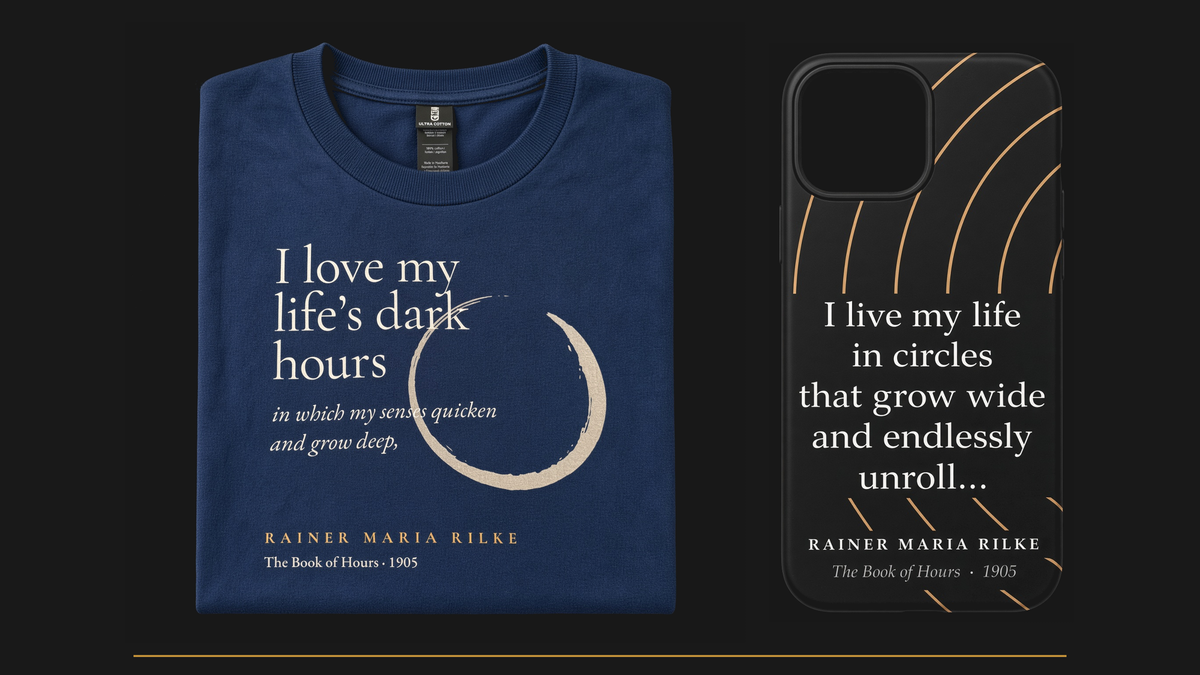
Rilke’s dark hours is one of those. “I love my life’s dark hours / in which my senses quicken and grow deep.” Book I of Das Stunden-Buch, written in a rented room outside Berlin in the autumn of 1899, in Jessie Lemont’s 1918 English. I love the dark — the moon, the planets, night launches. I’m a nighttime devotee. Other people read the line as the hard hours, and that’s fair. Either way it belongs. It lives on the sweatshirt, the tee, the phone case, and the journal that stops mid-thought and leaves you the rest of the page.
Four poems earlier in the same book: “I live my life in circles that grow wide and endlessly unroll.” A life that widens instead of narrowing — I needed that picture. Not a straight line to somewhere. A spiral going out. True confession: I own the shirt, the phone case, and the tumbler. That is how I know a line has stuck. I didn’t put it on the site and walk away. I live with it.
Wilde is sharper. “The truth is rarely pure and never simple.” Algernon says it in Act I of The Importance of Being Earnest — Wilde’s most charming liar, which is probably why it’s the truest sentence in the play. I said “truth” when I first read it and put it on the list the same afternoon. Comfort would have sanded “never simple” off. We didn’t. The line is on the tee, the zip hoodie, and the phone case — the one in your hand forty times a day, which is about how often a simple story tries to pass for a true one.
Montaigne I had never heard of. Then I read “When any one contradicts me, he raises my attention, not my anger” and it sounded like last week, not 1588. I looked him up. I stayed long enough to learn how to say his name, because I do that. Ask the question instead of letting the anger drive. That is the whole method, and it is on the Attention, Not Anger tee. The longer argument is in the Journal: the lost art of being contradicted.
William James caught me the same way. “…so the art of being wise is the art of knowing what to overlook.” Wisdom as knowing what to leave out — that one got me. Raise your hand if you can think of more than one time that would have been the better option. It went on the must-have list. I bought the shirt. The version I reach for is the kintsugi tee: a gold seam across the chest, the fracture treated as the honest part of the object. James spent twelve years on The Principles of Psychology and landed on selection, not accumulation. The repair mark is the same argument in metal.
Nullius in verba. Horace, then the Royal Society’s motto: take nobody’s word for it. People keep translating it “nothing in words,” which misses the point. It means on no one’s authority. That is the operating principle of this business, printed on the tee, the phone case, and the journal in The Heretics. If a quote only works when you take someone’s word for it, it does not belong here.
And Seneca’s stars. Non est ad astra mollis e terris via. There is no easy way from the earth to the stars. He gave the line to Megara in Hercules Furens. He could not have known what “the stars” would come to mean. He didn’t need to. This is my line. I watch rockets leave the atmosphere in real time, and a Roman tragedian called the cost two thousand years ago. I wanted the whole sentence on the Ad Astra tee — not the bumper-sticker half everyone else prints.
The list is not closed. Those are the ones that would not get off the table.
Caught is not the same as held
Seneca opens his letters with a command, not a consolation. “Continue to act thus, my dear Lucilius — set yourself free for your own sake; gather and save your time, which till lately has been forced from you, or filched away, or has merely slipped from your hands. The most disgraceful kind of loss, however, is that due to carelessness.” (Moral Letters to Lucilius, Epistle 1, trans. Gummere, 1917)
He is not comforting Lucilius. He is indicting him. The time you think you have been robbed of? Most of it, you gave away. The Latin under that first letter is vindica te tibi — claim yourself for yourself — which is what the Claim Yourself tee carries. Not an inspiring sentiment. A demand Seneca made in his first breath and never softened. I needed to hear it. Most people do.
Marcus Aurelius, writing to no one — the Meditations were a private journal — made the same structural point in a different register: “Such as are thy habitual thoughts, such also will be the character of thy mind; for the soul is dyed by the thoughts.” (Meditations, V.16, trans. Long, 1862)
The popular paraphrase floats around on pretty backgrounds: the soul becomes dyed with the colour of its thoughts. Rounded off. Long is blunter. Present tense. What you are filling your mind with right now is doing something to you. There is no comfort in that. Only consequence.
Epictetus takes it further: “What disturbs men’s minds is not events but their judgements on events.” (Enchiridion, Ch. 5, trans. Matheson, 1916) No sympathy. No footnote that the events might be genuinely hard. Read honestly, the Stoic tradition does not hand you comfort. It hands you a diagnosis. The cure is work — looking at your own mind without flinching — which is not soothing and was never meant to be. That argument, without the gym-poster overlay, is in Stoicism Is Not “Growth Mindset” in a Toga and What Stoicism Sounds Like When It’s Quiet. The objects sit in Stoic Wisdom.
Emily Dickinson, writing in a bedroom in Amherst with no audience, was doing something similar. The form is gentler until you let it land:
Tell all the truth but tell it slant —
Success in Circuit lies
Too bright for our infirm Delight
The Truth’s superb surprise
As Lightning to the Children eased
With explanation kind
The Truth must dazzle gradually
Or every man be blind —(Fr1263, Franklin Variorum Edition, c. 1868)
Read quickly, it looks like permission to soften things. Read again: she is explaining the mechanics of disruption. Direct truth blinds. The poem does what it describes — it looks gentle, and then it doesn’t. That is writing that changes something in you rather than affirming what you already suspected.
A shirt is a declaration. A phone case is a habit.
Wearing a line and living with a line are not the same job. A shirt walks into a room with you. A phone case is in your hand forty times a day. A journal sits next to the blank page and frames whatever you write next. A tumbler comes back every morning. We wrote about that difference in The Object That Holds the Thought. The short version: if a sentence is going to work on you, it needs more than one encounter.
That is why the same verified line shows up on more than one object. Not because we needed SKUs. Because the Circles tumbler does a different thing than the Circles tee. The Dark Hours journal — the one that stops at the ellipsis — is asking you to finish a thought Rilke started in 1899. The Wilde case is the line you pick up every time you are about to simplify something. The James kintsugi mark is the reminder that the crack is the part you keep.
Comfort is easy to fake. Provenance isn’t.
The tradition our business is built on was not trying to nourish anyone. Seneca was writing to a friend who needed to be told hard things. Dickinson was writing in the dark. Marcus was writing to himself in the middle of a life that demanded more than he wanted to give. Rilke was writing prayers in a borrowed voice. Wilde was writing a comedy in which the honest sentence comes out of a liar’s mouth. Montaigne was writing from a tower because conversation in the room had gotten worse. James was writing a psychology and accidentally described how to live. None of them were trying to create belonging. They were trying to be true. That is a different thing, and sometimes a less comfortable one.
That is why those words still land. Not because they soothe. Because they reorient. Once you’ve been reoriented, you can’t go back to the softer version you had before.
We’ve built Quoteiac on a rule I have never wanted to compromise: if we can’t verify it, we don’t print it. That is not a marketing line. It is the standard on Our Standards, and it follows from taking this seriously — from believing that the words on the things you carry should be what they claim to be, sourced to who they claim to be from, meaning what they claim to mean. Comfort is easy to fake. A quote that asks nothing of you is easy to manufacture. Truth is harder, and it shows — in the writing, in the sourcing, and in the fact that it doesn’t always leave you feeling better than you did before you read it.
The quotes that change you don’t ask you to feel better. They ask you to inhale deeply. They ask you to look again.
Related: Montaigne and the lost art of being contradicted. Why kintsugi and the ensō are the point of the design. What nullius in verba actually means. The object that holds the thought. Stoicism is not growth mindset in a toga.
The lines live on their quote pages first — Dark Hours, Circles, Wilde’s truth, Montaigne, James, Ad Astra, Claim Yourself — then on objects in Rilke, Montaigne, William James, Stoic Wisdom, and The Heretics.
About the Author
Vickie MacFadden is the founder of Quoteiac. She keeps a physical list — not a mood board, not a folder — of lines she cannot shake. The ones on this site are the ones that made it off the list and through verification. The ones that didn’t are a longer story for another time.