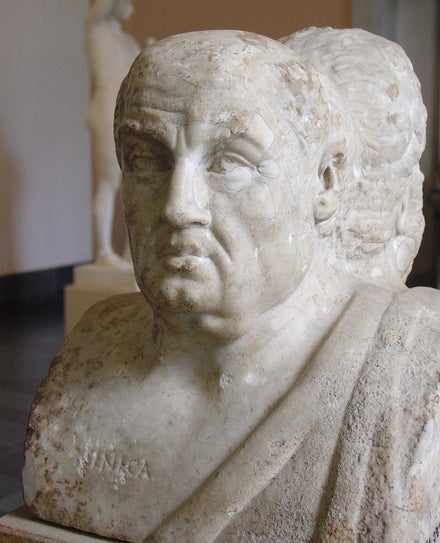
Seneca the Younger. Double herm bust, c. 1st–2nd century AD.Antikensammlung Berlin. Public domain.
Seneca
Seneca spent decades at the center of Roman power — one of the wealthiest men in Rome while writing about the irrelevance of wealth, and chief advisor to a murderous emperor while writing about moral integrity. His letters to Lucilius are among the most readable philosophy the ancient world produced.
Words We Carry
Every quote here is traced to a documented source. How we verify →
“Everywhere means nowhere.”
Seneca, Letters to Lucilius, Letter II — tr. Gummere, 1917 Loeb Nusquam est qui ubique est.
“While we are postponing, life speeds by.”
Seneca, Letters to Lucilius, Letter I — tr. Gummere, 1917 Loeb Dum differtur vita transcurrit.
“We suffer more often in imagination than in reality.”
Seneca, Letters to Lucilius, Letter XIII — tr. Gummere, 1917 Loeb Saepius opinione quam re laboramus.
“Withdraw into yourself as much as you can.”
Seneca, Letters to Lucilius, Letter VII.8 Recede in te ipse quantum potes.
“Everything is alien to us; time alone is ours.”
Seneca, Letters to Lucilius, Letter I Omnia… aliena sunt, tempus tantum nostrum est.
“Vindica te tibi. — Claim yourself for yourself.”
Seneca, Letters to Lucilius, Letter I Vindica te tibi.
“Non est ad astra mollis e terris via.”
Seneca, Hercules Furens, line 437
About Seneca
Lucius Annaeus Seneca spent decades at the center of Roman power — tutor to the young Nero, then his chief advisor during the quinquennium Neronis, a five-year stretch of good government that Seneca substantially shaped. He was one of the wealthiest men in Rome while writing about the irrelevance of wealth, and served a murderous emperor while writing about moral integrity. Critics from his own contemporaries to Montaigne have used the contradiction against him. His answer is embedded in the work: knowing the right way and walking it perfectly are different things, and the person who refuses to teach until they’ve mastered the lesson helps no one.
As Nero deteriorated, Seneca withdrew from court and returned to writing. The letters he produced in his final years — addressed to his friend Lucilius, on time, grief, fear, friendship, and the gap between knowing what is right and doing it — are among the most readable philosophy the ancient world produced. His most quoted line, that we suffer more in imagination than in reality, wasn’t a maxim but practical advice aimed at a specific fear Lucilius was carrying.
He was forced from the world in 65 AD, accused in a conspiracy he almost certainly had no part in, and met the end on his own terms — dictating to his secretaries until he could not. Tacitus recorded it. It is the most Stoic death in ancient biography. For the imperfect philosophers who keep doing the other thing, he is a two-thousand-year-old companion who understood the problem intimately.
The Work
From the Journal
Seneca Wrote 124 Letters on How to Live. This Line Is Why They Still Matter.
The letter, the line, and why it has outlasted almost everything else from antiquity.
ReadThe Misunderstood Geography of Control: Epictetus and Seneca on What You Actually Own
Two Stoics, one problem — and what it actually means to claim yourself.
ReadTim Ferriss Found Seneca at Rock Bottom. Then 14 Million People Did Too.
How a 2,000-year-old letter writer became the backbone of modern resilience culture.
ReadIn Their Orbit