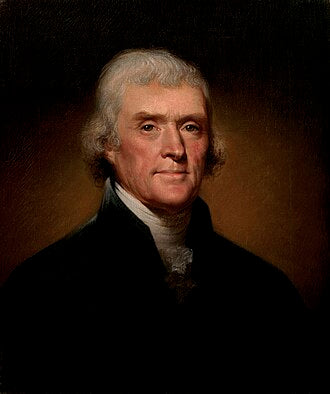
Thomas Jefferson. Portrait by Rembrandt Peale, 1800.White House Historical Association.
Thomas Jefferson
Thomas Jefferson wrote the sentence that launched a nation — and spent his life failing to live up to it. That failure is as much a part of his legacy as the sentence itself.
Words We Carry
Every quote here is traced to a documented source. How we verify →
“I like the dreams of the future better than the history of the past.”
Letter to John Adams, August 1, 1816
“I have sworn upon the altar of God eternal hostility against every form of tyranny over the mind of man.”
Letter to Benjamin Rush, September 23, 1800
About Thomas Jefferson
Jefferson was born on April 13, 1743, at Shadwell, a plantation in Albemarle County, Virginia. His father Peter — surveyor, mapmaker, justice of the peace — died when Thomas was fourteen, leaving him land, a library, and an education to finish. He enrolled at the College of William & Mary in 1760, fell under the influence of Professor William Small, and from there apprenticed in law under George Wythe, one of the most rigorous legal minds in colonial America. By his mid-twenties he could read Greek, French, Latin, and Italian, and was building Monticello on a mountain he owned. He was also the legal master of the enslaved people who built it. Jefferson inherited enslaved individuals from two separate estates — his father's and later his father-in-law's — and held over 600 people in bondage across his plantations. He wrote privately of slavery as a moral catastrophe. He freed two people during his life. He wrote that all men are created equal while owning human beings. That is not a paradox that resolves — it is the central fact of who he was.
In the summer of 1776, the Continental Congress gave Jefferson five weeks to draft a declaration. He wrote one that included a 168-word passage condemning the slave trade as “cruel war against human nature itself.” Congress cut it. What survived became the founding text of the American republic. He followed it in 1781 with Notes on the State of Virginia — his only book-length work, written in response to questions from a French diplomat — which touched natural history, law, agriculture, geography, and race. It contained some of his most troubling claims about Black inferiority alongside his most eloquent arguments against religious coercion and government tyranny. He served as third President of the United States from 1801 to 1809, doubled the country’s size through the Louisiana Purchase, and sent Lewis and Clark west. In 1815, when British forces had burned the congressional library, he sold Congress his personal collection of 6,487 volumes for $23,950 — the seed of the modern Library of Congress. He closed his public life designing the University of Virginia from scratch: the buildings, the curriculum, the idea that a university should have no divinity school.
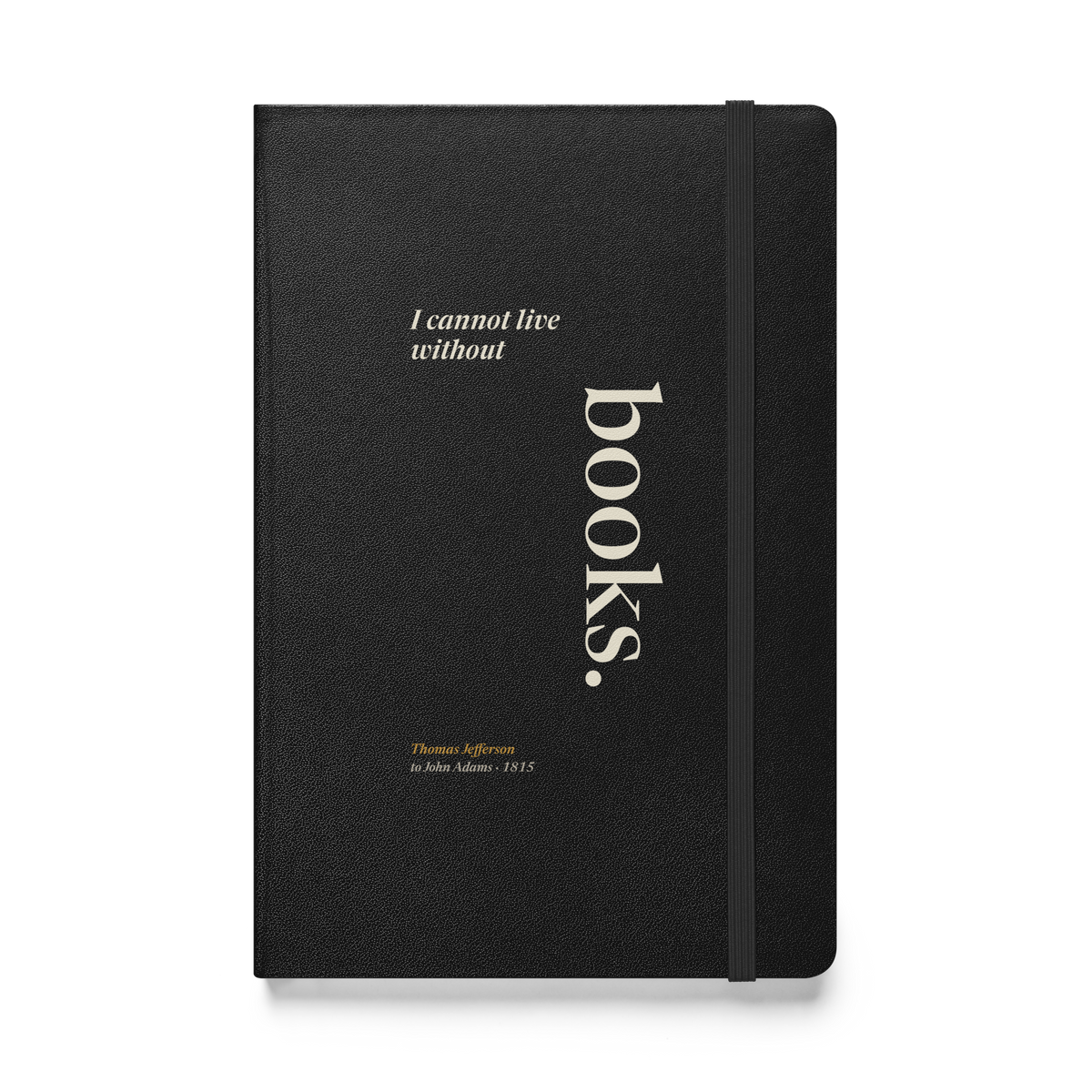
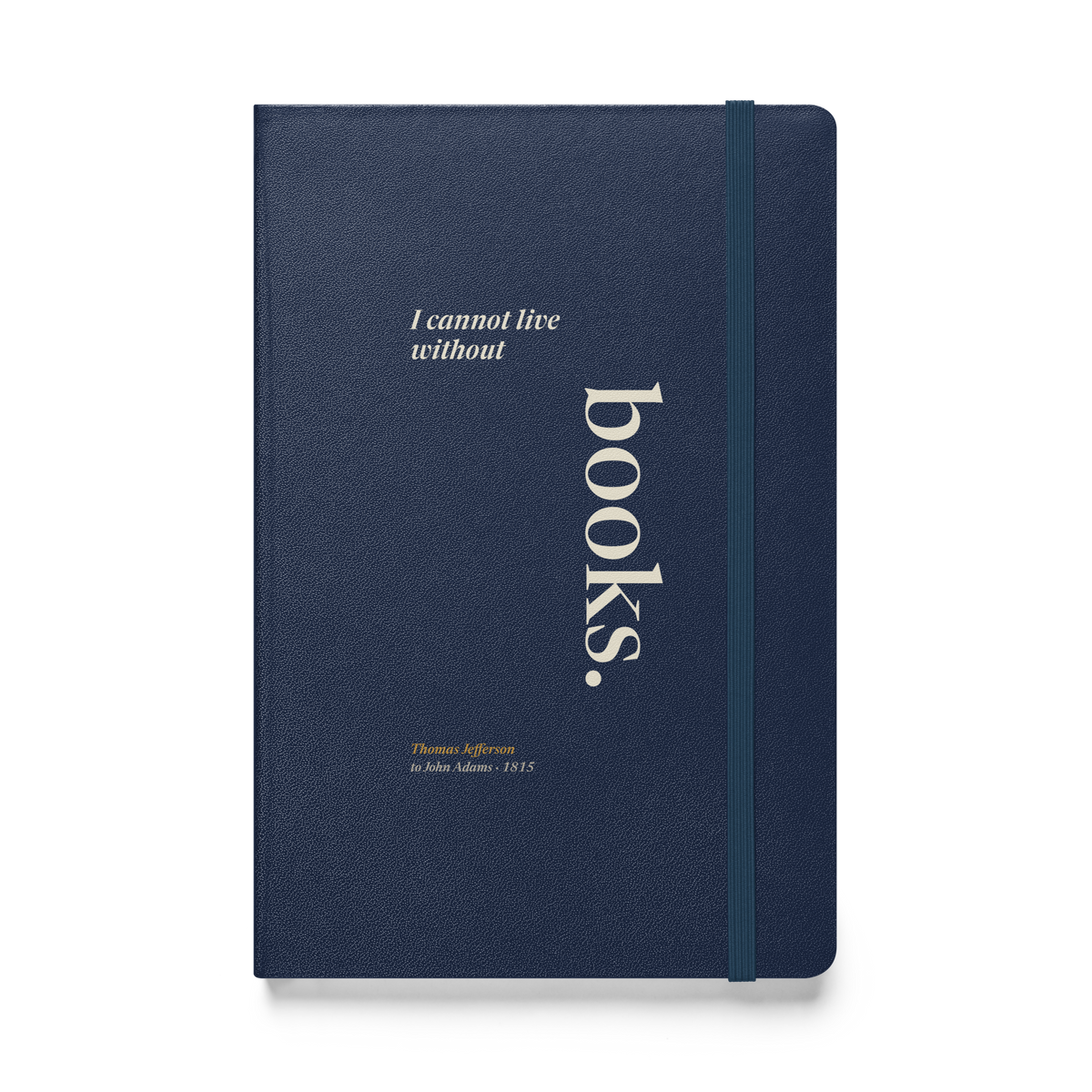
Jefferson chose his own epitaph. He listed three things: author of the Declaration of Independence, author of the Virginia Statute for Religious Freedom, and father of the University of Virginia. Not president. The quotes you carry are from a man who had every privilege and understood exactly what he was doing with it — who wrote the most consequential argument for human equality in the English language, and refused to apply it. The tyranny-over-the-mind quote comes from a letter he wrote in 1800, furious at clergy who believed they could dictate how Americans thought. The books quote is from 1815 — written at seventy-one, surrounded by the library he’d spent a lifetime assembling and was about to give away. The dreams-of-the-future quote is from 1816, an old man writing to his oldest rival, choosing hope over history. He died on July 4, 1826, the fiftieth anniversary of the Declaration — the same day as John Adams. What survives them both is the argument.
The Work
From the Journal
Thomas Jefferson on Books, Reading, and Ignorance
Jefferson spent a lifetime accumulating books and an equal lifetime arguing that a nation without readers couldn’t govern itself.
ReadThe Declaration of Independence Is Great Literature — Here’s How It Works
How Jefferson built the most consequential sentence in American history.
ReadWhat the Founders Actually Said (And Why It Matters in 2026)
Adams, Madison, Jefferson, Roosevelt — what the record shows when you check the sources.
ReadIn Their Orbit