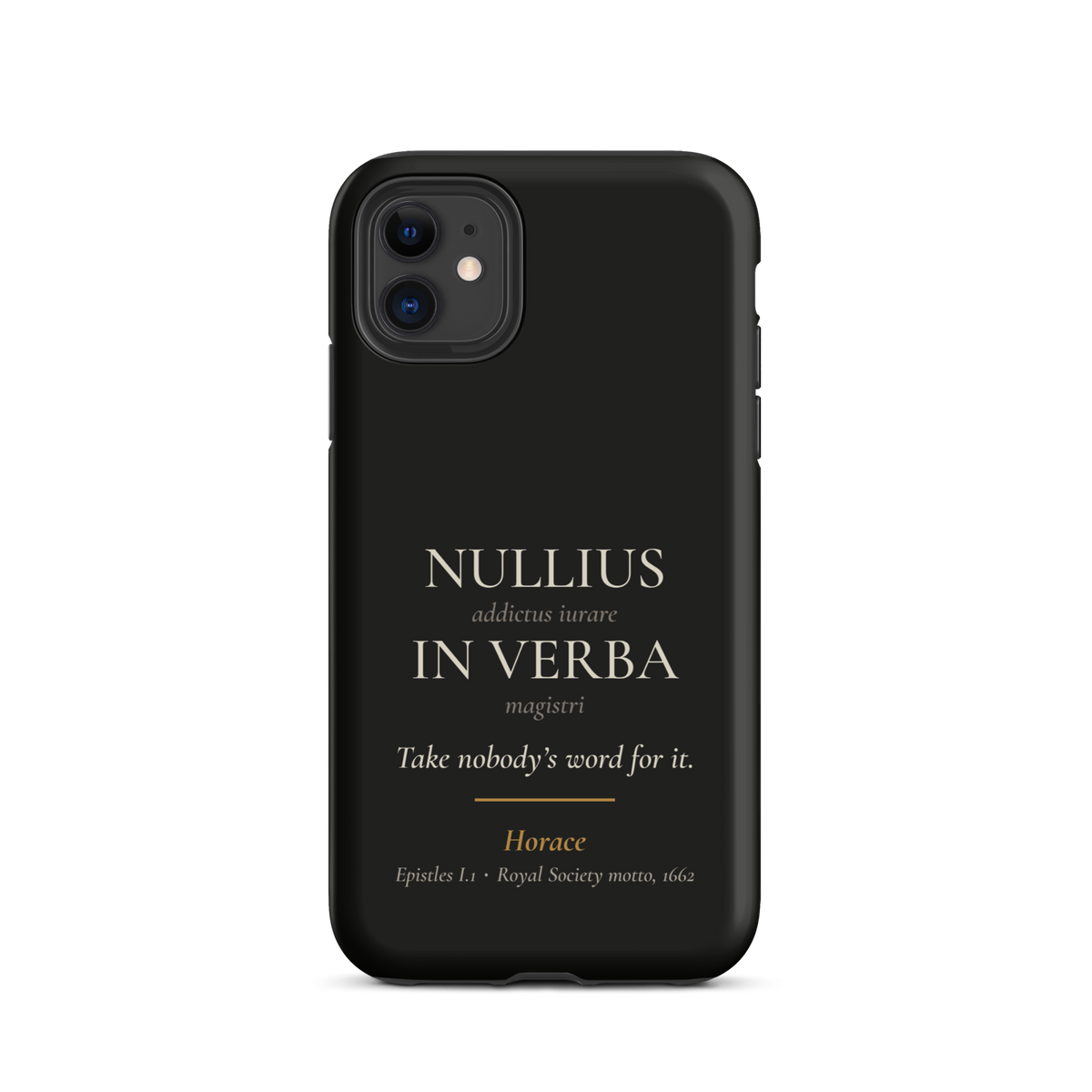
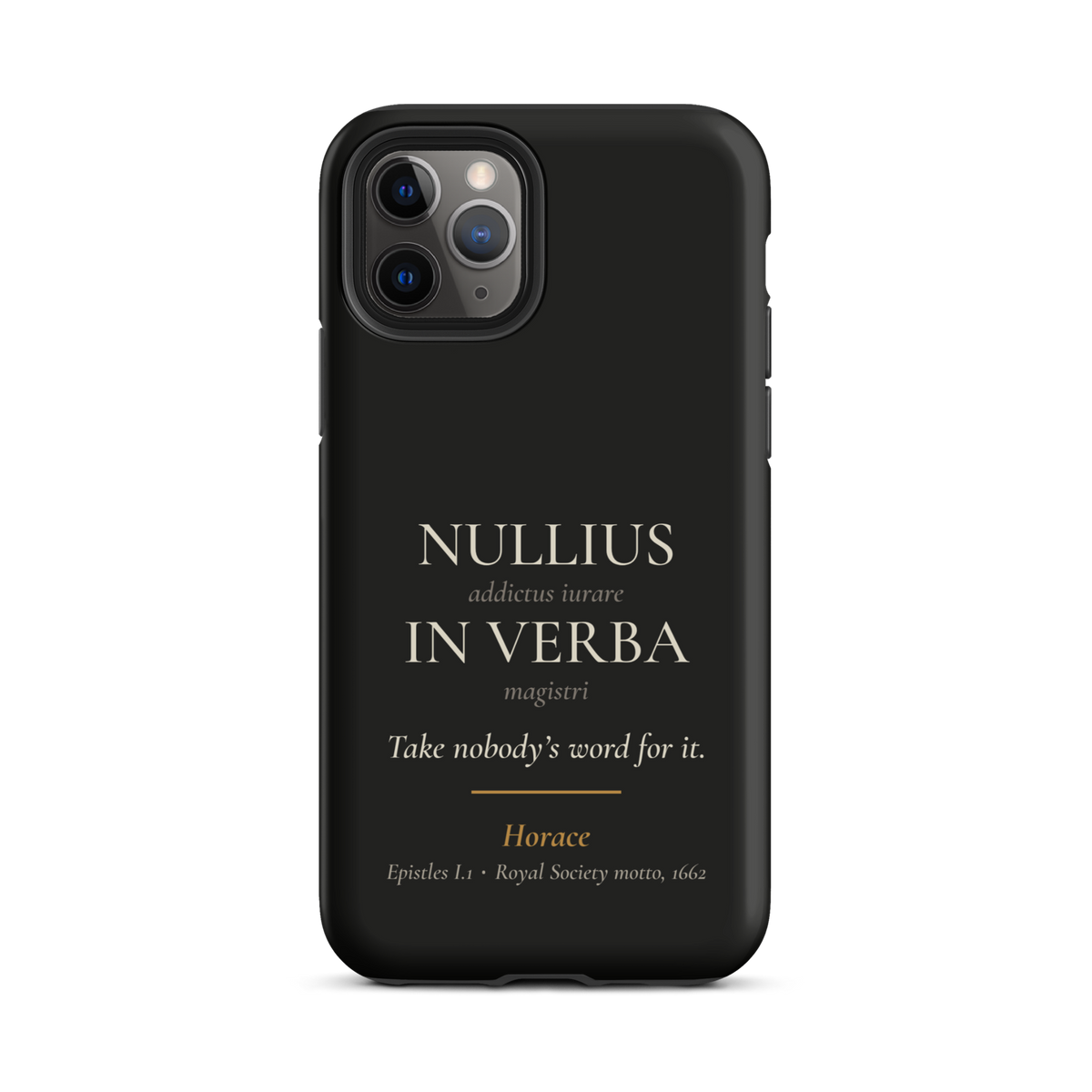
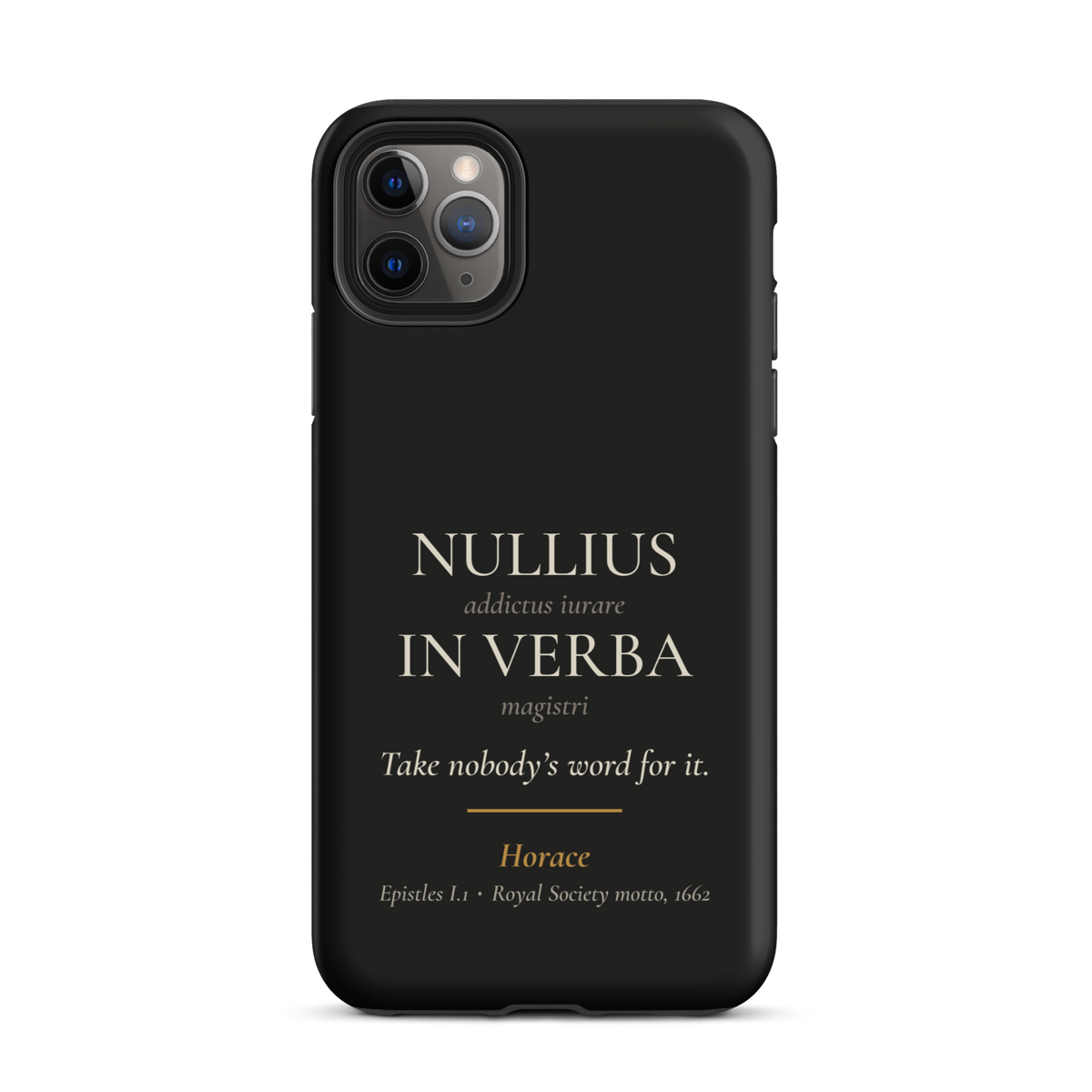
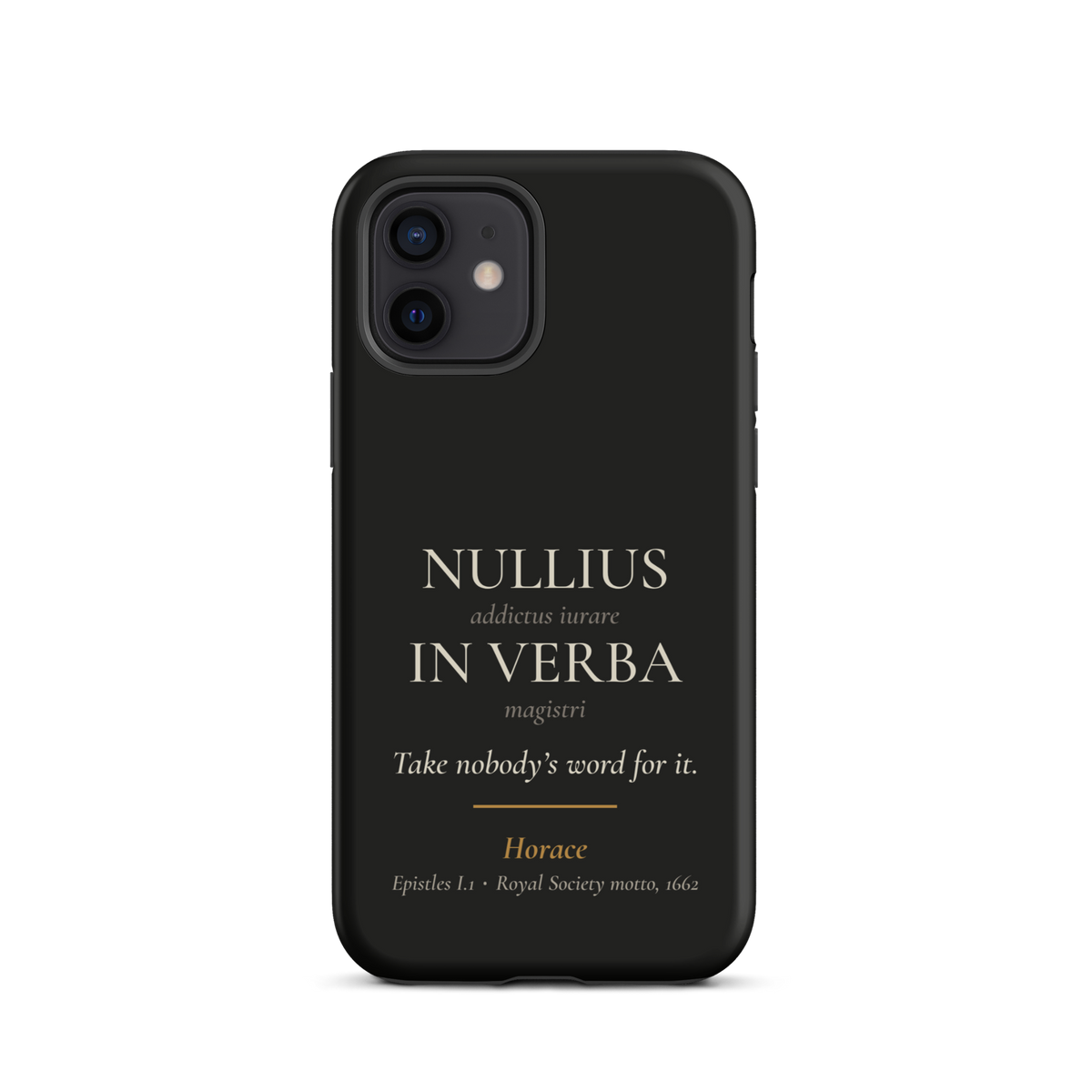
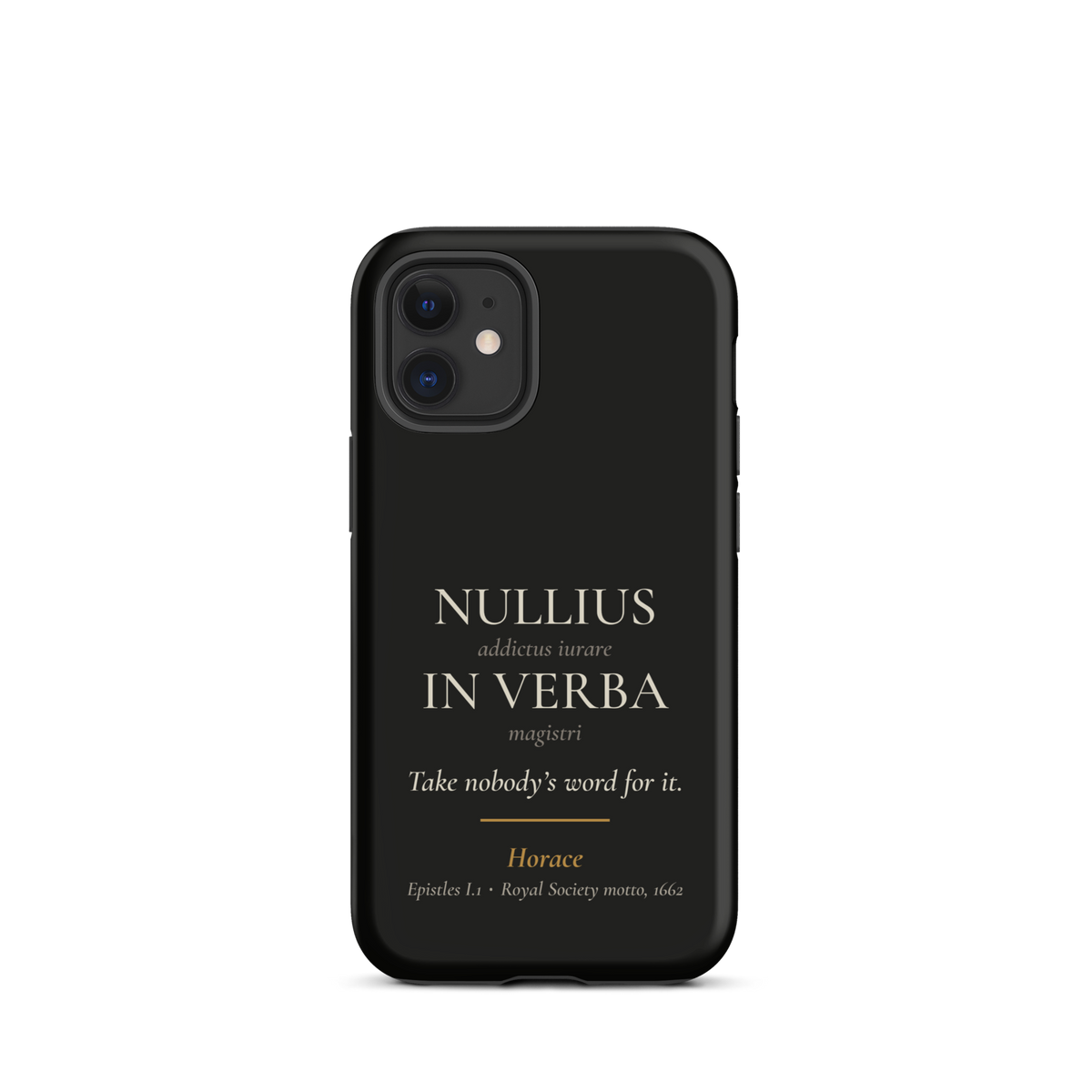
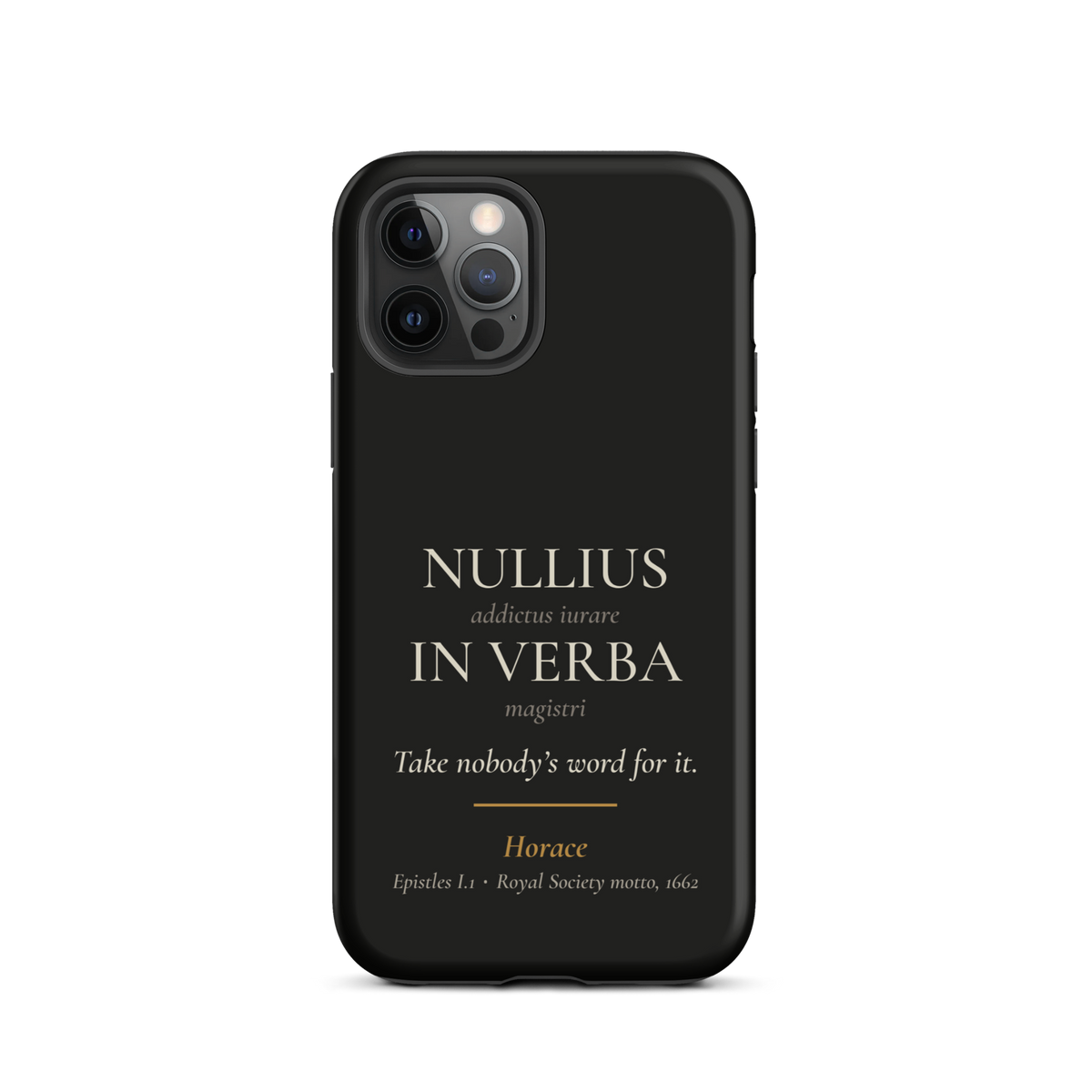
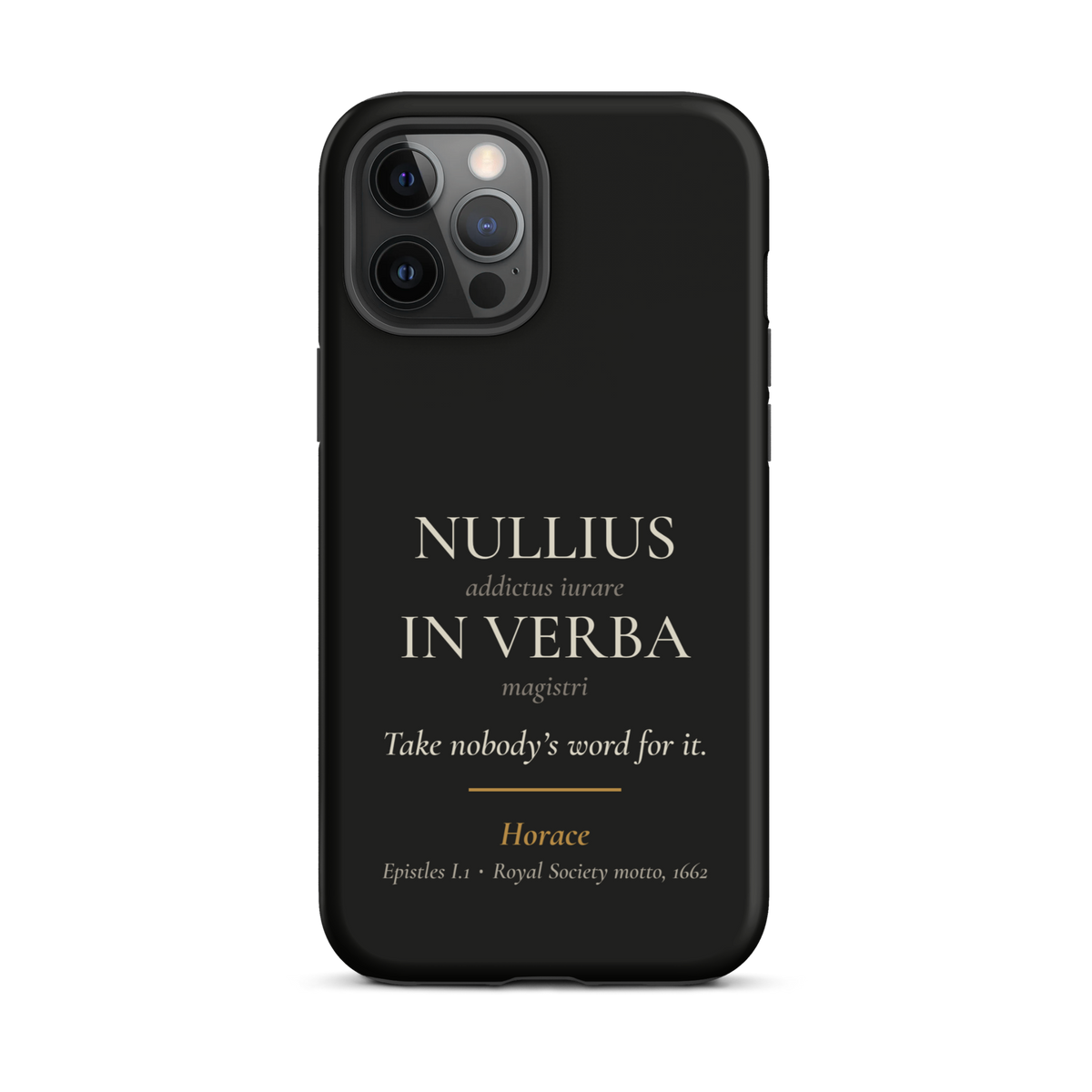
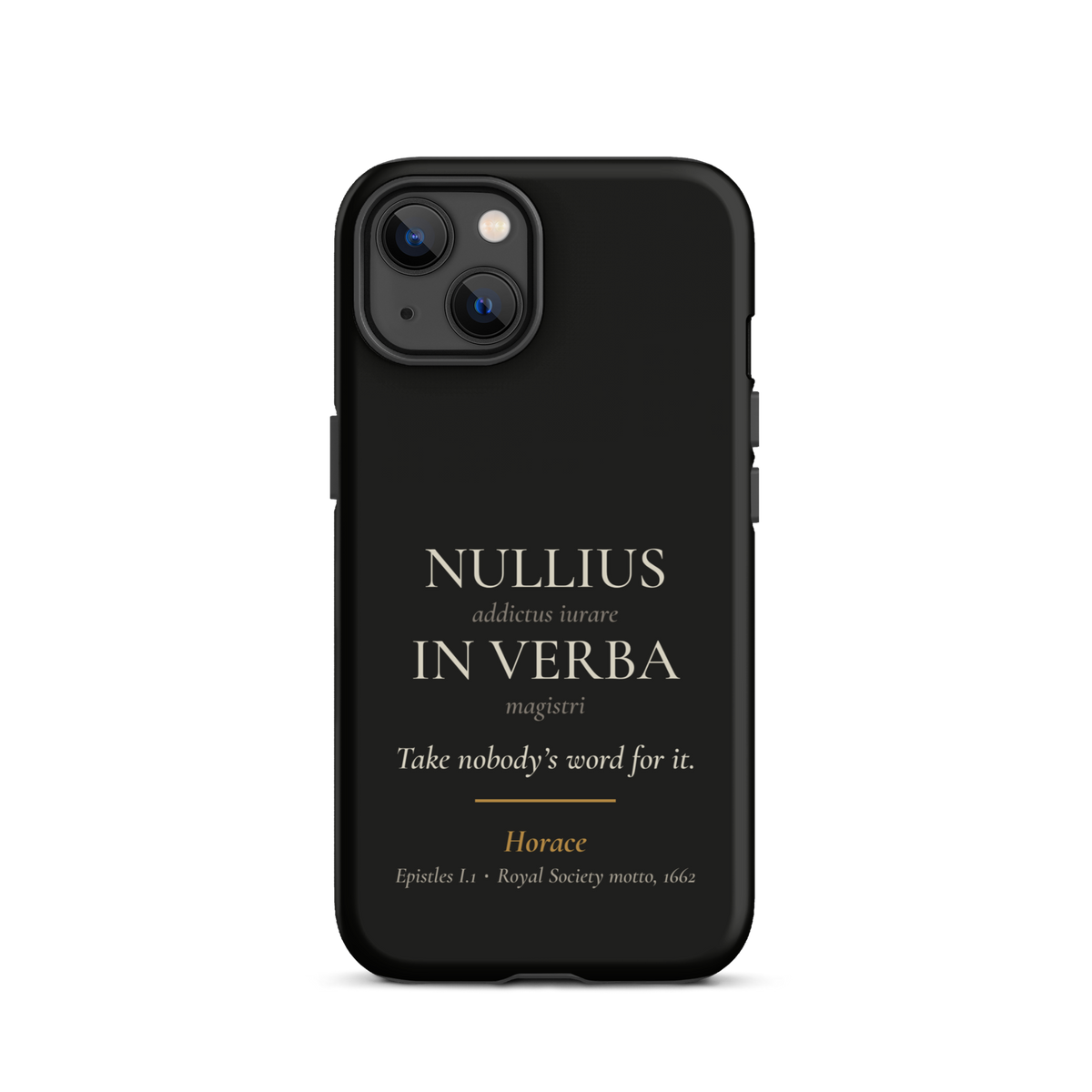
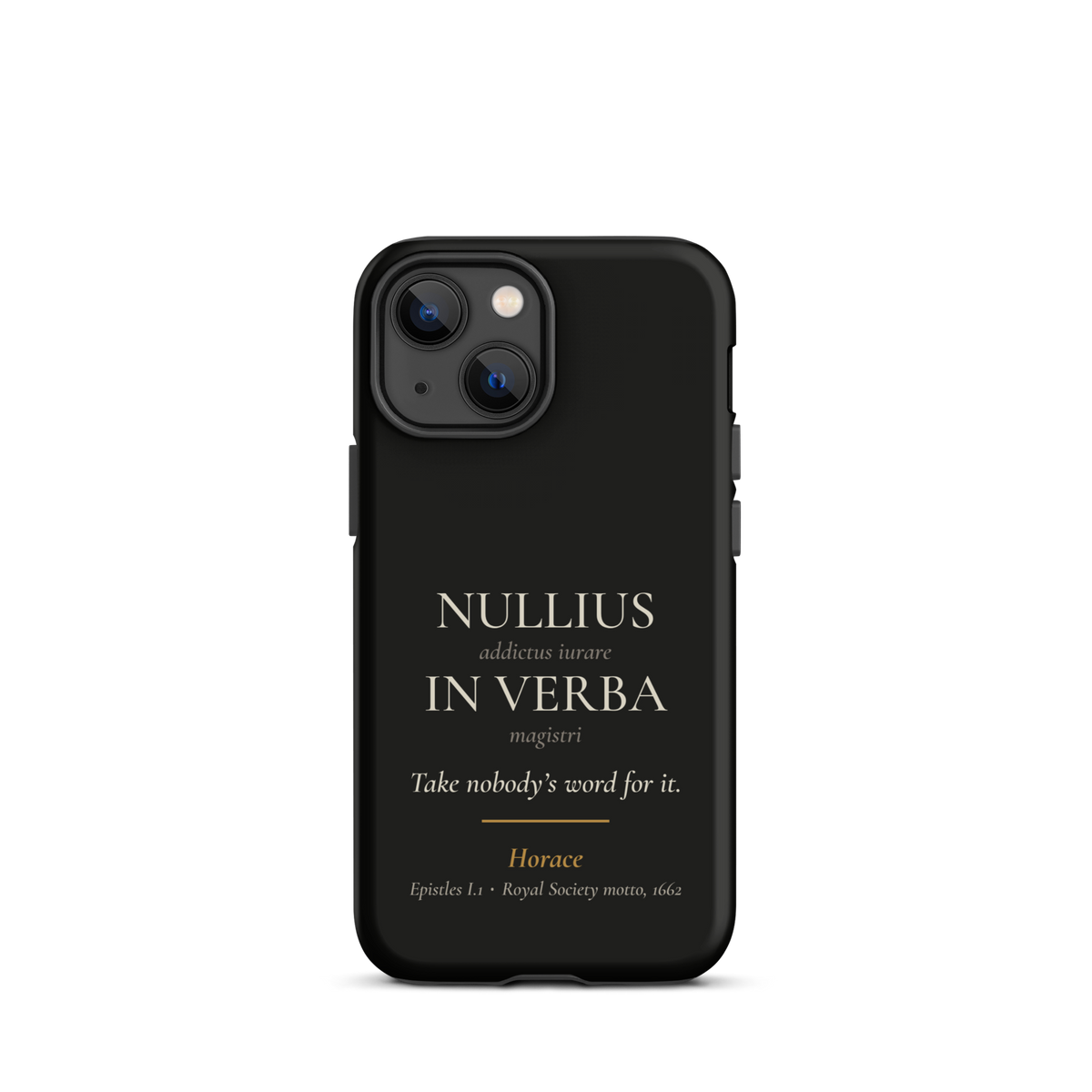
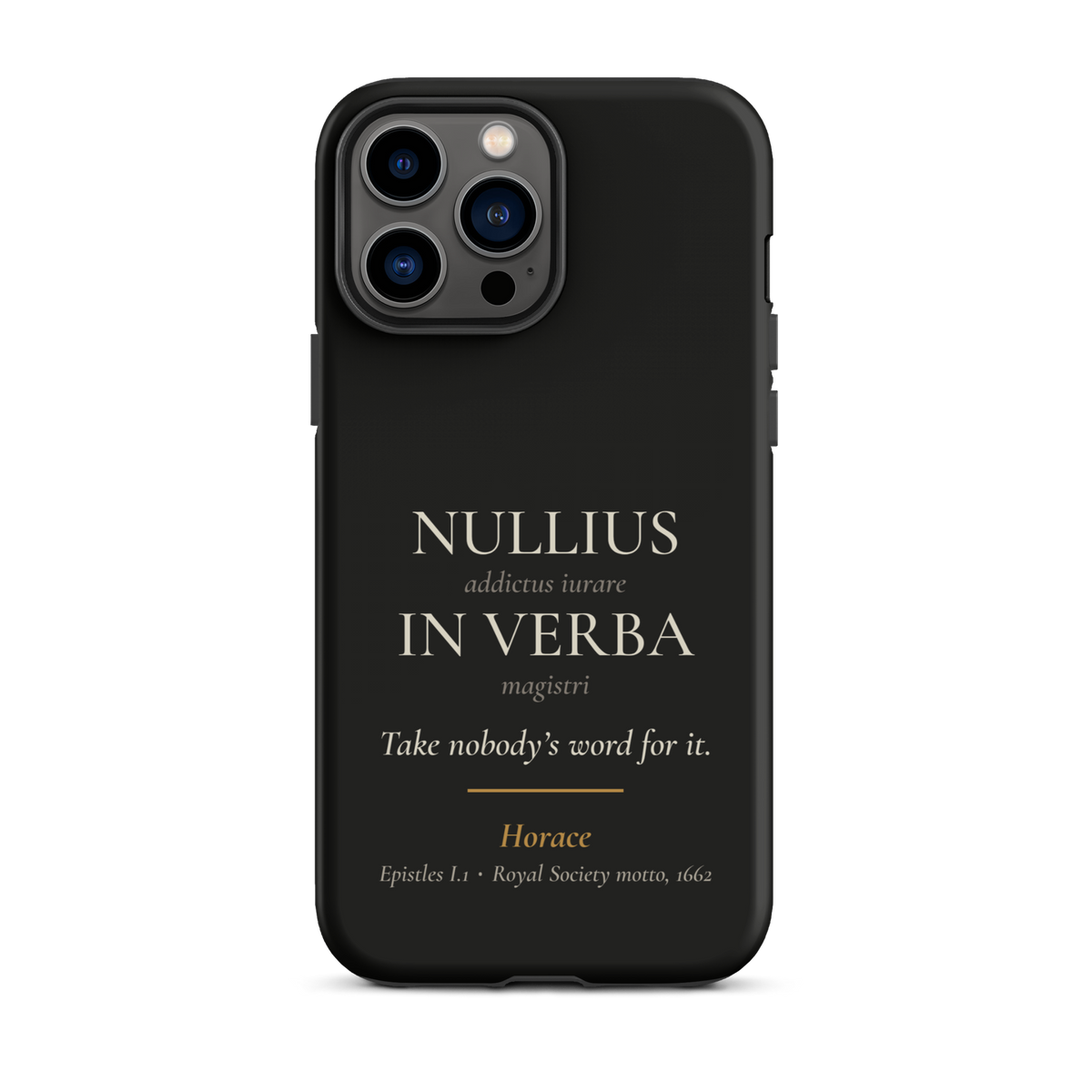
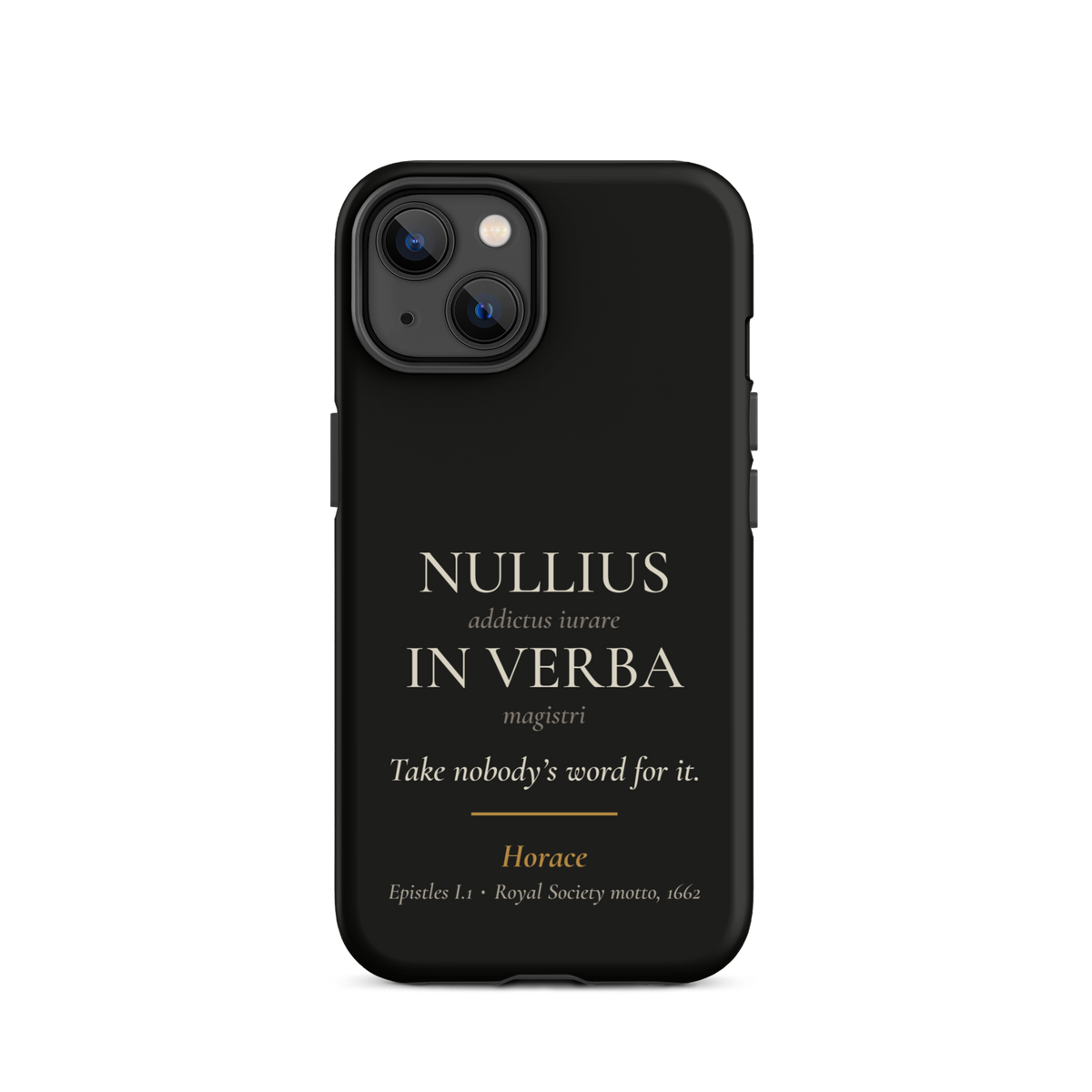
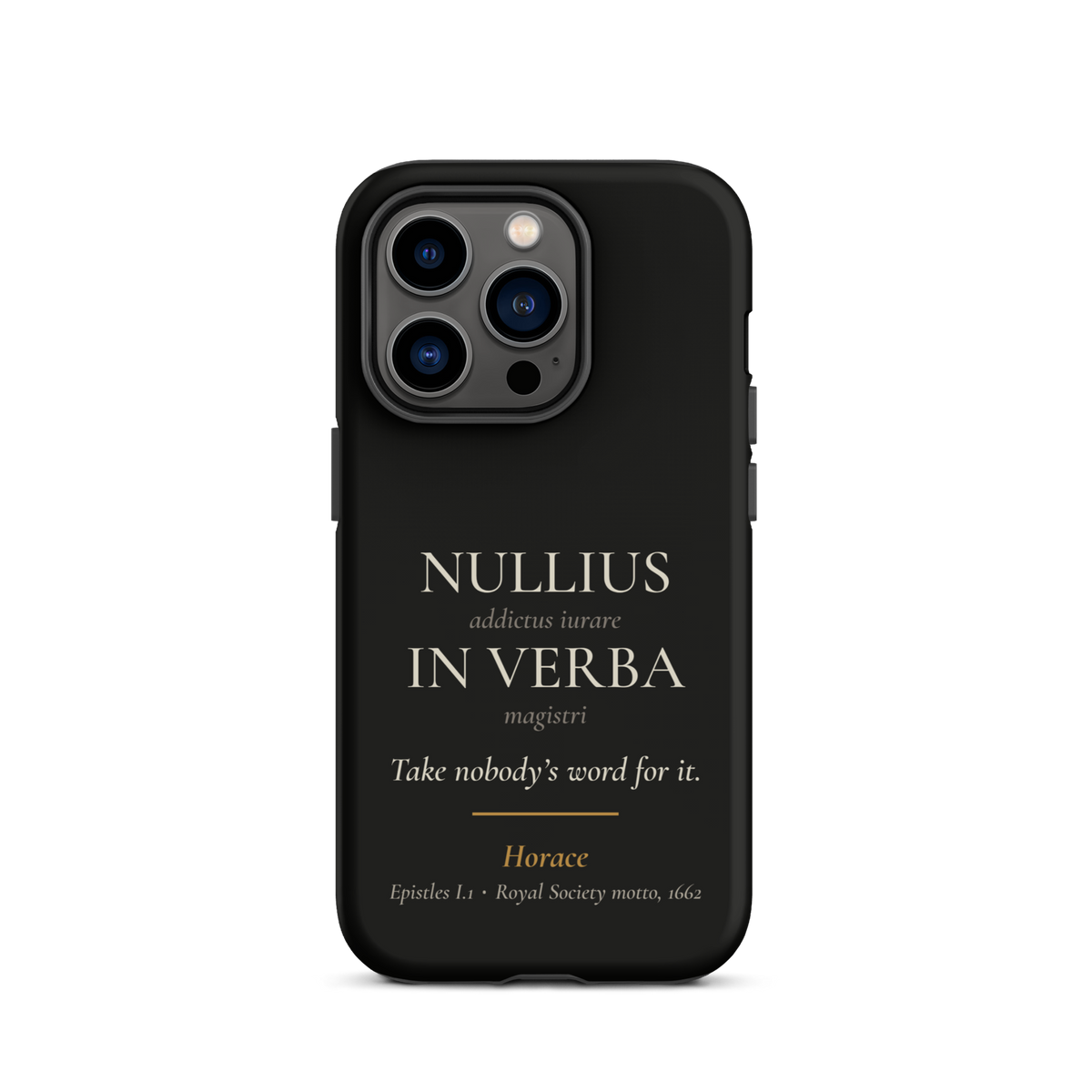
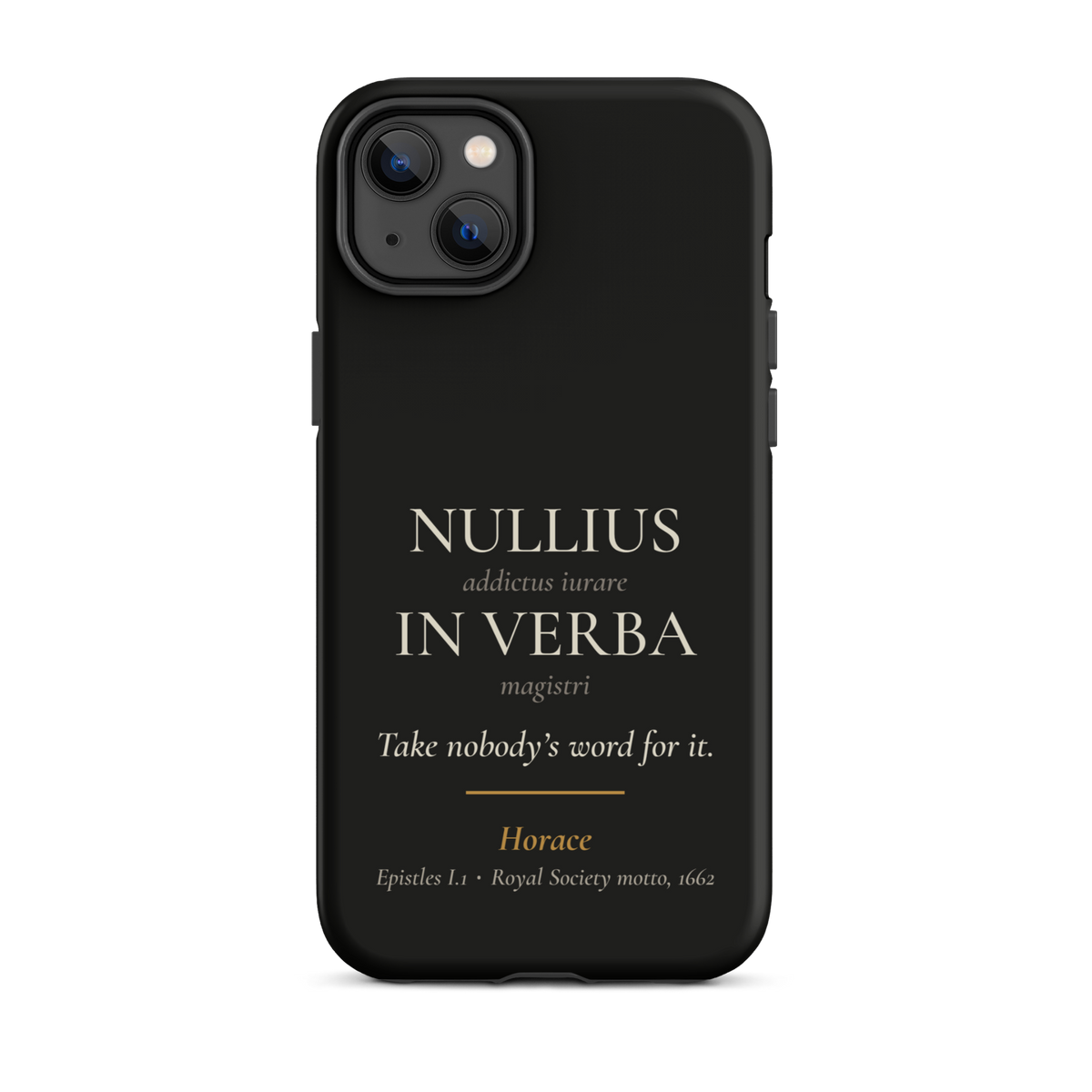
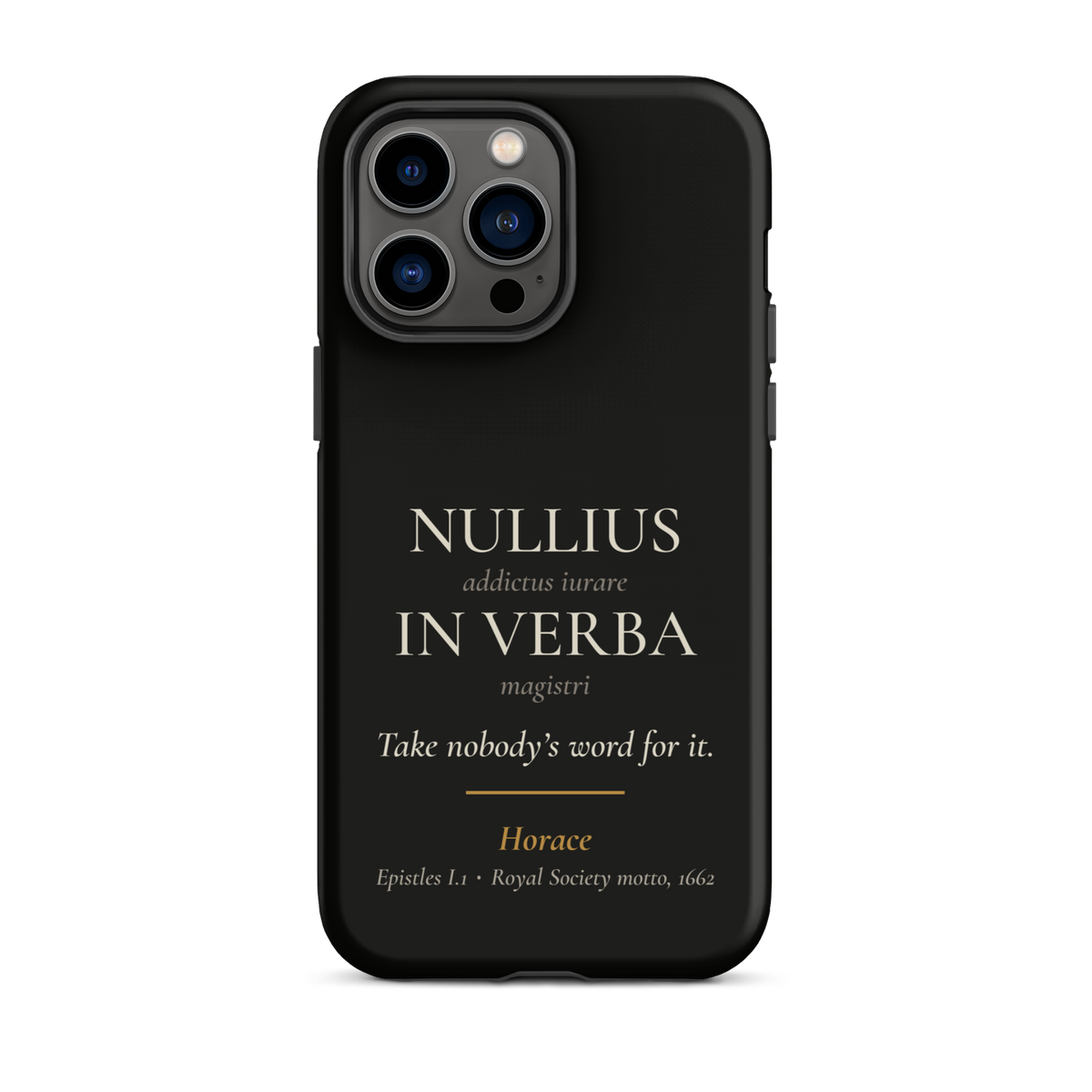
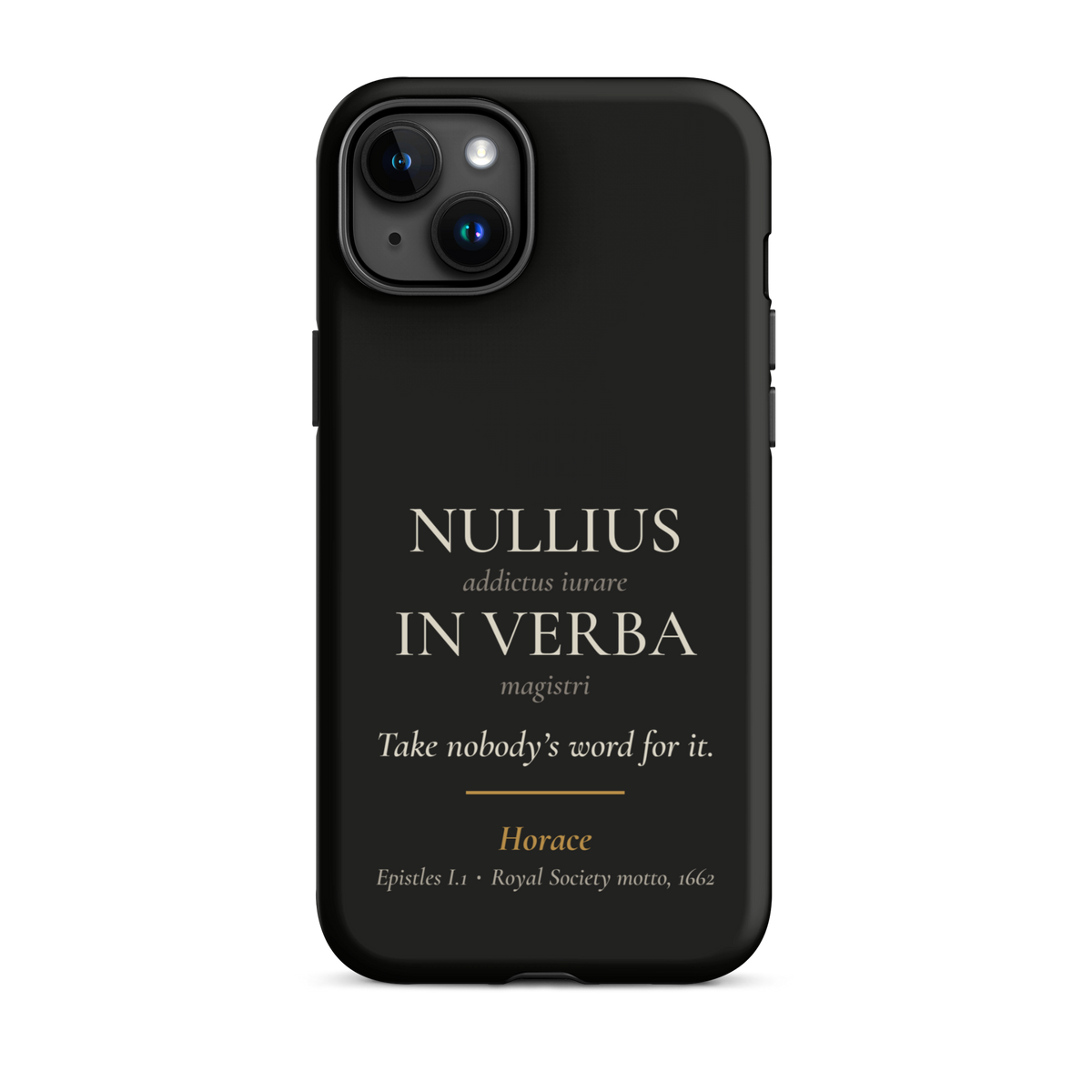
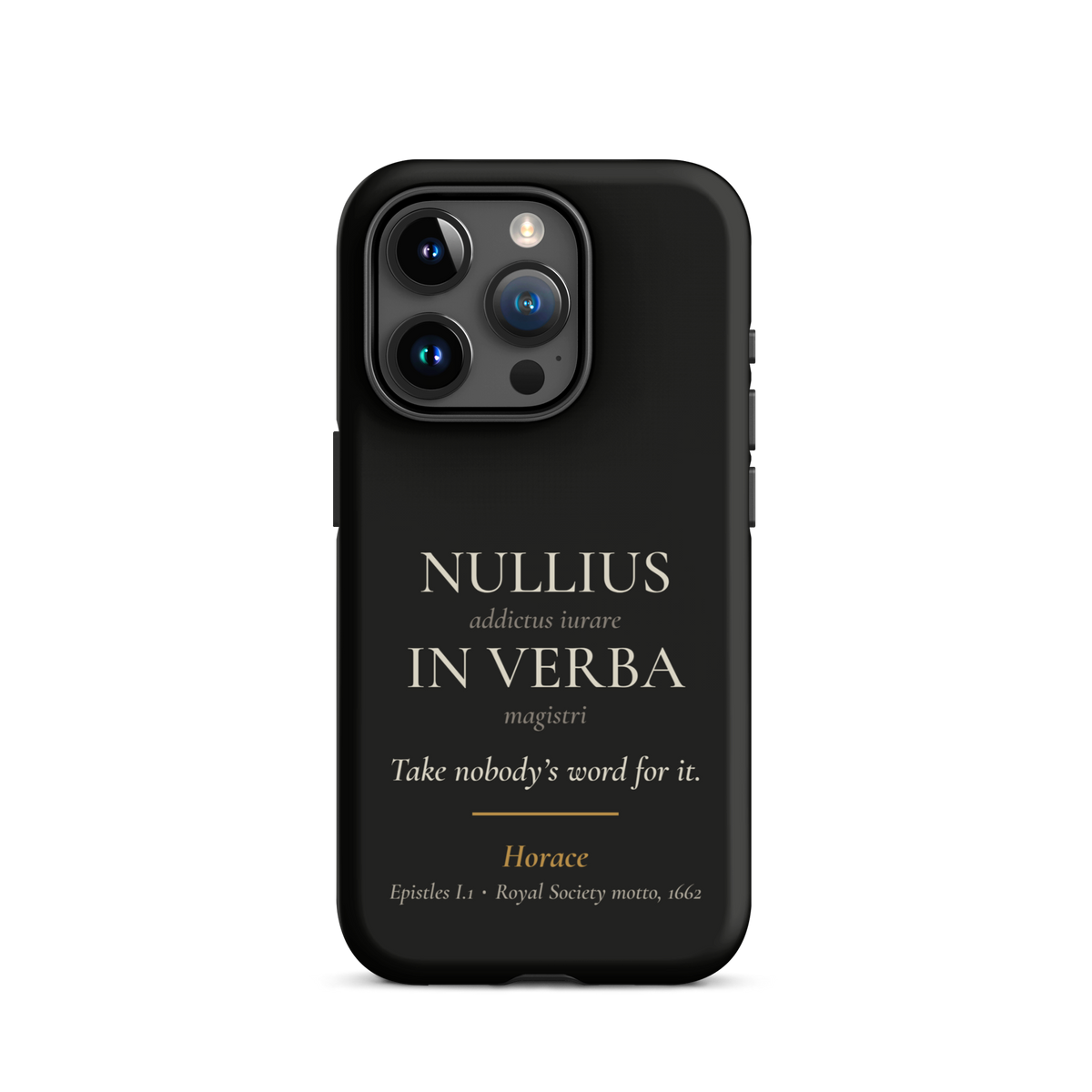
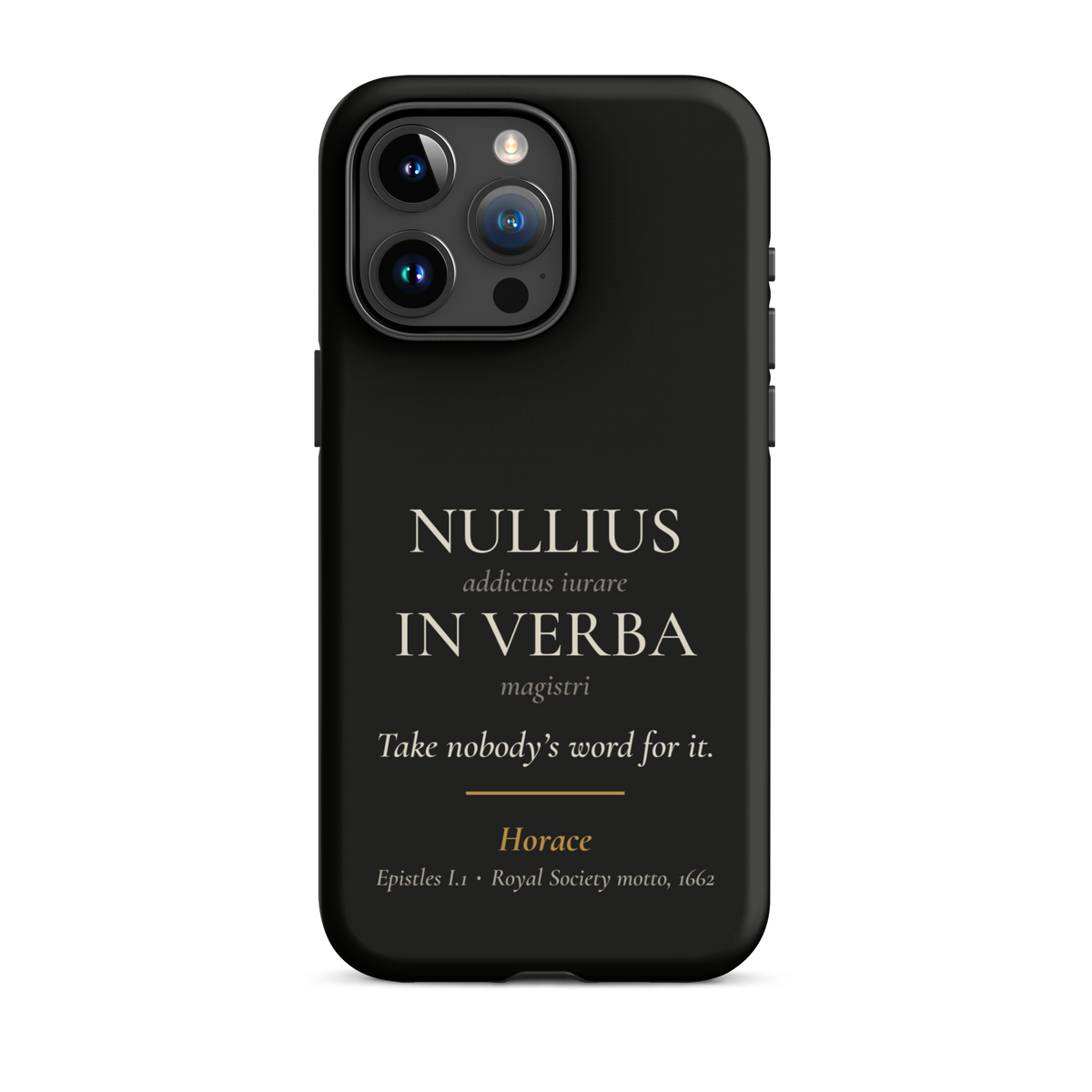
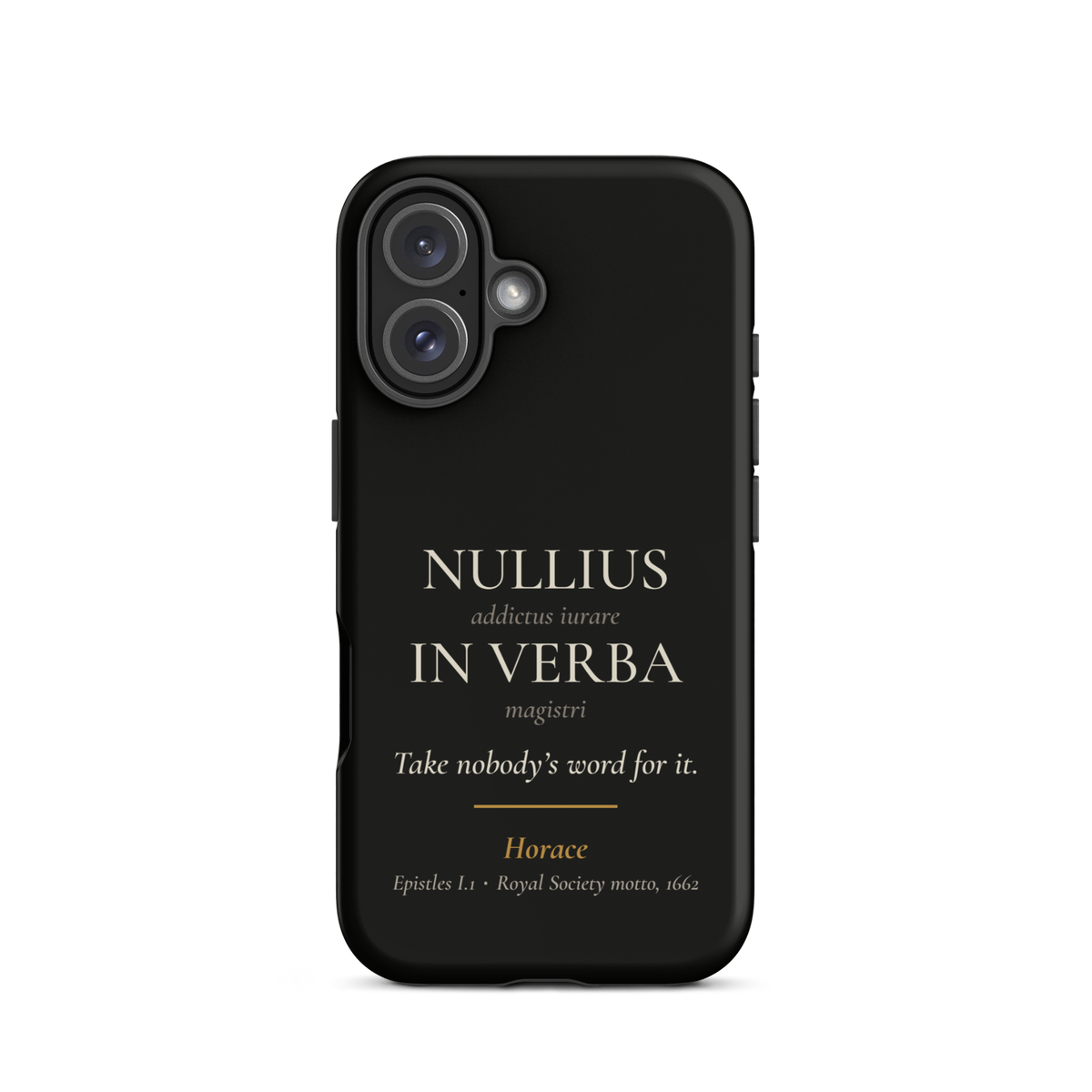
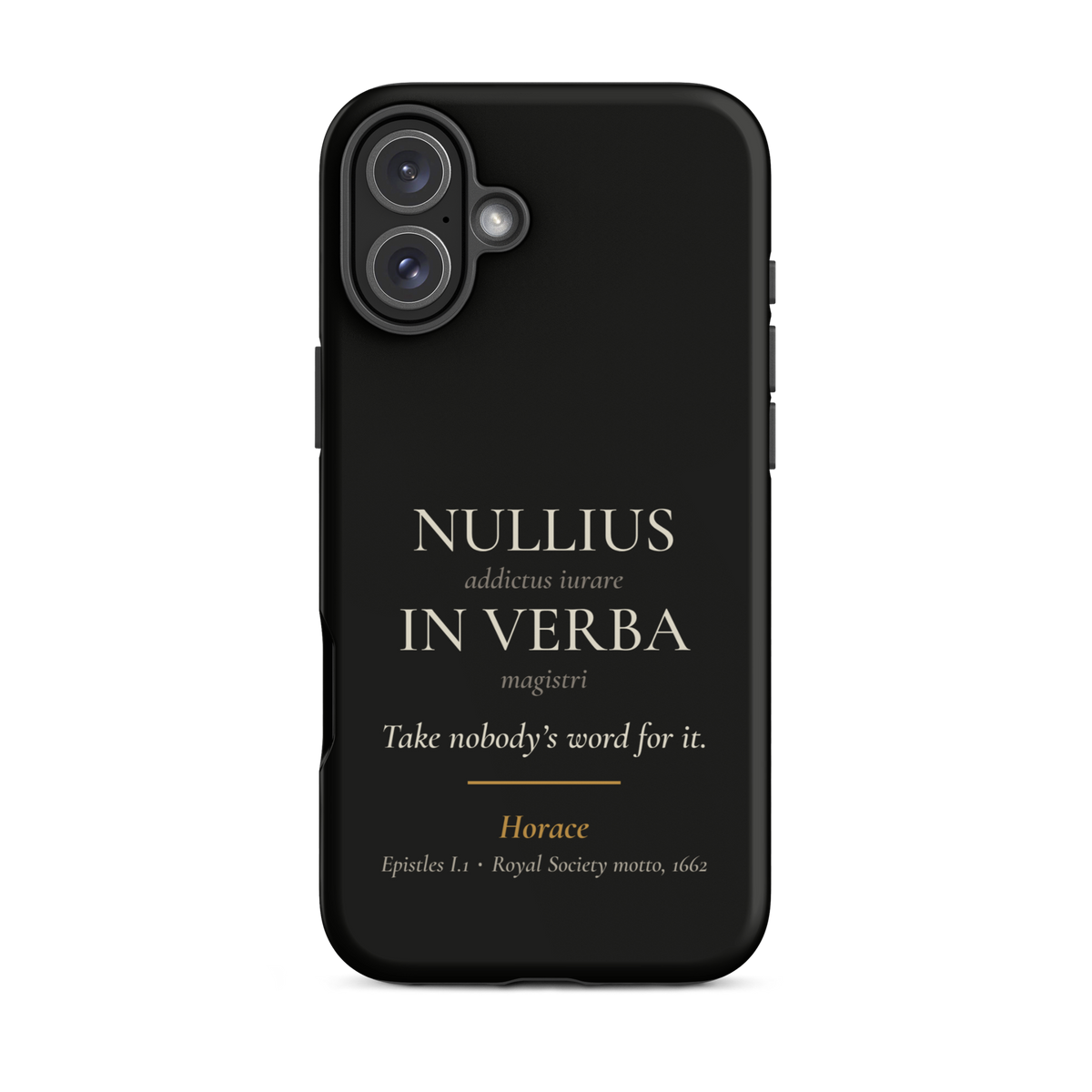
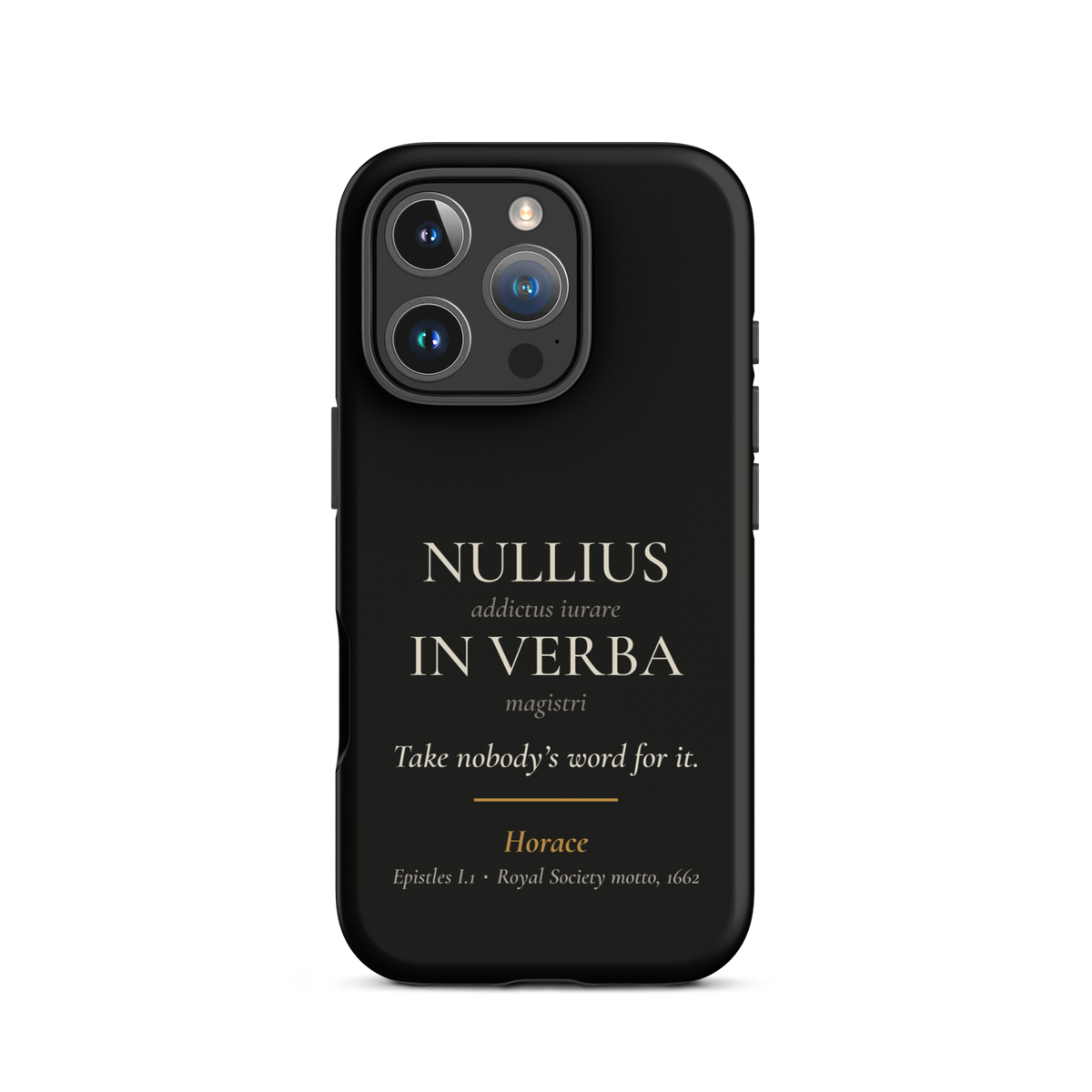
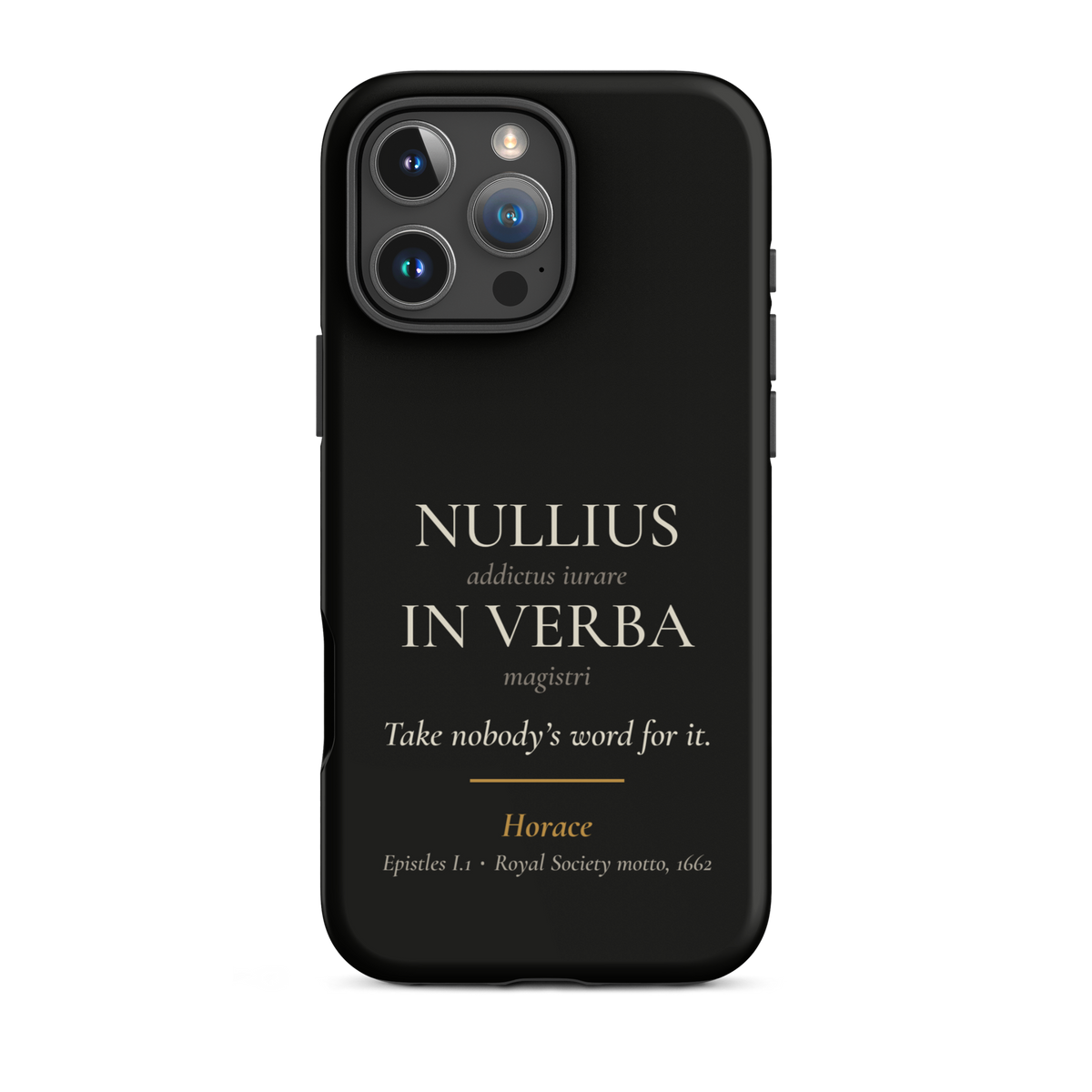
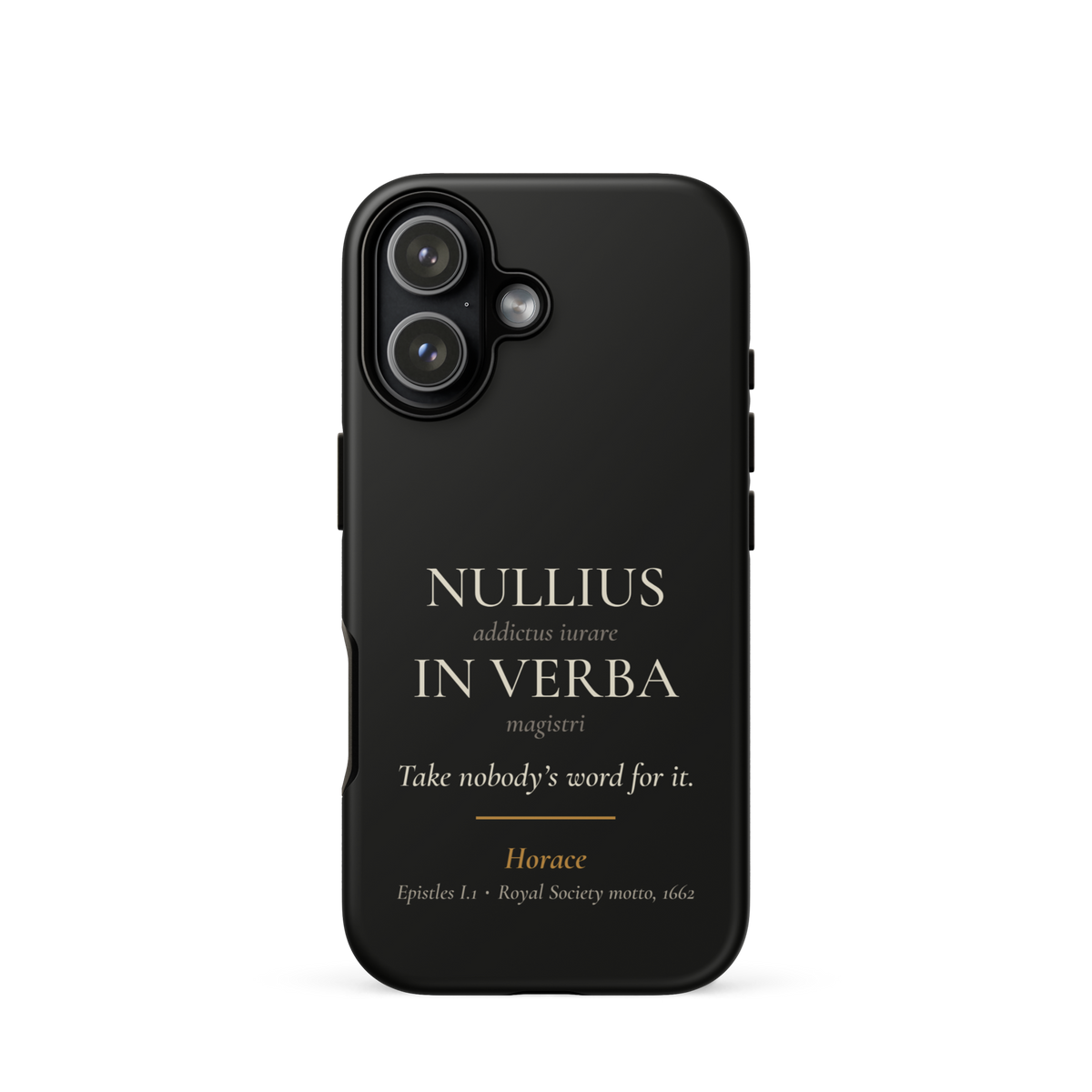
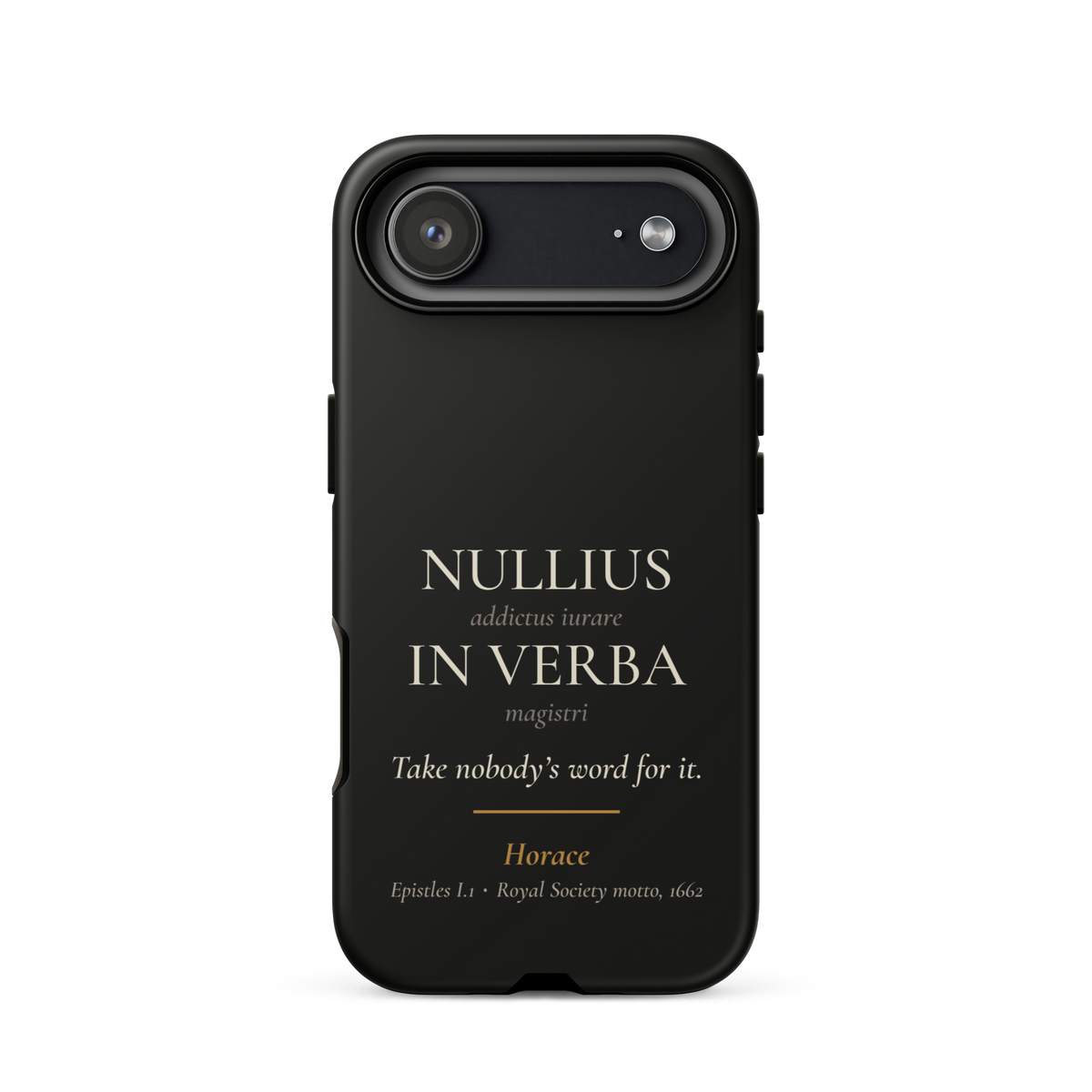
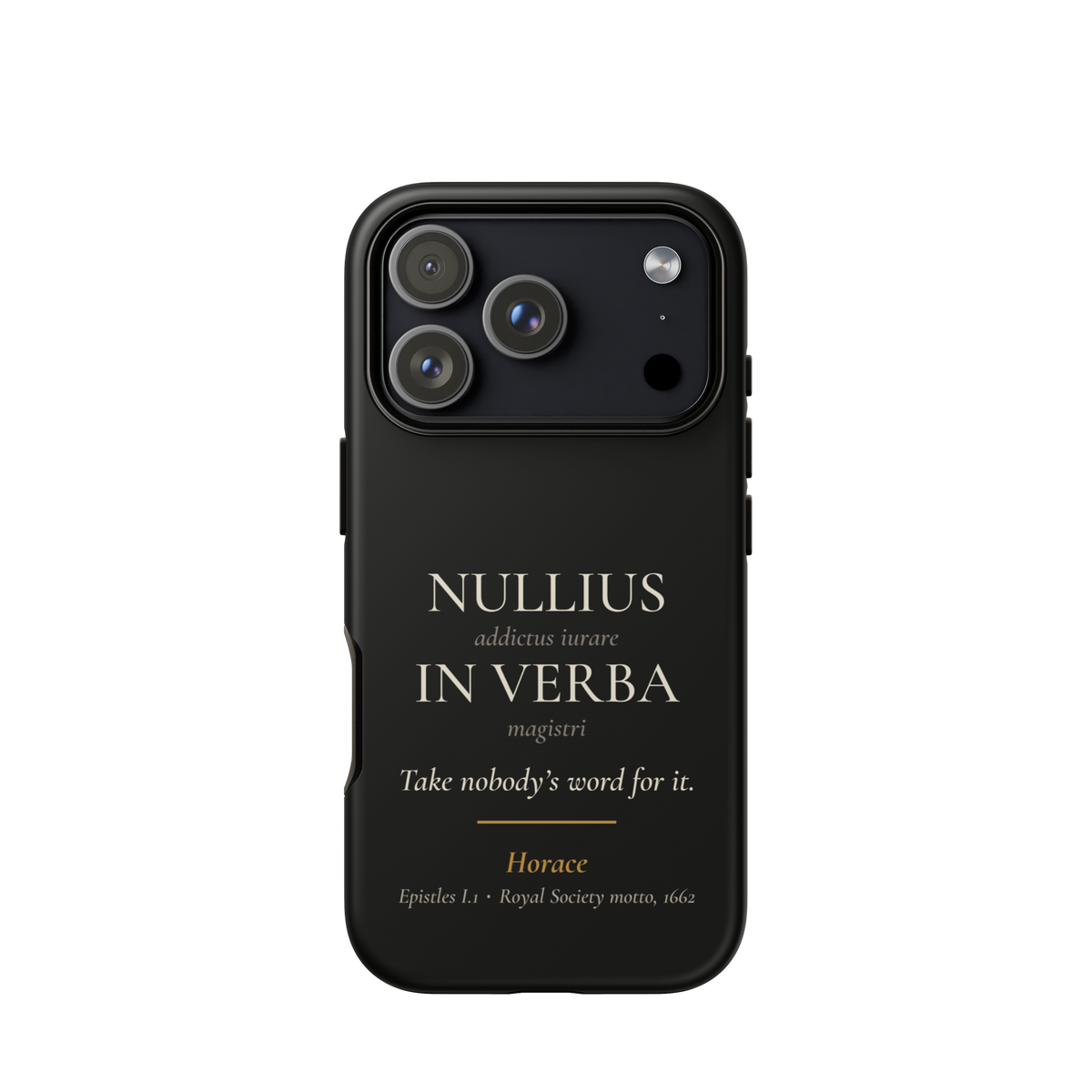


Nullius in Verba — Horace Heretics Phone Case
Carry the two-thousand-year-old instruction that became the Royal Society's motto — and that every phone in your pocket quietly violates — with you everywhere.
Horace
"Nullius in Verba. Take nobody's word for it."
You pick up your phone sixty, eighty, a hundred times a day. Every time you do, "NULLIUS IN VERBA" is the first thing you see — not as decoration, but as a question. What did you just read? Did you check it? Horace wrote this in 20 BC because he was tired of people citing Aristotle instead of looking at the world. The Royal Society put it on their crest in 1660 for the same reason. It's still the same question every time you pick this up.
The Design
The Latin sits centered on a matte black case, each word separated by dots — the spacing convention Roman scribes used to make every word legible on its own. The warm burnished rule marks the dividing line: above it, the claim; below it, the record. "Horace · Epistles I.1" and "Royal Society · 1660" — two citations, twenty centuries apart. The design works like a citation. Every time you pick it up, the source is right there.
Also available: Nullius in Verba Tee — wear the refusal. Nullius in Verba Journal — write your evidence.
About This Case
- Tough dual-layer construction — flexible TPU inner layer, hard polycarbonate outer shell
- Raised edges protect the screen and camera
- Induction charging compatible — works with most wireless devices
- Available for iPhone 11 through iPhone 17 Pro Max
- Care note: Keep away from liquids with high alcohol content and prolonged direct sunlight to preserve the design.
Who It's For
The one who actually reads the study. The one who follows the footnote. The one who learned — from a teacher, a mistake, or both — that the loudest claim and the true one are not always the same thing.
Carry the challenge.
Horace, in Plain English
- Lived: 65–8 BC, Roman Italy
- His father was a freed slave who worked as a tax collector; the money went entirely to Horace's education in Rome and Athens
- He fought at the Battle of Philippi, survived the losing side, came home, and spent the rest of his life writing — including the Odes, the Satires, and the Epistles
- The line that became the Royal Society's motto was written in a verse letter, addressed to a friend, in a poem about refusing to be anyone's philosophical disciple
- "Carpe diem" is his most quoted line. "Nullius in verba" is his most consequential.
Choose options