
Nullius in Verba: What Horace's Phrase Really Means — and Why We Built a Standard on It
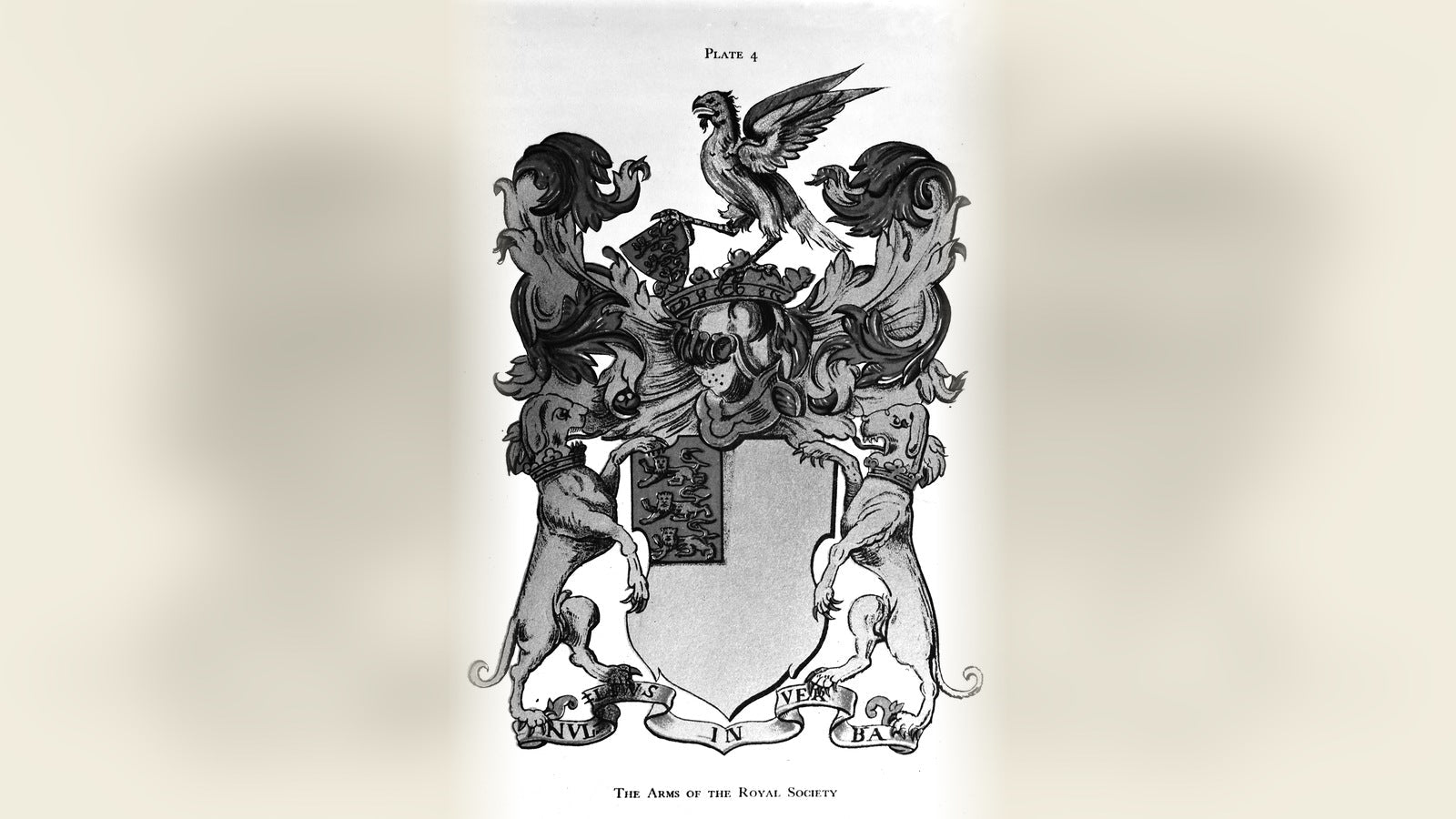
“Nullius in verba” is a Latin phrase from Horace’s Epistles (c. 20 BC), meaning “take nobody’s word for it” or, more literally, “on the word of no one.” It was adopted as the motto of the Royal Society of London in 1662 — the world’s oldest national scientific academy — as a declaration that claims about nature must be verified by observation and experiment, not accepted on authority alone. The phrase appears in full context in Horace’s Epistles I.1.14: Nullius addictus iurare in verba magistri — “not bound to swear by the words of any master.”
It is, in other words, the oldest documented argument for primary sources. It is also the sentence on the Nullius in Verba tee.
What Horace Actually Wrote
The full line from Epistles I.1 is worth reading in context. Horace is writing to his patron Maecenas, explaining why he has left behind the literary games of his youth — the poetry of praise and occasion — for something less glamorous: the work of thinking clearly. The line reads:
Nullius addictus iurare in verba magistri,
quo me cumque rapit tempestas, deferor hospes.“Not bound to swear allegiance to any master’s words, wherever the storm carries me, I put in as a guest.”
The truncated version — nullius in verba — strips the line to its spine. What remains is a complete philosophical position: no master, no oath, no inherited authority. You go where the evidence takes you. For a case study in what happens when that standard fails — even for us, see the Curie investigation.
The Royal Society adopted it in 1662, the year of its royal charter under Charles II, as a pointed rejection of Aristotelianism — the practice of settling scientific questions by citing Aristotle rather than running the experiment. The motto named what the founders were refusing to do. It was a statement of method, not humility.
How It Gets Misquoted
The truncation is almost always correct — nullius in verba is the canonical short form, used by the Royal Society itself. What goes wrong is the translation.
The phrase is frequently rendered as “nothing in words” — a literal translation that misses the point entirely. Nullius is genitive singular: “of no one.” In verba means “on the words” or “by the words.” The correct reading is “on no one’s word” or “by nobody’s words.” The phrase is about authority, not language. It is a rejection of testimony as proof, not a dismissal of words as a medium.
A second common error: attributing the motto’s coinage to Francis Bacon or Isaac Newton. Neither wrote it. Horace wrote it, in approximately 20 BC. The Royal Society chose it as their motto. Newton, who later became President of the Society, was bound by the same motto as everyone else — which is exactly the point.
Why We Printed It
This is the quote that shaped Quoteiac’s attribution standard. Not because it is obscure — it isn’t — but because the reasoning it encodes is the reasoning behind every attribution check we run before anything goes to print.
We do not accept a quote because a dozen websites agree on it. We do not accept an attribution because it has appeared in print for a hundred years. We go to the source — the letter, the manuscript, the first edition — and we verify. Nullius in verba. On no one’s word. For our sourcing process in practice — what verifying a quote actually involves, see the full method.
The Horace source is clean: Epistles I.1.14, written c. 20 BC, pre-1926 translation in public domain. The Royal Society adoption is documented in their 1662 royal charter. There is no attribution question here. That clarity is rarer than it should be.
The Nullius in Verba tee carries the Latin. The journal and phone case carry it too. If you want the full line — the one Horace actually wrote — it is in the product description. We put it there on purpose.
The Standard It Sets
The Royal Society’s motto has outlasted every scientific orthodoxy it was designed to question. Aristotelianism is long gone. The experimental method it defended is now the baseline assumption of every working scientist on the planet. The motto didn’t win the argument — it became so thoroughly correct that the argument dissolved.
That is what a verified primary source does. It doesn’t need to be defended forever. It just needs to be right once, in the original, with the context intact.
Horace wrote nullius in verba as a personal credo — a note to his patron about why he had stopped performing and started thinking. The Royal Society took it and built an institution on it. We took it and built a quality standard on it. Three uses, seventeen centuries apart, and the phrase holds its meaning in each one.
That is what a good line does.
The Arms of the Royal Society, showing the Nullius in Verba motto on the scroll. Engraving from the Wellcome Collection. Wellcome Library, London / Wikimedia Commons, CC BY 4.0.
The Verification Desk
Quoteiac’s attribution team. Every quote is traced to a primary source before it’s printed or published.


,%20meaning%20%E2%80%9Ctake%20nobody%E2%80%99s%20word%20for%20it%E2%80%9D%20or,%20more%20literally,%20%E2%80%9Con%20the%20word%20of%20no%20one.%E2%80%9D%20It%20was%20adopted%20as%20the%20motto%20of%20the%20Royal%20Soc...)