Verified Quote Sourcing for Merchandise: What "Verified" Should Mean
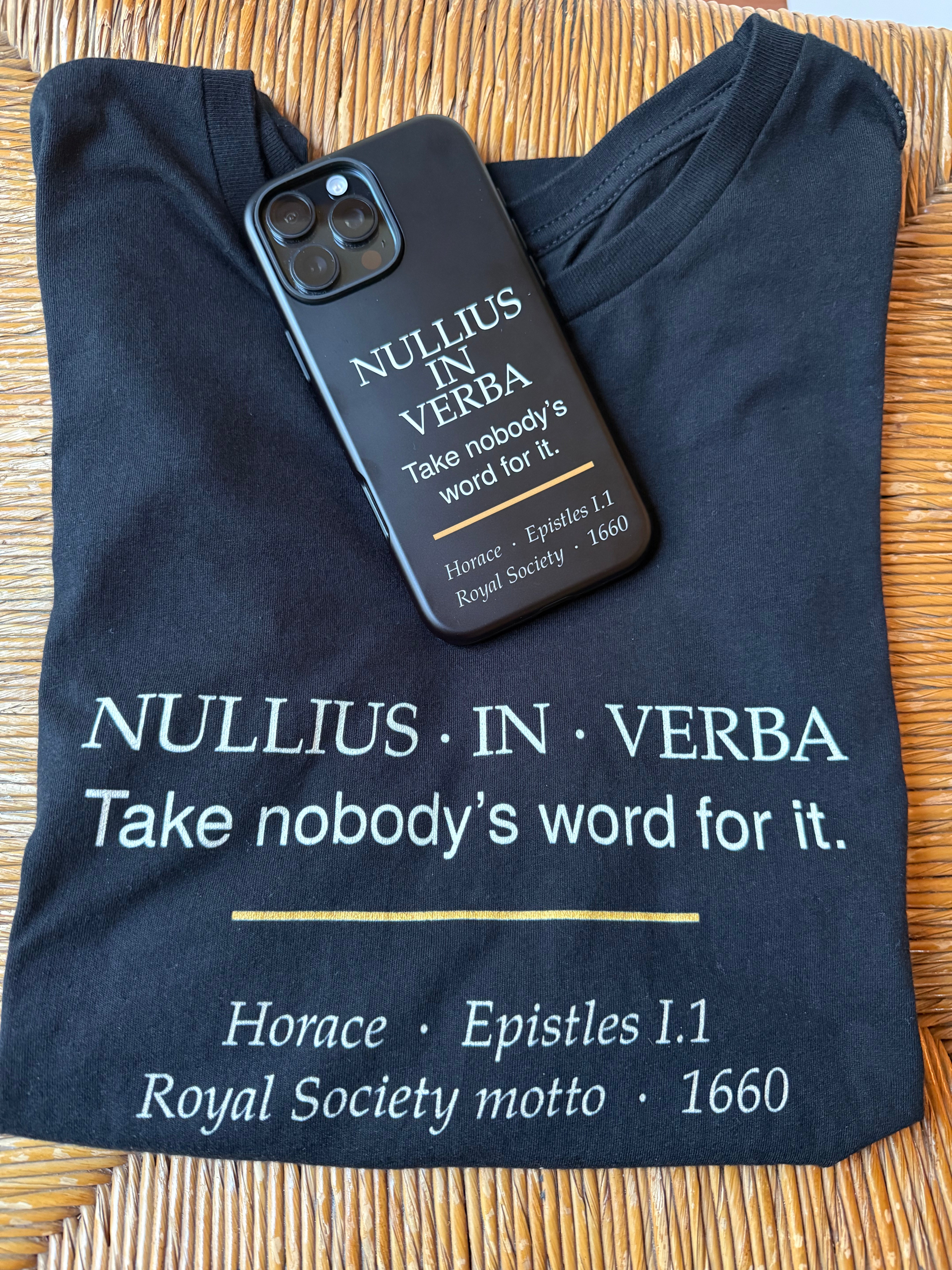
Pictured: the Nullius in Verba tee and phone case — Horace, Epistles I.1, adopted as the Royal Society's motto in 1660. Shop the tee · Shop the case.
If you have ever bought a quote on a shirt, a mug, a wall print, or a tattoo flash sheet, there is a meaningful chance the quote is wrong. Not stylistically wrong. Factually wrong. Attributed to the wrong person, or invented entirely, or paraphrased so loosely that the original author would not recognize it.
This is not a niche problem. It is the default condition of the print-on-demand industry, the gift industry, and most of what gets sold under the word "inspirational." The quote on the product comes from a quote site. The quote site copied another quote site. None of them checked the original — because checking the original takes longer than copying the line, and at scale, time wins.
Verified sourcing is the opposite practice. It means tracing every quote on every product back to a primary source — the original book, letter, speech, or manuscript — before the product is built. It is slower. It rules out a meaningful percentage of the most-shared quotes online. It is also the only standard that holds up when a careful reader looks at the tag.
Here is what verified sourcing actually involves, and why it matters when you are buying something you intend to wear, gift, or keep.
What "verified" should mean on a product page
The word "verified" is doing a lot of work in marketing right now, and most of it is unearned. On a quote product, verified should mean something specific: the wording on the product matches a primary source the seller can name.
Three things follow from that definition.
First, the seller has to know what the primary source is. Not "this is a famous Marcus Aurelius quote" — but Meditations, Book 4, Section 7, in a specific translation. Not "Thoreau said this" — but Walden, chapter and edition. If the seller cannot name the source, the quote is not verified. It is just attributed.
Second, the wording on the product has to match the wording in that source. Quotes drift. A line gets shortened for Pinterest, a comma gets moved for rhythm, a "the" gets dropped because it scanned better in a meme. By the time the line reaches a product designer, it can be three edits away from what was actually written. Verified means the version on the product is the version in the book.
Third — and this is the step almost no one does — the translation has to be accounted for. Marcus Aurelius wrote in Greek. Seneca wrote in Latin. Kafka wrote in German. The English wording you see on a quote product is a translator's choice, and translations are separately copyrighted. A seller using a modern translation without a license is in different trouble than a seller using a public domain one. Both should be able to tell you which translator they're quoting.
The categories of attribution failure
When sourcing falls apart on a quote product, it usually falls into one of four categories. Each is worth recognizing.
The clean misattribution. The quote is real. The named author did not say it. "Be the change you wish to see in the world" is the canonical example — a real sentiment from Gandhi's broader thinking, but not a sentence Gandhi ever wrote or said. Quote Investigator's 2017 entry traces the actual origin to a 1970s reformulation by Arleen Lorrance.
The quoter mistaken for the originator. "There is no exquisite beauty without some strangeness in the proportion" is widely sold as Edgar Allan Poe. Poe did write that sentence — inside his short story "Ligeia," where he is explicitly quoting Francis Bacon's Essays from 1625. The line is Bacon's. The two-hundred-year game of telephone made it Poe's.
The translation drift. A quote attributed to a non-English author often appears in dozens of slightly different English versions, depending on translator. Selling "the impediment to action advances action" as Marcus Aurelius is fine if you can name the translation. Selling it without knowing whether you're quoting Gregory Hays, George Long, or someone's loose paraphrase from Reddit is not the same thing.
The clean invention. Some quotes were simply made up — assigned to a famous name to make them stick. These are the hardest to disprove for a casual reader, because there is no real source to find. They circulate forever on the strength of the name attached.
None of these four are obscure problems. All of them show up regularly on products being sold today.
Why this matters more on a product than on a feed
A wrong quote in a post disappears. A wrong quote on a permanent object does not.
A shirt is worn for years. A mug is filled every morning. A wall print is seen by every visitor. A tattoo is permanent. The error scales with how long the object exists and how often it is encountered — and unlike a social post, the error is presented with the confidence of a finished, sold, branded product. A reader does not think "this might be wrong." They think "someone manufactured this, so someone must have checked."
Usually no one checked.
The reader-class buyer — the person who has actually read the author whose name is on the tag — notices. They notice the wording, they notice the translation, they notice when "Emerson" is attached to a line Emerson didn't write. The quote was supposed to be a signal of literacy. The misattribution turns it into the opposite.
What to look for as a buyer
If you want to buy quote merchandise that holds up, four questions tell you almost everything.
- Does the product page or brand name a specific work? Not just "Marcus Aurelius" — but Meditations, ideally with book and section. The presence of that information signals that the seller did the work. The absence of it doesn't always mean they didn't — but it usually does.
- For translated quotes, does the brand name the translator? This is the single most reliable test of whether a quote-merchandise brand is doing real sourcing or copying from aggregators. Aggregators almost never include the translator. Brands that verify almost always do.
- When a quote is contested or paraphrased, does the brand say so? A brand that sells "Be the change you wish to see in the world" without acknowledging it isn't actually Gandhi's exact phrasing is telling you something about their standard. A brand that sells it with that context — clearly, on the product page, not buried in legal — is telling you something different.
- Does the brand correct mistakes publicly? Everyone gets a quote wrong eventually. The question is what happens after. A brand that quietly relabels or hides errors has one standard. A brand that publishes the correction has another.
None of those four questions require expertise to ask. They just require knowing they are worth asking.
How Quoteiac does this
Every quote on every Quoteiac product is traced to a primary source before the product is built. Where the original was in another language, the translator is named and the translation is verified as public domain. Where a quote is widely attributed but historically contested, the product page says so.
We are not the only people who do this, but the standard is rare enough that it is part of why the brand exists. If we can't verify it, we don't print it.
We have also gotten it wrong, and corrected it publicly. The full account of what verified sourcing means at Quoteiac — including the time we attributed a line to Poe that actually originated with Washington Irving — is in We Check the Original. If you want the method itself, free for anyone to use, it is laid out in How to Check If a Quote Is Real.
The catalog is organized by author. Every quote is sourced, every attribution is checked.