How to Check If a Quote Is Real (Without Trusting the Internet)
Most quotes online are wrong. Not all of them — but enough of them, and confidently enough, that "I saw it on a quote site" should never be the end of the trail. The good news is that verifying a quote is easier than people think. The tools are mostly free, the originals are mostly digitized, and the method is the same whether you are checking a line for a wedding toast or a book manuscript.
We run a brand that depends on getting this right. Every quote on a Quoteiac product is traced back to a primary source before it ships. Quote Investigator has examined the attribution history of the “Be the change you wish to see in the world” quotation. We have also gotten it wrong — in April 2026 we archived three products after discovering that a quote we had attributed to Edgar Allan Poe actually originated with Washington Irving. We wrote about that publicly, because correcting a mistake is part of the same standard as not making it in the first place.
What follows is the method. Four steps. Anyone can do them.
- Search Quote Investigator first.
- Find the primary source yourself.
- Check the translation if the original was in another language.
- When you cannot verify, say so.
1. Search Quote Investigator first
Quote Investigator is the gold standard. It is the work of Garson O'Toole, a researcher who has spent over a decade tracing quotes to their actual origins, citing primary sources, and documenting how each misattribution spread. The site is free, searchable, and rigorous.
The method: search the exact phrase first. If that returns nothing, try the most distinctive three or four words. If QI has investigated the quote, you will usually have your answer in under a minute — who actually said it, when it first appeared in print, and how the wrong name got attached to it.
Quote Investigator’s 2017 investigation of “Be the change you wish to see in the world” established, with primary-source evidence, that Gandhi never said or wrote the sentence. He expressed adjacent ideas across several texts. The exact phrasing is a 20th-century paraphrase.
The limit of Quote Investigator is that not every quote in the world has been investigated yet. When QI does not have an entry, you move to Step 2.
2. Find the primary source yourself
A primary source is the original document: the book as first published, the letter as written, the speech as delivered and transcribed. For public domain literature — works whose authors published through 1930 (US law runs on publication date plus 95 years, not the author’s death — as of 2026, works published through 1930 are US public domain regardless of when the author died) — most of these documents are digitized and free to read online.
Three resources to know:
- Project Gutenberg — full-text public domain books, searchable inside the text. Best for prose works where you can search by phrase.
- Internet Archive — scanned facsimiles of original editions, including periodicals, pamphlets, and out-of-print books. Best when you need to see the actual printed page, not a re-typed version.
- HathiTrust Digital Library — academic-grade digitized collections from major research libraries. Best for harder-to-find editions and scholarly material.
Here is how the method works in practice. Take the line "There is no exquisite beauty without some strangeness." It is everywhere attributed to Edgar Allan Poe. Search Project Gutenberg for Poe's short story "Ligeia" and the line is there — but read the surrounding paragraph and Poe is quoting Francis Bacon. Search the Internet Archive for Bacon's Essays (1625) and the line appears, in Bacon's own essay "Of Beauty." The idea is Bacon’s — Poe was quoting him, in his own slightly sharpened wording. Two hundred years of misattribution later, it circulates as Poe's own thought.
That whole verification took about five minutes and cost nothing.
One note on accuracy. When the wording matters down to the punctuation — and on a permanent object, it usually does — favor facsimile scans of the original edition over re-typed digital editions. Re-typed editions sometimes modernize punctuation, fix spelling that the author chose deliberately, or introduce typos. The scanned original is the truth.
3. Check the translation if the original was in another language
This is the step most people miss, and it is where careful sourcing diverges from confident guessing.
A work originally written in Latin, German, French, Russian, or any other language can be fully in the public domain — and the English translation you are reading can still be under copyright. Translation is creative work. A translator's specific phrasing is separately protected, even when the underlying text is two thousand years old.
Practical examples. Marcus Aurelius wrote in Greek; he died in 180 AD. The Greek is public domain everywhere. But the popular Gregory Hays translation (2002) is fully under copyright. If you want a public domain English Marcus Aurelius, you need the George Long translation (1862) or the Meric Casaubon (1634). The wording will be different. That difference matters.
Kafka wrote in German; the German is public domain. The Muir translations enter US public domain on a rolling 95-year basis. Modern translations by Mark Harman or Michael Hofmann are under active copyright.
For most readers, this is a "good to know" caveat. For anyone publishing, printing, or building products around quotes, it is load-bearing. The fix is straightforward: when you find a translated quote you want to use, identify the translator and the publication date before you trust the wording.
4. When you cannot verify, say so
Some quotes will never be traceable to a primary source. The trail goes cold at a quote site, or at a 1950s anthology that gave no citation, or at a Pinterest board that cited nothing. That does not always mean the quote is fake. It means the evidence isn't there.
The honest move is to say which category you're in. There are three:
- Verified. The primary source exists, the wording matches, the attribution is correct.
- Paraphrase. The spirit of the quote is accurate to the named author, but the exact wording is not theirs. "Be the change you wish to see in the world" sits here — defensible as a distillation of Gandhi's thought, not defensible as a direct quotation.
- Unverified or misattributed. The trail leads nowhere, or it leads to the wrong person. These should not be presented as direct quotations.
The difference between "Gandhi said" and "often attributed to Gandhi, paraphrased from his writings" is small in word count and large in honesty. A reader who knows the difference will respect the second. A reader who doesn't will still be better served by it.
Why the work matters
A wrong quote in a feed disappears. A wrong quote in a book, on a wall, on a shirt, in a wedding toast, in a eulogy — that one lasts. It gets remembered. It gets repeated. It becomes part of how a real person who actually lived is remembered by people who never read them.
Verification isn't gatekeeping. It is the minimum respect owed to the writers, philosophers, and ordinary people whose words got separated from their names somewhere along the way. The tools to put the names back are sitting on the open internet, free, and most of them are searchable.
This is the method we use on every Quoteiac product. The standard behind it — and what we do when we get it wrong — is laid out in We Check the Original.
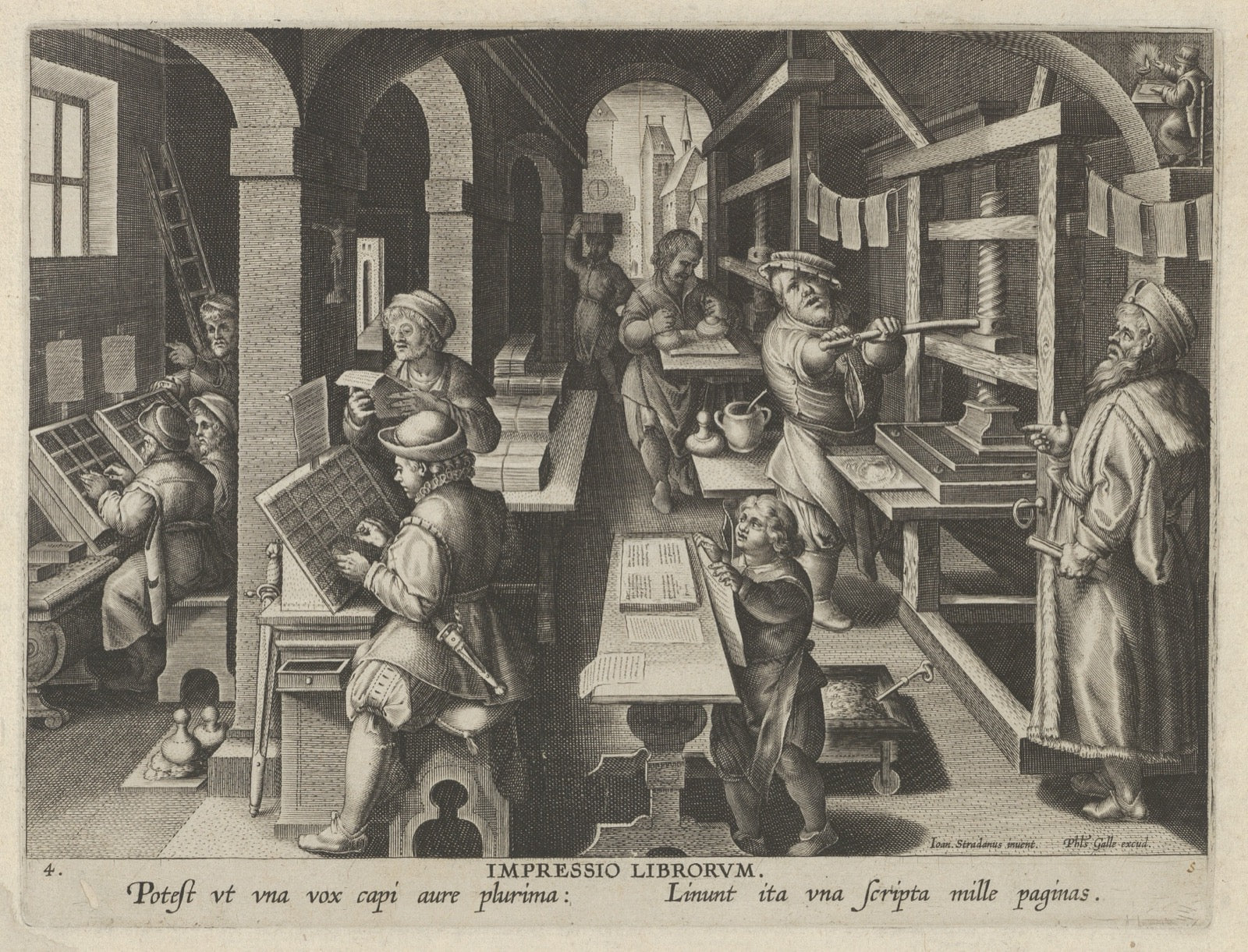
Renaissance printing workshop, c. 1580–1605 — compositors setting type, pressmen checking sheets before they go to press. Engraving by Jan van der Straet (Stradanus), from Nova Reperta. Metropolitan Museum of Art, CC0 public domain.