
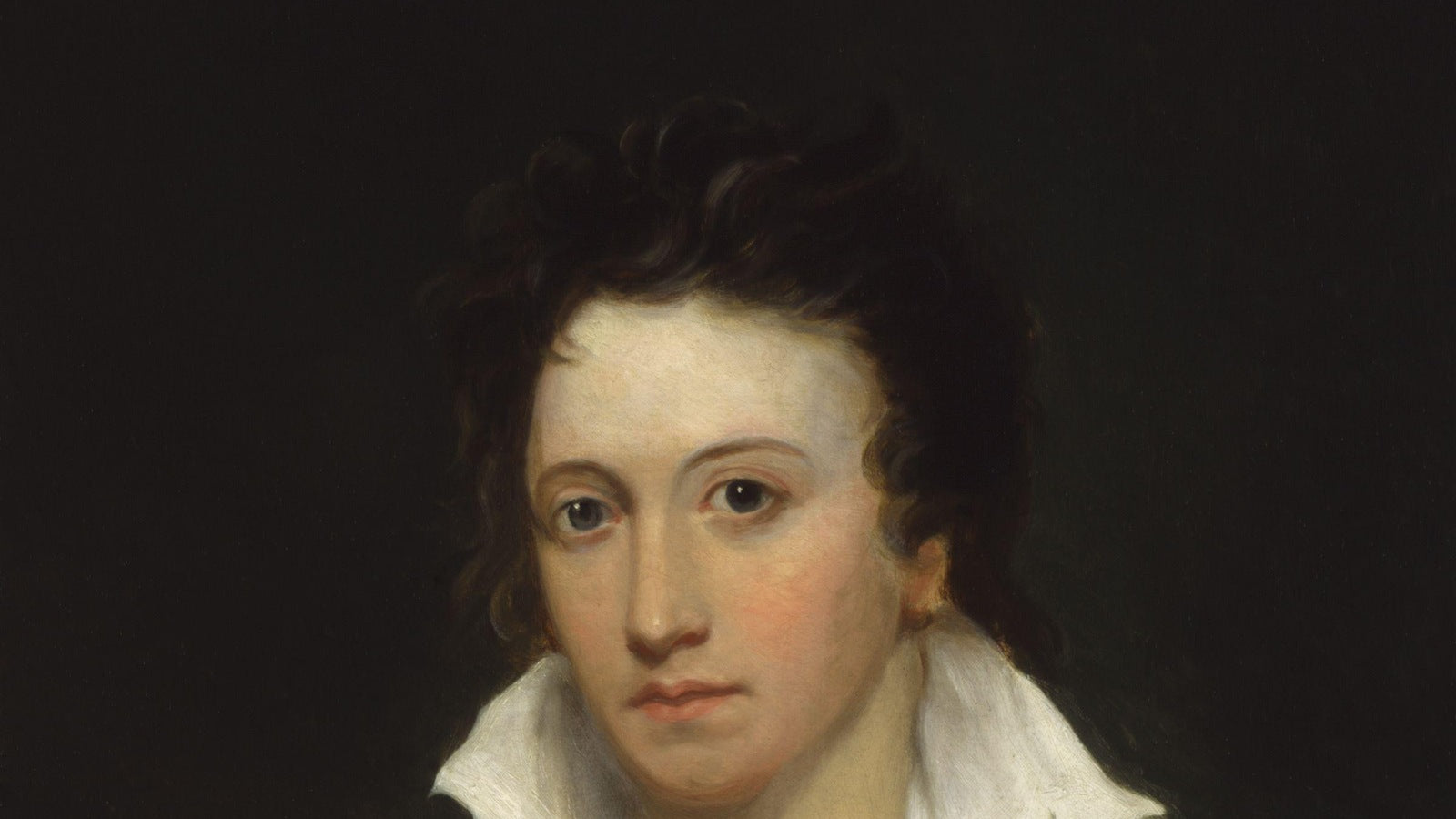
Percy Shelley Was Always in Mary’s Shadow. He Shouldn’t Be.
Percy Bysshe Shelley (1792–1822) was an English Romantic poet whose work argued, with sustained philosophical precision, that imagination was not decoration but the primary instrument of human liberation — the faculty by which the world could be understood and, eventually, changed. He was expelled from Oxford at 19 for co-writing a pamphlet on atheism. He drowned in the Gulf of Spezia at 29. His wife was Mary Shelley. That last fact has, for two centuries, done a great deal of damage to his reputation.
Not because Mary Shelley’s reputation is undeserved. It is entirely deserved. Frankenstein is a genuine work of genius, written at 18, still surgically relevant. The problem is that “Mary Shelley’s husband” is how Percy often arrives in conversation, as if the author of Adonais and Mont Blanc and the “Ode to the West Wind” were primarily a biographical footnote.
He wasn’t.
What He Actually Believed
Shelley was a political radical in a period when that carried genuine legal risk. He was a republican, an atheist, a believer in free love and the redistribution of property, and an opponent of the British establishment at a time when those positions could result in losing custody of your children — which, in his case, they did. A court ruled that he was an unfit father based on his published views. He never saw his children from his first marriage again.
His political poetry was not vague idealism. The Masque of Anarchy (1819) was written in direct response to the Peterloo Massacre, in which cavalry charged a crowd of 60,000 people peacefully gathered to demand parliamentary reform, killing fifteen. Shelley’s poem, written in days, is one of the founding texts of nonviolent resistance: “Rise like lions after slumber / In unvanquishable number.” His publisher refused to print it. It was not published until 1832, a decade after his death.
The Poetry
The political conviction and the lyric achievement are not separate things in Shelley. The same philosopher who argued that imagination was the instrument of moral progress wrote the “Ode to the West Wind” in a single afternoon, sitting in a forest outside Florence, watching the leaves. The poem is about death and renewal, about being swept up by a force larger than yourself and made part of its motion — and it is also, formally, a technical marvel: five sonnets in terza rima, each one building pressure toward a close that opens rather than resolves. See also: the Dark Romanticism tradition his work helped define.
“Make me thy lyre, even as the forest is: / What if my leaves are falling like its own? / The tumult of thy mighty harmonies / Will take from both a deep autumnal tone.”
He was 26 when he wrote it.
Mutability
“Mutability” (1816) is the poem on the Midnight Moon Percy Shelley Tee and the three products in the Percy Shelley collection. It is a short poem — sixteen lines — about the nature of change, and it contains the line: “The moonlight from her sleeping face—” which arrests you mid-sentence with an image so specific and domestic it feels stolen from an actual night.
The poem’s argument is that nothing is permanent — not joy, not grief, not the self — and that this is both loss and release. It is the argument Shelley kept returning to: that the transience of things does not make them meaningless, but it does change what you do with them while you have them.
He was 24 when he published it. He had eight years left.
Percy Bysshe Shelley, In Plain English
- Born: 1792, Sussex. Died: 1822, drowned in a storm off the coast of Livorno, Italy. His body washed ashore ten days later. His friends cremated him on the beach. His heart did not burn. Edward Trelawny pulled it from the fire. Mary Shelley kept it for the rest of her life, wrapped in a page of “Adonais.”
- Expelled from Oxford in 1811. The pamphlet was called The Necessity of Atheism. He sent it to every bishop and head of college at Oxford. This was either brave or catastrophically naïve, depending on your view of Percy Shelley.
- Lost custody of his children by his first wife Harriet on the grounds of his atheism and “immoral and vicious” conduct. Harriet drowned herself in the Serpentine in 1816. He married Mary Godwin five weeks later.
- The circle he moved in: Byron, Keats, Leigh Hunt, his father-in-law William Godwin. His mother-in-law, whom he never met, was Mary Wollstonecraft, author of A Vindication of the Rights of Woman.
- What he left: roughly 50 significant poems, several verse dramas, a prose essay called A Defense of Poetry (1821) that ends with the line “Poets are the unacknowledged legislators of the world” — which is either the most arrogant or the most accurate thing ever written about literature, possibly both.

%20was%20an%20English%20Romantic%20poet%20whose%20work%20argued,%20with%20sustained%20philosophical%20precision,%20that%20imagination%20was%20not%20decoration%20but%20the%20primary%20instrument%20of%20human%20libe...)