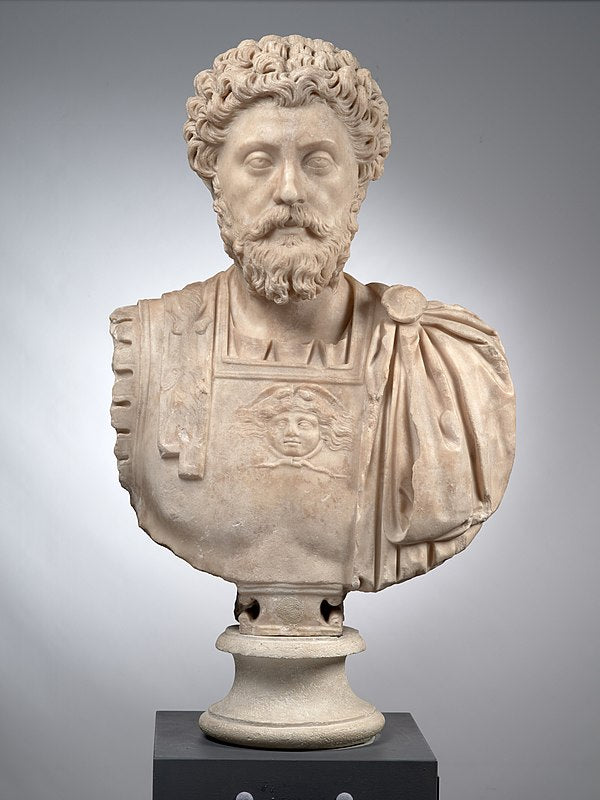
Marcus Aurelius
The private journal Marcus Aurelius kept for the last two decades of his life was written in Greek, titled To Himself, and never intended for publication. He was the Emperor of Rome — the most powerful man alive — and what he was writing was a series of reminders to himself about how to behave, how to think, and how to keep returning to what actually mattered when the pressures of his position pushed against all of it. The document we know as Meditations is that journal. It was found after his death and copied. He never gave it a title and never meant for anyone else to read it.
- Born: April 26, 121 AD, Rome
- Died: March 17, 180 AD, Vindobona (modern Vienna) or Sirmium (modern Serbia), age 58
- Era: Roman Imperial period; Late Stoicism
- Major works: Meditations (written c. 161–180 AD; published posthumously)
- Ruled the Roman Empire 161–180 AD; studied Stoic philosophy under Quintus Junius Rusticus, who introduced him to the works of Epictetus
He ruled during the Antonine Plague — a pandemic that swept the Roman Empire from approximately 165 to 180 AD, killing an estimated five to ten million people, with some estimates higher. Soldiers brought it back from campaigns in the east. It spread through the empire's road network. Marcus kept ruling. The Meditations were written during this period, alongside military campaigns against Germanic tribes on the northern frontier. The man writing about equanimity and the discipline of the mind was doing so while managing an empire in crisis.
What makes Meditations unlike almost any other philosophical text is its honesty about the difficulty of the practice it describes. Marcus is not writing for an audience he wants to impress. He is writing for himself, in the middle of the night, reminding himself of things he already knows and keeps failing to do. He loses his temper. He grows impatient. He returns to the practice. The whole document is the record of that return, over and over again.
Stoicism in his hands is not cold detachment. It is the daily discipline of returning to what matters: controlling the controllable, meeting adversity without flinching, choosing response over reaction. He believed these things because he had to — because his position gave him every excuse not to, and he knew it.
His words are for anyone under pressure — anyone rebuilding, anyone who needs a reminder that the obstacle and the path are sometimes the same thing. He was the most powerful man in the world, and he kept needing the same reminders you do.