
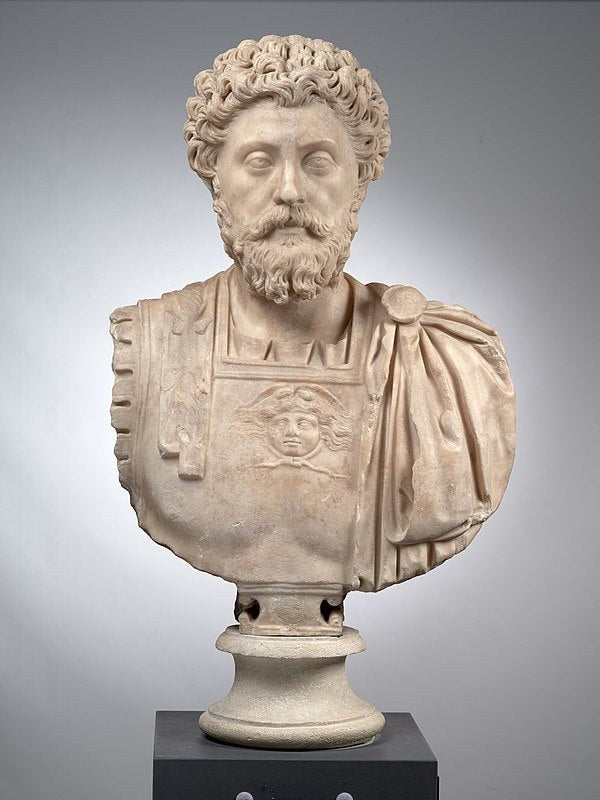
Did Marcus Aurelius Write "The Soul Is Dyed by the Thoughts"? Yes — Here's the Source
Verdict: Verified — both quotes. “…for the soul is dyed by the thoughts” is real: Marcus Aurelius, Meditations, V.16, George Long translation, 1862. “The cost of anything is the amount of life you exchange for it” is real: Thoreau, Walden, 1854. Both are on Quoteiac products. Here are the primary sources for both.
| Quote 1 | “…for the soul is dyed by the thoughts” |
| Author | Marcus Aurelius |
| Primary source | Meditations, V.16 — tr. George Long, 1862 (public domain) |
| Quote 2 | “The cost of anything is the amount of life you exchange for it” |
| Author | Henry David Thoreau |
| Primary source | Walden, 1854 |
| Verification status | ✅ Both verified — primary sources confirmed |
Earlier this week, on an episode of The Diary of a CEO with Steven Bartlett, Ivanka Trump paraphrased two lines that stopped us mid-listen. Not because of who said them on the podcast — because of who said them first.
The first: ...for the soul is dyed by the thoughts. The second: the cost of anything is the amount of life you exchange for it.
Both real. Both verified. Both sitting on Quoteiac products for exactly this reason.
The Soul Is Dyed by the Thoughts
Marcus Aurelius wrote this in Meditations, Book V, Section 16. The exact line, in George Long's 1862 translation:
"Such as are thy habitual thoughts, such also will be the character of thy mind; for the soul is dyed by the thoughts."
The Greek word is baptetai — literally, dipped. The same root as baptism. Aurelius wasn't reaching for a metaphor. He was describing a process he understood as mechanical: what you return to, repeatedly, in your mind is not neutral. It stains. It colors everything that comes after it.
The remarkable thing about this line is where it was written. Aurelius composed Meditations — all of it — in military camps on the northern frontier of the Roman Empire, during the Marcomannic Wars. He was commanding armies, managing a plague that was killing a quarter of the Empire, governing millions of people — and in private, in Latin, in a journal he never intended anyone to read, he was writing notes to himself about how to think correctly. Read about the man who wrote those notes — and why he wrote them privately.
Not philosophy for the public. Not an argument for posterity. Notes. Reminders. The same lines repeated, refined, returned to — because he kept needing to hear them again.
That context is what gives the dye metaphor its weight. He wasn't observing this from a comfortable distance. He was writing it in a tent at war, trying to keep his own mind clean under conditions designed to corrode it.
If you find yourself drawn to Marcus Aurelius, this is the line that earns the most return visits — and the one we put on our Soul of the Thoughts tee and journal.
The Cost of a Thing
Henry David Thoreau wrote this in Walden, in the opening chapter, "Economy." The exact line: Read where that line sits in the argument Thoreau built at Walden Pond.
"The cost of a thing is the amount of what I will call life which is required to be exchanged for it, immediately or in the long run."
Note the word Thoreau uses: life. Not time. Not money. Not effort. Life — the irreducible unit that all the others are just proxies for.
He wrote this in 1854, two years after leaving Walden Pond, having spent two years and two months in a cabin he built himself, tracking exactly what he spent and exactly what he received in return. The "Economy" chapter is essentially an audit — of money, of time, of the gap between what people say they value and what they actually trade their days for.
The question the line asks isn't abstract. It's practical. What are you paying, in life, for what you're getting? Is the exchange worth it?
Thoreau had his own answer — the woods, the deliberate reduction of expense, the hours that opened up as a result. Your answer doesn't have to match his. The question is the thing.
The line — "the amount of what I will call life" — is the one on our Cost of Living tee and journal. Browse the Thoreau collection if you find yourself coming back to that question.
The Eagle and the Crow
This one isn't Stoicism, isn't Thoreau — it surfaced in the same conversation as an analogy for how to handle harassment and provocation.
The image: a crow harasses an eagle in flight, diving and pecking, trying to provoke a fight. The eagle doesn't fight back. It doesn't descend to the crow's level. It rises — higher and higher — until the air thins and the crow, who cannot fly at that altitude, simply falls away.
The origin of this analogy isn't definitively traced — it circulates in various forms across different traditions, which is part of what makes it interesting. The image itself does the work. The crow's harassment only has power at the crow's altitude. Change the altitude, and the attack becomes irrelevant.
It's not Stoic doctrine, but it rhymes with Stoic thinking: the Stoics were obsessed with the distinction between what is yours to control and what isn't. A crow's behavior isn't yours. Your altitude is.
Why These Lines Travel
Both the Aurelius and the Thoreau lines get paraphrased constantly — in podcasts, speeches, books, Instagram bios — usually without the source. Sometimes without the author. The paraphrase travels further than the original because it's been compressed for speed.
But the original is always better. "The soul is dyed by the thoughts" lands harder than any cleaned-up version because dyed is the word — permanent, physical, the result of repeated immersion. And "the amount of what I will call life" is Thoreau being precise about something people usually blur past.
The full sentence stops you. The paraphrase lets you move on.
That's the difference between hearing a quote on a podcast and sitting with the original text. One is a signal that something worth knowing exists. The other is the thing itself.

