Walden Was an Experiment. Thoreau Published the Data.
On July 4, 1845, Henry David Thoreau moved into a small cabin he had built himself on the shore of Walden Pond in Concord, Massachusetts. He stayed for two years, two months, and two days. He was not on vacation. He was running an experiment — and he kept detailed records.
Walden, or Life in the Woods is the published data from that experiment. Not a memoir, not a nature journal: a methodical account of what it costs to live, and what you get in return.
The Setup
Thoreau was 27 when he moved to the pond. He borrowed an axe, cut timber on Emerson’s land, and built a 10-by-15-foot house for $28.12½ — he lists every expense in the first chapter. He grew beans and tracked what the crop returned against what the labor cost. He recorded the date the ice went out on Walden Pond each year. He timed how long it took to earn enough to cover his food, shelter, and clothing. The full story of the man who lent him the land and the philosophy behind the experiment is worth knowing separately.
He was answering a specific question: how much of your life does a life actually require?
“The cost of a thing is the amount of what I will call life which is required to be exchanged for it,” he wrote in the chapter called Economy. That’s not a metaphor. That was the hypothesis. The two years at the pond were the test.
The Method
Thoreau wasn’t naive about what he was doing. He lived less than two miles from Concord center. He walked to town regularly. His mother did his laundry. He knew this, and he said so — Walden is unusually honest about its own conditions, which is part of what makes it a record rather than a fantasy.
What he was testing wasn’t solitude. He was testing the assumption that the way most people arranged their working lives was the only way, or the best way. He was running a controlled comparison: here is what a life costs when you reduce it to what it actually requires. Here is what remains.
What remained, in his accounting: time. Time to read, to think, to walk, to observe the pond in every season. Time to write the book itself, which he revised for eight years before publishing in 1854.
The Data
Walden was not immediately celebrated. It sold modestly in Thoreau’s lifetime — fewer than 1,800 copies before he died in 1862. The experiment didn’t produce a bestseller. It produced a record.
That record has outlasted almost everything published in American letters in 1854.
“I went to the woods because I wished to live deliberately,” Thoreau wrote, “to front only the essential facts of life, and see if I could not learn what it had to teach, and not, when I came to die, discover that I had not lived.”
That sentence is still the clearest articulation of a question a significant number of people are still trying to answer — not as escapism, but as methodology. What does your life actually require? What does the rest cost you?
Why It Holds
Thoreau is cited regularly in the conversation about deliberate living, slow culture, and the calculation of time-versus-income that the internet has made newly legible. He’s often reduced to a motivational poster. The poster version leaves out the ledger.
The ledger is the point. Walden works as literature because it works as argument — it makes a specific claim, supports it with specific evidence, and leaves the reader to apply the method to their own conditions. Thoreau didn’t say his answer was the right answer. He said the question was worth asking, and he showed his work.
The book is on Project Gutenberg. It’s 200 pages. The first chapter alone — Economy — is a 50-page financial audit of one year of a human life. It’s worth reading as a primary source, not a quote feed.
Quoteiac carries Thoreau pieces in The Quiet Mind collection and across the Thoreau catalog. Every line traces back to the text. The Walden quotes Thoreau actually wrote are more interesting than the ones he’s routinely credited with online — and more useful, because they’re specific enough to mean something.
The experiment ran for two years. The record has been in print since 1854.
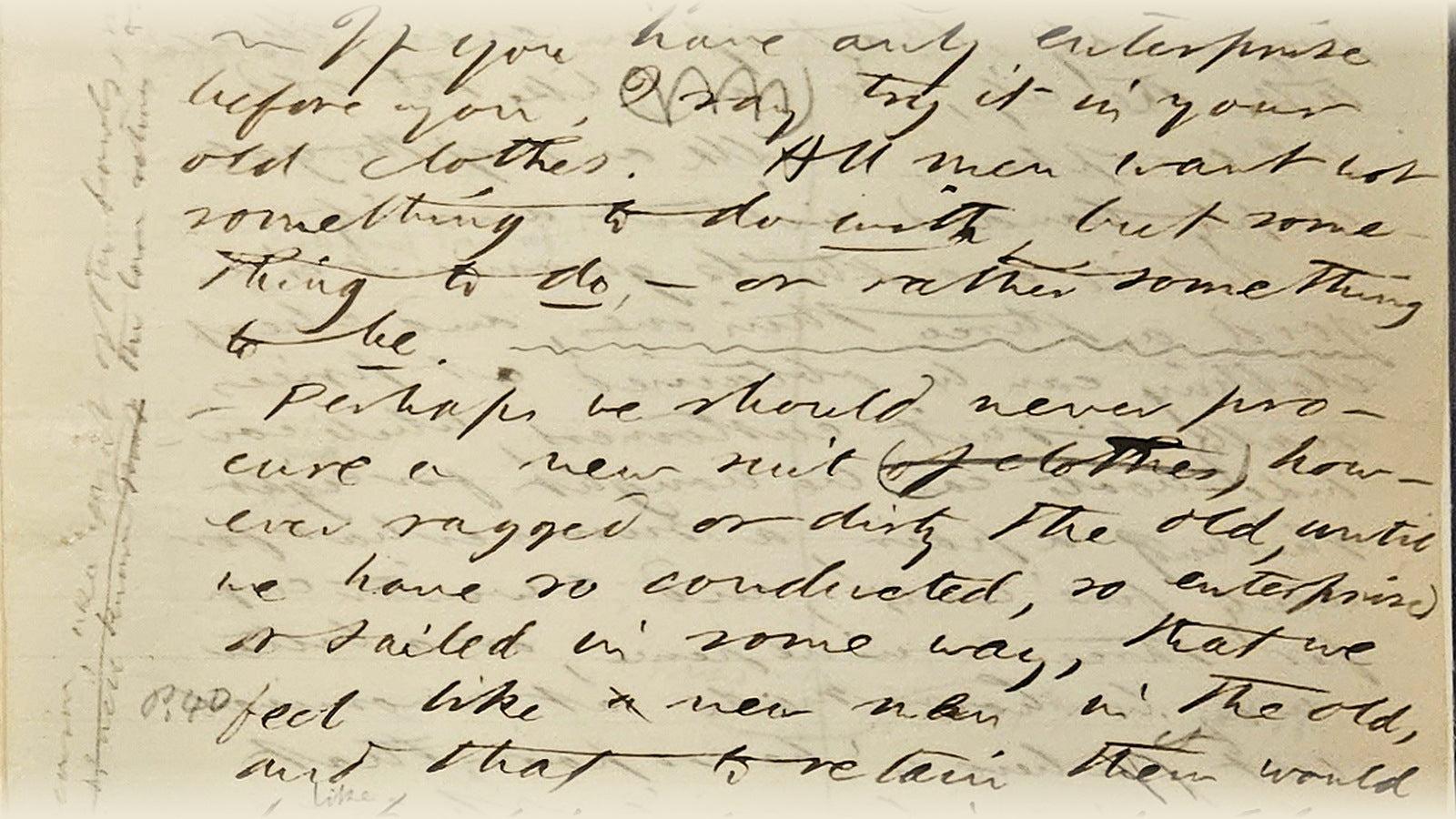
A draft page of Thoreau’s manuscript for Walden, held at the Houghton Library, Harvard. Public domain.
The Verification Desk traces every quote to a primary source before it’s printed or published.