The Object That Holds the Thought
Quote objects — mugs, phone cases, journals, tumblers — work through a mechanism that is distinct from wearing a quote on a shirt. The difference is the encounter: you choose to put on a tee, but you simply pick up your phone. The Roosevelt quote on the case is there before you have decided to read it. That involuntary, repeated encounter is how objects become associated with ideas — not through intention, but through accumulation.
There is a term in behavioral psychology for this: incidental exposure. Unlike deliberate reading or active recall, incidental exposure works because you are not trying. The idea enters sideways, while you are doing something else. Over time, the association strengthens. The object becomes a cue not because you instructed it to, but because it showed up every time.
THE INVOLUNTARY ENCOUNTER
Consider the difference between a sticky note and a phone case.
You write something on a sticky note. You put it on your monitor. For two days it works. Then it becomes wallpaper — your brain stops registering it because the context hasn’t changed. Neuroscientists call this habituation: the nervous system filters out stimuli that remain constant and non-threatening. The note is still there. You stopped seeing it the moment it became familiar.
A phone case is different. Every time you pick up your phone, you are doing something slightly different — checking a message, switching apps, putting it in your pocket, setting it on a table. The context changes constantly. The quote is the one constant. And unlike the sticky note, you didn’t decide to look at it.
The quote finds you. That’s the mechanism.
THE RITUAL OBJECT
A mug is not just a container. If you use the same mug every morning, it becomes part of a ritual — and rituals are among the most effective behavioral anchors we have. The sequence is fixed: you make the coffee, you reach for that specific mug, you sit down. By the time you pick it up, your brain is already in a particular state. If the mug carries a line from Marcus Aurelius or Epictetus, that line is encountered not in isolation but as part of a daily practice you have already, unconsciously, reinforced.
The Stoics understood this better than most. Aurelius didn’t just write his notes to be read once — he wrote them to be returned to. Meditations is a practice document, not a treatise. Book IV opens with the instruction that “the universe is transformation” and Book X with the demand to stop talking about virtue and simply be virtuous. These are not arguments to be settled. They are reminders to be repeated.
An object that carries that kind of line becomes, over time, a portable version of that practice.
THE PHONE CASE AS DAILY ARGUMENT
You pick up your phone between 80 and 150 times a day. That is the research estimate for average users — and even the lower end of that range means you encounter whatever is on your phone case several hundred times a week.
Roosevelt’s “…who at the worst, if he fails, at least fails while daring greatly” appears on the Man in the Arena phone case. Not the whole passage — the hinge. The line that separates the person who stepped in from the person who watched. Roosevelt gave that speech at the Sorbonne in 1910, the year after leaving the presidency, coming back from fourteen months in Africa. He had been in the arena for thirty years. He wasn’t theorizing.
That context travels with the object. It doesn’t need to be re-read every time. After the first few weeks, the line and the context have merged. You pick up your phone and the argument is already in the room.
Oscar Wilde’s “The truth is rarely pure and never simple” is eight words from Act I of The Importance of Being Earnest, 1895. On the Wilde phone case, the enso wraps the quote and continues around the sides of the case — the circle doesn’t end at the edge. Every time you pick it up, you’re holding the argument at the same moment you’re about to simplify something.
THE TUMBLER AND THE RETURNING IDEA
A tumbler is a different kind of object. You don’t glance at it the way you glance at a phone case — you hold it. The encounter is longer, warmer, more physical. If you drink coffee or water from the same vessel every day, the associated idea has more time with you.
Rilke’s “I live my life in circles that grow wide and endlessly unroll” is on the Life in Circles tumbler. He wrote The Book of Hours between 1899 and 1903, in three separate bursts. Not a planned expansion — he kept coming back. The poem grew by returning. The warm burnished arcs on the tumbler don’t close into full rings; they keep opening. You hold the tumbler, and the circles are still moving.
That is a different relationship with a quote than reading it on a wall. A wall holds the quote at a distance. An object that you hold, fill, wash, and reach for again in the morning is inside the rhythm of the day in a way a print never is.
THE JOURNAL AND THE CONVERSATION
A journal is the most collaborative of the object types. A phone case carries the quote for you. A mug presents it to you. A journal asks you to sit next to it.
The Epictetus “He Is Free” journal carries the line from Discourses IV.1 — “He is free who lives as he wishes” — on the cover. Every time you open it to write, that line is the last thing you saw before the blank page. Epictetus opened Book IV with this sentence and spent the next chapter dismantling every easy reading of it. He was not talking about freedom as license. He was talking about the freedom that comes from having stopped being ruled by fear, by craving, by what other people think. He knew what he was saying. He’d been a slave.
Writing in a journal that carries that line is not the same as writing in a plain notebook. The frame changes what enters it.
THE DIFFERENCE BETWEEN WEARING AND LIVING WITH
Wearing a quote is a declaration — you put it on and walk into the world with it. An object is an accumulation. The declaration is active and outward. The accumulation is quiet and inward.
Both work. They work differently.
The tee is the flag. The mug is the practice.
What the object offers that apparel doesn’t: you use it alone. No one sees your mug at 6am. No one sees the quote on your phone case while you’re in the kitchen. The encounter is private. That’s where some of the most durable behavior change happens — not in public declarations but in the daily, unobserved return to something you believe.
HOW TO CHOOSE THE OBJECT
The question is not which product. The question is which line — and which context in your day you want it to inhabit.
If you pick up your phone as the first thing in the morning, the phone case encounters you at the most malleable moment. If you sit down to work with coffee, the mug is in the room for the whole session. If you write every day, the journal carries the line into every entry.
The only requirement: the quote has to be real. Not a paraphrase. Not a misattribution. The weight of the object depends entirely on the weight of what it carries. Every quote on a Quoteiac product is traced to a primary source — the original document, not a quote aggregator’s copy of a copy. See also: what makes a quote worth carrying in the first place.
Browse Objects — Things to Live With: mugs, journals, tumblers, phone cases. Or start with the collections built around a single idea: Stoic Wisdom, The Heretics, Dark Romanticism.
The quote finds you. The object just keeps showing up.
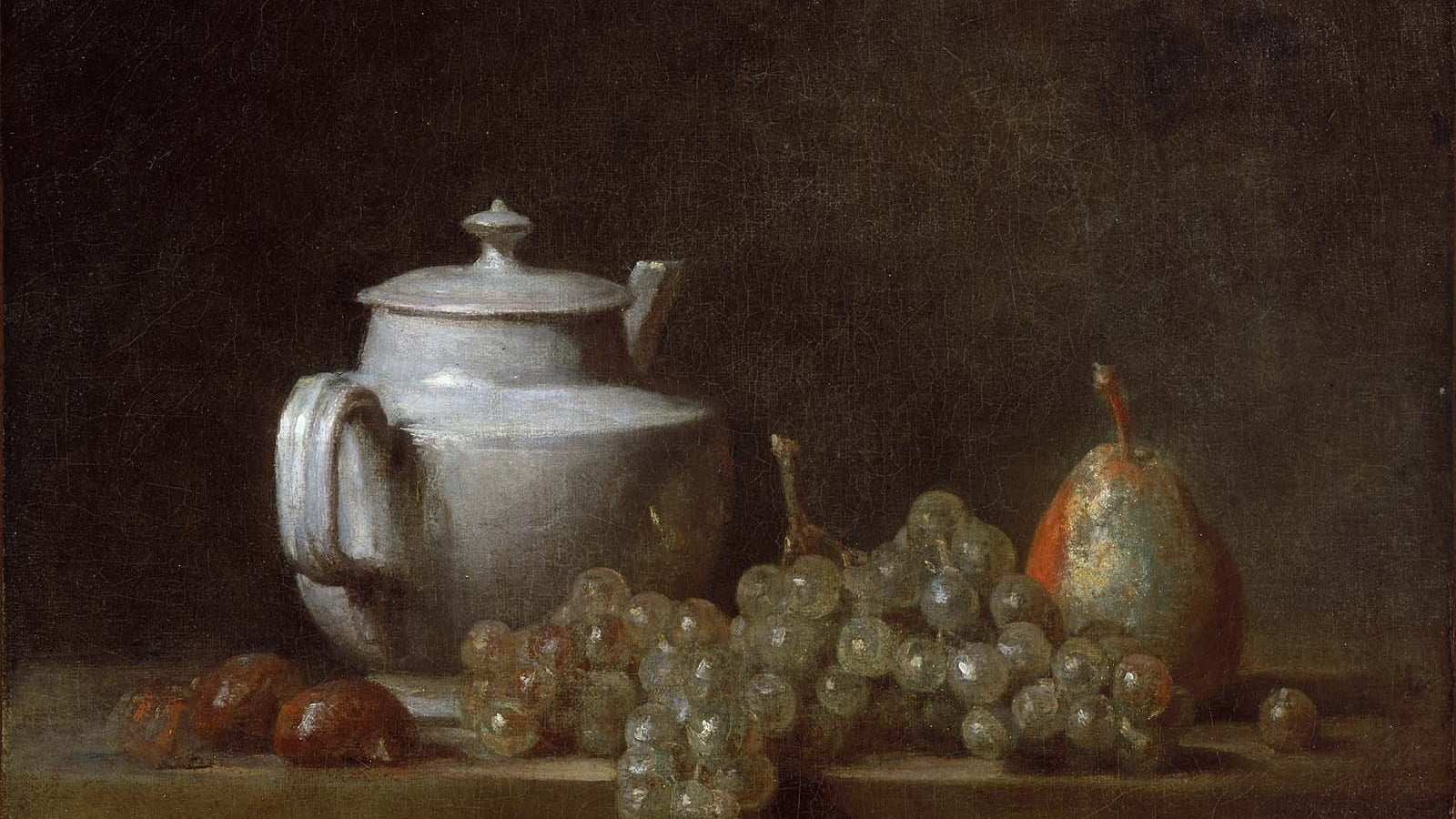
Image: Jean-Baptiste-Siméon Chardin, Still Life with Teapot, Grapes, Chestnuts, and a Pear, c. 1760. Oil on canvas. Museum of Fine Arts, Boston. Public domain. Chardin (1699–1779) spent his career painting the objects of ordinary domestic life — pots, jugs, fruit, the things people handle every day without thinking about them. He is considered the greatest still-life painter of the 18th century and one of the finest in Western art history. This painting has been in the MFA Boston collection since 1883.