Kintsugi as Philosophy: What Broken Things Know
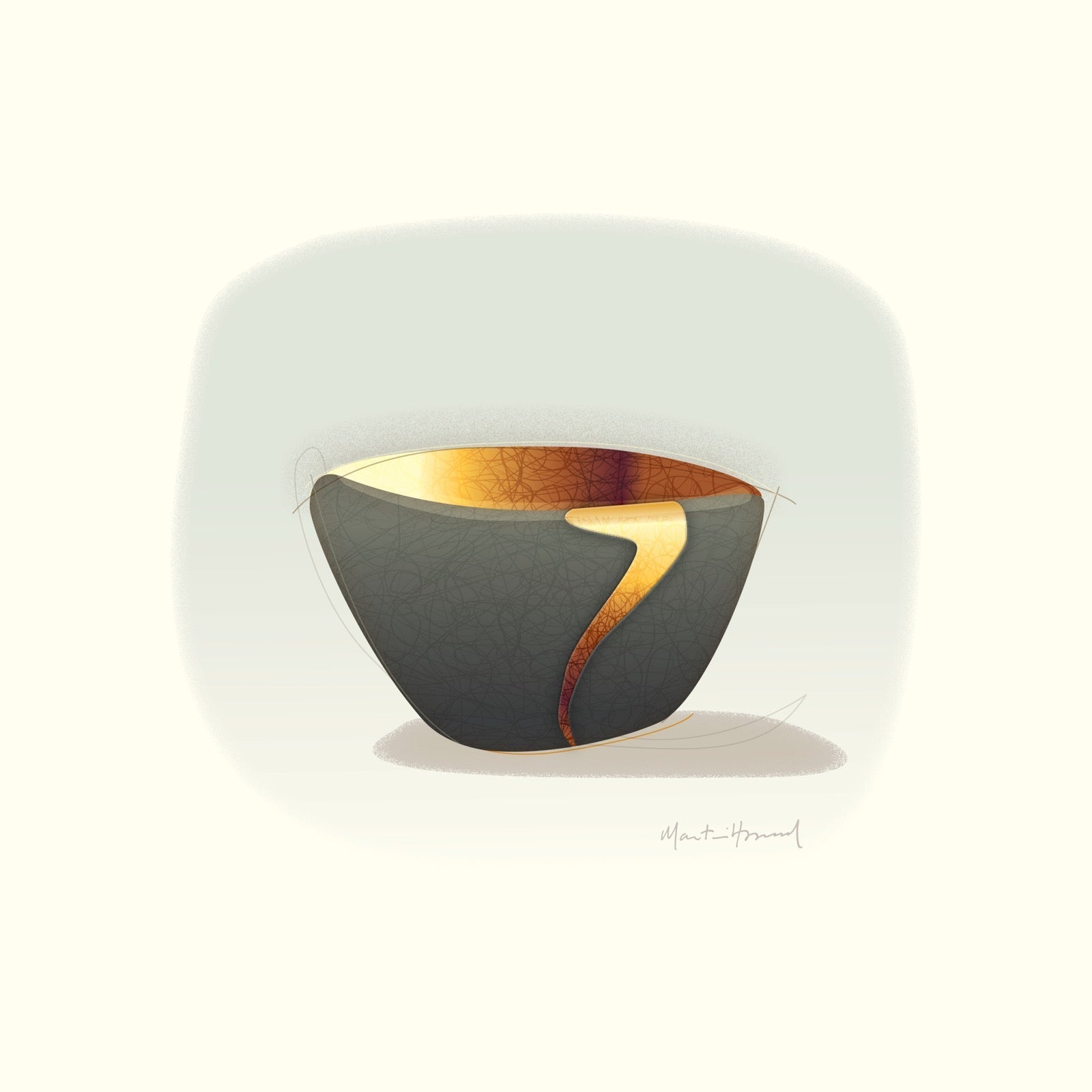
Kintsugi (金継ぎ, meaning 'golden joinery') is a Japanese ceramic repair technique originating in the late 15th to early 16th century, in which broken pottery is reassembled using lacquer mixed with gold, silver, or platinum powder — a method that makes fracture lines the most visible feature of the finished object, treating damage as inseparable from, and constitutive of, the object's full history.
The technique does not restore a vessel to its pre-break appearance. That is the point. A kintsugi bowl is not a repaired bowl in the usual sense — it is a different object than it was before, one whose biography is now legible on its surface. The gold seam runs where the crack ran. The repair is not camouflage; it is annotation.
The Mechanics of Visible Repair
A practitioner begins with the fragments and a base of urushi lacquer — harvested from the Toxicodendron vernicifluum tree, the same resin used in Japanese lacquerware for centuries. Mixed with powdered gold or silver, the paste binds the broken edges and, once cured and polished, hardens to a surface more structurally resilient than the original ceramic. The repair is stronger than the clay. The seam outlasts the surrounding material.
This matters philosophically because it inverts the usual hierarchy of damage and wholeness. Most repair strategies aim to make the break invisible — to return the object to an unmarked state. Kintsugi operates on the opposite premise: that the break is where the object's meaning accumulated. Concealing it would be a kind of erasure. The gold does not hide the fracture; it illuminates it.
The aesthetic lives inside the wabi-sabi tradition — a Japanese sensibility that finds value in impermanence, asymmetry, and the evidence of use. Tea ceremony culture, which shaped the aesthetic standards of late Muromachi and early Edo Japan, valued bowls that showed wear. A tea bowl that had never been dropped had never been used. A kintsugi bowl had been dropped, recovered, and marked by that recovery.
The Break as the Moment of Discovery
Henry David Thoreau described the experience in Walden’s eighth chapter, “The Village,” walking home from Concord late at night through dark woods, navigating by feel alone. In Walden, he wrote: “Not till we are lost … do we begin to find ourselves…” The phrasing is precise. Not after we are lost. Not despite being lost. Until — meaning the loss is the condition, not the obstacle. The disorientation is the mechanism.
That convergence — between a 15th-century Japanese repair technique and a 19th-century American naturalist — is not coincidence. Both observations identify the break as the site of meaning. Neither romanticizes damage; both insist it be acknowledged rather than smoothed over. The fracture is where the object, or the person, became something other than what they were.
Our piece Henry David Thoreau on Getting Lost to Find Yourself examines how that passage from Walden earns its staying power — not through consolation, but through clarity about what disorientation actually does.
Wearable Provenance
The Quoteiac argument draws on the same logic kintsugi uses. A quote worn on a body carries different weight depending on how it was found. One chosen for aesthetic appeal — the right font, a pleasing cadence — remains decorative. One earned through a specific difficulty becomes something closer to a mark. The wearer knows what it cost to understand it.
The Gold Seam takes its name directly from the kintsugi tradition — the visible repair line as the object's most honest feature. The Thoreau passage printed on it is not chosen for warmth. It is chosen because it accurately describes a specific experience: the moment before clarity, when the familiar coordinates have dropped away. People who have been there recognize it. People who haven't, don't — and that distinction is part of the garment's function.
The Art of Being Wise tee works within the same logic — wisdom as the product of what has been worked through, not what has been absorbed passively. On the material itself, the journal entry on why Quoteiac uses organic cotton covers why provenance extends to the shirt as well as the words on it.
Kintsugi does not argue that breaking is desirable. It argues that what breaks and is repaired is not diminished by the break. The gold seam is evidence of the repair, not an apology for it. A garment carrying a quote earned through difficulty operates the same way — the difficulty is part of what makes the words accurate, which is part of what makes them worth wearing.
The bowl was dropped. The seam runs where the crack ran. The gold holds.