What Stoicism Sounds Like When It’s Quiet
Stoicism — the Greek philosophical school founded by Zeno of Citium around 300 BC and developed by Epictetus, Marcus Aurelius, and Seneca into the most practiced philosophy of the Roman Empire — has accumulated a modern commercial aesthetic that would have puzzled all three of them: distressed typefaces, barbell photography, and MEMENTO MORI across a torso. The actual Stoic literature is quieter than that, and more demanding. This article is about what it sounds like when you read it without the branding.
You know the aesthetic. Distressed MEMENTO MORI across a torso. A bust of Marcus Aurelius next to a barbell. Threads quoting Meditations the way a CrossFit gym quotes Goggins. Stoicism, in the popular telling, has become a productivity system for men who want to wake up at 4 a.m.
That isn’t Stoicism. That’s the cosplay.
Real Stoicism was a philosophy of grief, mortality, and the radical interdependence of human beings. It was practiced by an emperor who wrote in private notebooks he never expected anyone to read, and by a senator who was eventually ordered by a paranoid emperor to slit his veins in the bath.
Neither of them was optimizing.
This post is for the readers who came to Stoicism through Ryan Holiday, picked up the Loebs, kept reading — and noticed the originals are quieter than the gym tees. Holiday’s a careful reader; the bumper-sticker version is not him. The bumper-sticker version is what you get three steps downstream of him, when the algorithms have stripped the nuance out and what’s left is the slogan.
The Stoic Wisdom collection is for the steps before that strip-down.
Seneca, who knew about time
Seneca is the Stoic the gym tees skip. There’s a reason. See also: what Seneca actually wrote about time and attention — letter by letter.
The popular Stoicism market wants discipline-bro content. Seneca writes about time — how it slips, how we waste it on people who don’t deserve it, how we postpone the actual living until the actual life is over. He writes about friendship, retreat, sleeplessness, the texture of being alive. He writes the way a tired adult writes when they’ve stopped pretending they have everything figured out.
Eight of the ten quotes in our Seneca lineup come from his Letters from a Stoic — letters he wrote to a friend named Lucilius near the end of his life, knowing the emperor would eventually come for him. They are the most human Stoic documents we have. They are also, as it happens, the ones that make you stop scrolling.
A few of the lines we put on tees:
The Quiet Torment Tee — We suffer more often in imagination than in reality. This is Seneca on anxiety, eighteen hundred years before the word existed. The mind generates a constant background hum of catastrophic forecasting, and most of it never comes true. The cost of that hum, measured in actual suffering, is enormous. Anyone who has ever lain awake at 3 a.m. knows exactly what he’s describing.
Life Speeds By Tee — while we are postponing, life speeds by. Letter I. The hardest single sentence in the Letters, and possibly the truest. He’s not saying seize the day. He’s saying you are giving your days away, in small unnoticed pieces, and one morning you’ll look up and they’ll be gone.
Time Alone Tee — everything is alien to us; time alone is ours. Also Letter I. He’s serious. Money, possessions, even relationships — none of those are yours, in the deepest sense. Time is. And you’re spending it.
Retire Into Yourself Tee — retire into yourself, as much as you can. Letter VII. The Stoic case for solitude, written by a man who knew exactly how exhausting other people can be. Not a hermit’s manifesto. A working philosopher’s permission slip to close the door.
Everywhere Is Nowhere Tee — one who is everywhere is nowhere. Letter II. Seneca on attention. He’d have understood your phone perfectly.
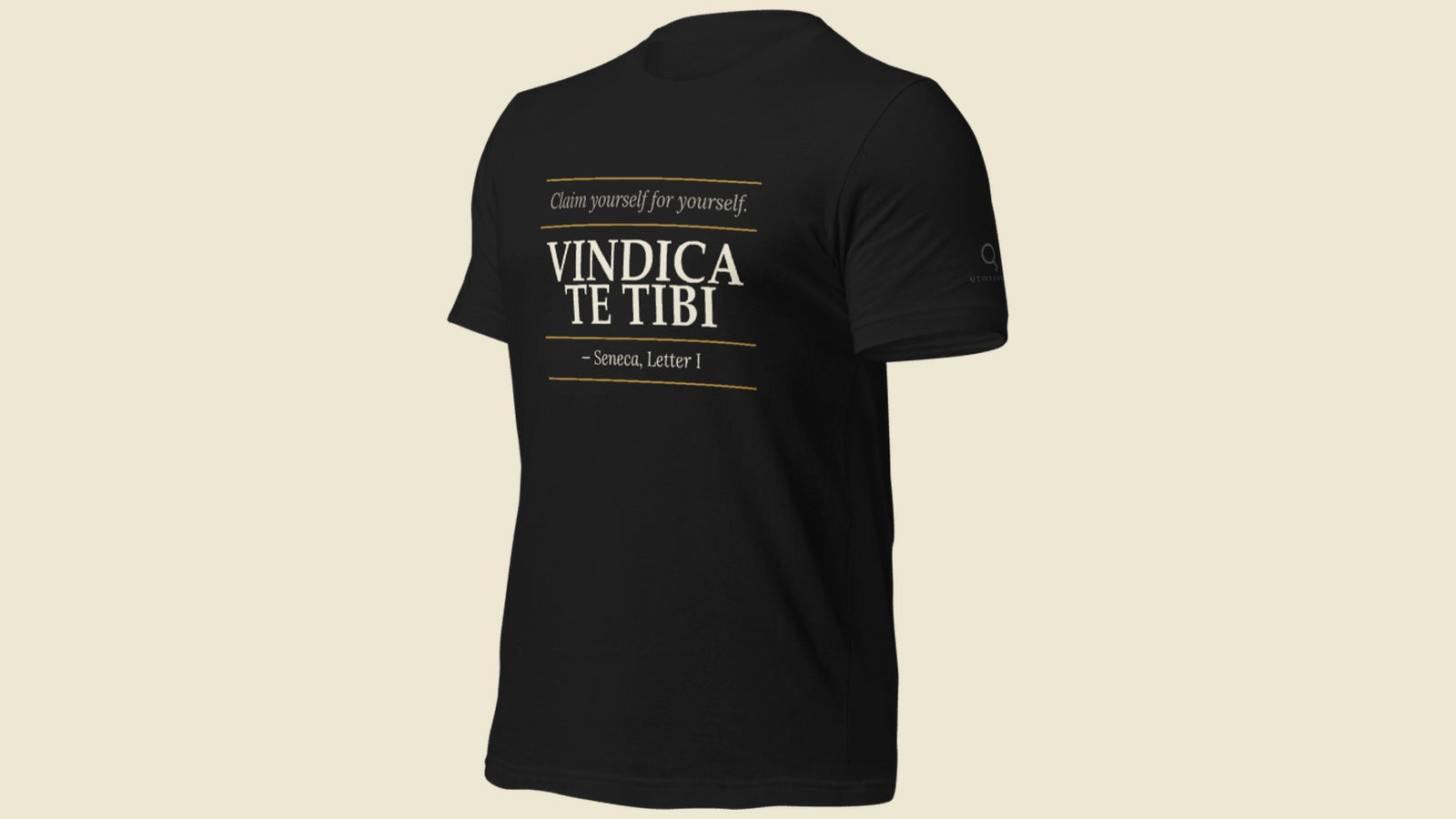
Claim Yourself Tee — claim yourself for yourself. Letter I again. Vindica te tibi. (More on the Latin in a minute.)
These are the lines we lead with because these are the lines that hold up. They aren’t motivational. They’re observational. The man is paying close attention to his own mind and reporting honestly. That’s a different aesthetic than grind harder, and it makes a different kind of garment. See also: Rilke on the same discipline — from a different tradition.
Marcus, who was tired
Marcus Aurelius wrote Meditations in private. He never published it. He never named it. The book we have is a series of notes a Roman emperor wrote to himself, in Greek, while running a war on the Danube frontier and watching his soldiers die of plague. He was trying to keep his mind from breaking. The text is a record of a man under enormous pressure, talking himself into staying sane. See also: the biography of the man who wrote those notebooks.
That’s the part the bro version skips. The struggling. The repetition. Marcus repeats himself constantly because he keeps forgetting his own advice — which is what makes the book feel real, eighteen centuries later. He sounds like a person, not a brand.
Our Marcus lineup includes the journal and tee for for the soul is dyed by the thoughts, the no opinion tee, the waste no more time arguing what a good man should be mug and tee — and The Quality Tee, which we particularly like for the anti-hustle case.
The soul is dyed by its thoughts.
This is the line that ends the entire bro reading. Quality of thoughts is the opposite of grind. It’s the opposite of output. It’s the opposite of 5 a.m. routine. What Marcus is saying — what the actual emperor is saying, in private, to himself, in the middle of a war — is that the only durable lever you have on your own life is the texture of what’s running through your head when no one is watching.
That isn’t a productivity tee. That’s a much harder ask.
The Latin treatments, and a small confession
Several of the Seneca pieces include the original Latin. Vindica te tibi. Non est ad astra mollis e terris via. This is rare in apparel. There’s a reason most quote brands skip it.
I should explain how I ended up here.
I took Latin in high school. Not because I had any plan to use it. I took it because Mrs. Whoever-it-was offered a class trip to Nashville, Tennessee, to tour the full-scale replica of the Parthenon. (Yes, that exists. Yes, I know it's Greek. It is in a park. It is, against all reason, glorious.) I wanted to see the Parthenon. I took two years of Latin to earn the trip. Worth it.
What I didn’t expect — and what I doubt my fifteen-year-old self could have articulated — is that Latin has a density English doesn’t. Vindica te tibi is three words. The closest English translation is claim yourself for yourself, which is five, and it still loses something. The Latin has the compression of a command and the intimacy of a whisper at the same time. Vindica means more than claim — it carries the legal sense of win back what is rightfully yours, the way you’d claim a prisoner of war or recover stolen property. Te tibi — yourself for yourself — does something English can’t do without sounding redundant.
When you put VINDICA TE TIBI on a tee, with Claim yourself for yourself in italic above it as the English gloss, you are asking the wearer to carry both versions. The Latin is the muscle. The English is the meaning. Together, they are the line.
The same is true of the Ad Astra Tee — non est ad astra mollis e terris via, there is no easy way from the earth to the stars. That phrase comes from one of Seneca’s tragedies, Hercules Furens. The Latin is the inscription. The English is the door into it. The wearer who knows Latin reads both. The wearer who doesn’t reads the English first, then notices the Latin underneath, and one day looks it up.
That’s the bet. The bet is that some readers want a quote that doesn’t give itself up immediately. That a small puzzle, in a dead language, on a black tee, is worth more than another printed slogan in the only language everyone already speaks.
If you took Latin once, you understand. If you didn’t, this is how you start.
Why our pieces don’t look like the bro tees
A few specific choices, since this is what makes the difference visually:
- No iconography. No busts, no laurel wreaths, no Spartan helmets, no skulls. The text is the design. The typography carries the meaning. We treat each line like a page from a book, not a graphic for a gym.
- Cream and copper, not black-on-black distressed. The Quoteiac palette stays consistent across the Stoic Wisdom collection. Cream type, near-black ground, copper accents only where the composition calls for them. It reads as serious without leaning costume.
- Attribution on the garment. Seneca, Letter I. Seneca, Letter II. Seneca, Letter VII. The book and the location, on the tee itself. Not because anyone has asked. Because we’d rather over-deliver on attribution than under-deliver.
- No memento mori. Not yet, anyway. The phrase has been so flattened by the gym crowd that we’d rather hold it back than print a version that gets read as grind harder, you’ll die. When we do it, it’ll respect the original frame. Probably without the tank-top font.
Who this stuff is for
If you’ve read Meditations and noticed it’s mostly a tired man writing reminders to himself that he’s tired —
If you’ve read Seneca and felt the slight queasiness of recognizing your own avoidance —
If you’ve worked your way through Holiday and kept going past him —
Then the Stoic Wisdom collection is for you, and the bro tees aren’t.
The Stoics didn’t write any of this so they could end up on a tank top with a barbell silhouette. They wrote it because they were trying to live, and the living was hard, and they wanted to leave behind something useful for the next person trying to live.
We just try not to embarrass them on the way to the printer.
The Stoic Wisdom collection features verified quotes from Seneca and Marcus Aurelius, set in cream and copper on near-black cotton. Every translation is sourced. Every Latin original is intact. Every attribution is checked. No 4 a.m. wakeup required.