The Philosophy of Kintsugi and the Ensō: Why Imperfection Is the Point of Good Design
Western industrial design is obsessed with flawlessness: seamless surfaces, hidden fasteners, and the total suppression of how an object was made. Two foundational Japanese aesthetic concepts—kintsugi and ensō—argue the exact opposite: that fracture, repair, and the uncorrected brushstroke are not defects to conceal, but vital information to preserve.
Kintsugi does not disguise the break; it makes the repair the focal point.
Primary Aesthetic Concepts & Provenance
- Kintsugi (金継ぎ, "golden joinery"): The 15th-century Japanese art of repairing fractured ceramics using natural urushi lacquer dusted with powdered gold, silver, or platinum. Rooted in the wabi-sabi (侘寂) philosophy of impermanence, kintsugi treats an object's history of breakage and renewal as constitutive of its beauty, not a subtraction from it.
- Ensō (円相, "circle of togetherness / mutual form"): A single uninhibited brushstroke executed in one continuous breath within Zen calligraphy. Practiced for centuries by Zen monks, the circle may be left open (allowing for continuous growth) or closed (representing complete containment). Neither is an error; the stroke captures the unrepeatable state of mind at the moment of creation.
What Kintsugi Actually Is: The Record of Testing
The practice is physically simple yet philosophically radical: a broken vessel is reassembled with tree-sap lacquer and illuminated with gold powder. The seams are not disguised under paint. They trace across the surface in bright metallic veins, announcing exactly where the object failed and exactly how it was restored.
The crack is data. An object that has never broken has never encountered resistance. Its repair history adds narrative weight and resilience. Where conventional manufacturing uses factory finishing to imply an object appeared out of nowhere without history or labor, kintsugi honors the event of fracture and the intentionality of restoration.
What the Ensō Actually Is: The Unrepeatable Stroke
The ensō is drawn in a single continuous breath. Once the ink hits the paper, the brush does not stop, adjust, or correct.
A mechanically perfect circle is the output of a compass or a digital vector tool. The ensō is distinctly human: its variations in line weight, its bristles feathering on the paper, its asymmetry, and its gap prove that a conscious mind was present in real time. It embraces the unrepeatable present over sterile perfection.
An open ensō leaves space for movement, infinite possibility, and the unfinished nature of existence. A closed ensō represents total presence and wholeness. Neither form is superior—they are two distinct ways of marking how a disciplined mind occupies time.
Western Thinkers Working in the Same Framework
Kintsugi and ensō are not mere decorative motifs imported for visual styling; they provide a precise visual grammar for ideas Western writers wrestled with independently.
In his 1907 lecture What Pragmatism Means, William James dismissed rigid philosophical systems that demanded flawless perfection before they could function. Pragmatism is structurally kintsugi: it takes fractured, messy human experience and builds functional truth out of what works. When James noted that "The art of being wise is the art of knowing what to overlook," he was pointing to selective focus—valuing what is durable and functional over what is pristine. The Art of Being Wise Tee makes this alignment visible: the golden fracture is the argument itself.
Rainer Maria Rilke's opening poem from The Book of Hours (1905) mirrors the geometry of the ensō. In Anita Barrows and Joanna Macy's translation, he writes: "I live my life in widening circles / that move out over the things of the world." Each concentric circle of experience widens outward without snapping into a sterile, closed loop. The Life in Circles Tee and Life in Circles Tumbler carry this exact structure—the visual stroke of an expanding, imperfect loop reflecting the text.
At Walden Pond, Henry David Thoreau carried out a deliberate experiment in kintsugi on 19th-century life. He took the fractured conventions of inherited debt, industrial work, and social posturing, and refused to live inside them without exposing the seams. In Walden, he wrote: "Not till we are lost, in other words, not till we have lost the world, do we begin to find ourselves." The Find Ourselves Tee embodies the open stroke of deliberate disorientation, while the Gold Seam Tee renders the metaphor concrete—Walden was the fracture line that made an authentic life visible.
These writers did not copy Japanese philosophy; they arrived at identical conclusions from different traditions. Kintsugi and ensō simply give those universal insights their cleanest visual form.
Inside the Zen Philosophy Collection
The Zen Philosophy Collection is not a shallow mood board. It is a series of deliberate design choices built on a single premise: the marks of living, thinking, and repairing are the actual work. Every piece in the collection pairs a verified literary text with a structural design logic already present in the author's thought.
Explore the Zen Philosophy Collection →
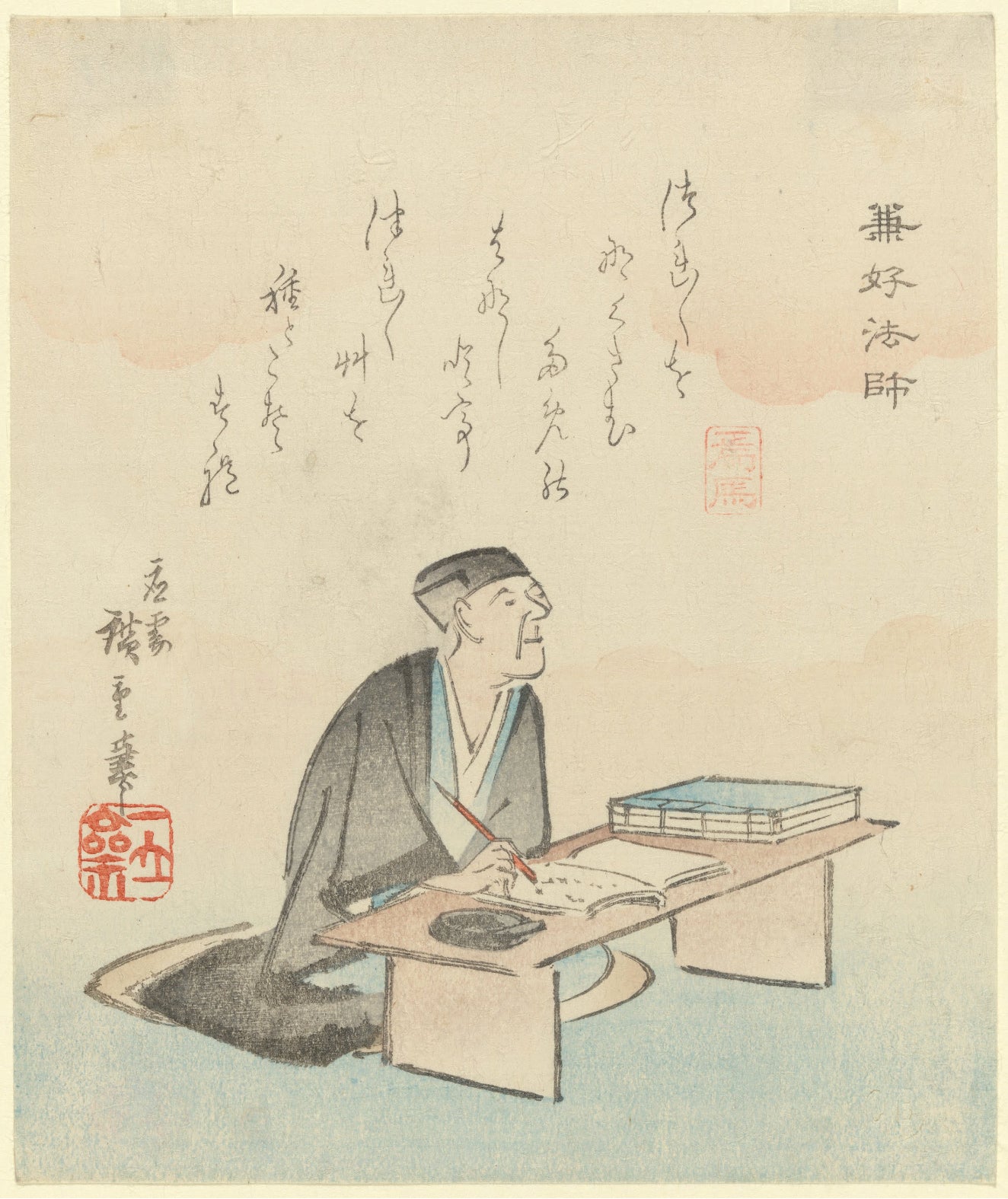
Utagawa Hiroshige, Yoshida Kenkō (兼好法師), c. 1840s. Chester Beatty Library, Dublin. Kenkō's Tsurezuregusa (Essays in Idleness, c. 1330) is the closest Japanese equivalent to Montaigne's Essays — an essayist working in the same fragmentary, observation-first form, three centuries before they arrived at the same conclusion independently. Public domain.