Michel de Montaigne and the Lost Art of Being Contradicted
Michel de Montaigne finished Of the Arte of Conferring — Book III, Essay 8 of Les Essais — in 1588. The essay is about disagreement. Not corporate conflict resolution, not polite civility, and not how to de-escalate an argument. It is an unsparing analysis of why real intellectual dialogue is so rare, and why most people are terrified of being contradicted.
The central argument turns on a single observation:
"When any one contradicts me, he raises my attention, not my anger."
— Michel de Montaigne, Of the Arte of Conferring, Book III Essay 8, Les Essais (1588), tr. Charles Cotton, 1685–86
Primary Source Citation
- Author: Michel de Montaigne (1533–1592)
- Work: Les Essais, Book III, Chapter 8 (De l'art de conferer)
- First Publication: 1588
- Translation quoted here: Charles Cotton, 1685–86
- Earlier English rendering: John Florio, 1603, as Of the Arte of Conferring — "When I am impugned or contraried, then is mine attention and not mine anger, stirred up"
- Core Theme: Intellectual rigor, conversational vanity, and cognitive resilience
What the Essay Actually Argues
Montaigne's point is that most people enter an argument simply to win. They treat disagreement as a zero-sum contest where the objective is to defend territory rather than discover what is true. Contradiction produces defensiveness, not attention. It fuels the vanity of being right instead of the curiosity to find out whether you are mistaken.
He considered this a fundamental failure of thinking.
Writing from the tower library of his estate in Périgord, thirty miles east of the Bordeaux he governed as mayor, Montaigne diagnosed the exact friction we experience across modern discourse: mistaking friction for malice. He was equally hard on both sides of a broken conversation: the combative speaker who argues with hostility, and the passive listener who concedes immediately because they mistake superficial agreement for kindness. Both are waste. Both foreclose the only valuable outcome a conversation can yield: a change in how you think.
Montaigne actively sought out contradiction. He used the entire project of Les Essais as a laboratory to subject his own assumptions to sustained pressure without the protective mask of social performance.
The Design and What It Holds
This piece is built around Montaigne's premise, pairing Cotton's line with two marks: a kintsugi fracture and an ensō circle.
The kintsugi seam represents repair through fracture. In the Japanese tradition of mending broken ceramics with gold lacquer, the break is illuminated rather than concealed. Something was challenged, fractured, and remade stronger along the fracture point.
The same gold seam reads a second way — as a bolt. Not destruction, but kinetic clarity: the moment an unexamined belief is struck by a better argument. One mark, two readings, and both are meant to be there.
The ensō represents completeness through deliberate imperfection. The brushed ink circle is drawn in a single breath and left open on purpose, carrying the gesture that made it rather than a clean geometry.
These elements are not decorative filler; they mirror Montaigne's thesis. Fracture, intellectual friction, and ongoing revision are the raw materials of a disciplined mind. The person who can absorb contradiction without losing their composure becomes more resilient, not less.
The Other Montaigne: The Sanctuary of the Mind
In Of Solitarinesse (Book I, Essay 38), Montaigne addressed the necessary prerequisite for handling such friction:
"Wee should reserve a store-house for our selves, what neede soever chaunce; altogether ours, and wholy free, wherein wee may hoarde-up, and establish our true libertie, and principal retreite and solitarines."
— Michel de Montaigne, Of Solitarinesse, Book I Essay 38, Les Essais (1580), tr. John Florio, 1603
These two essays form a single philosophical posture. You can only welcome contradiction productively when you operate from an unshakeable inner retreat. The "store-house" of private solitude is what makes the lightning of public debate safe to endure.
The Of the Arte of Conferring piece is the first Montaigne design in the collection. Attention, Not Anger tee
Montaigne (1533–1592) wrote from his estate during the French Wars of Religion, publishing the first edition of Les Essais in 1580 and expanding them until his death. John Florio's 1603 English translation carried him into English for the first time; Charles Cotton's, eighty years later, gave the line the wording most readers know. Both are firmly in the public domain; the discipline they demand remains as urgent as ever.
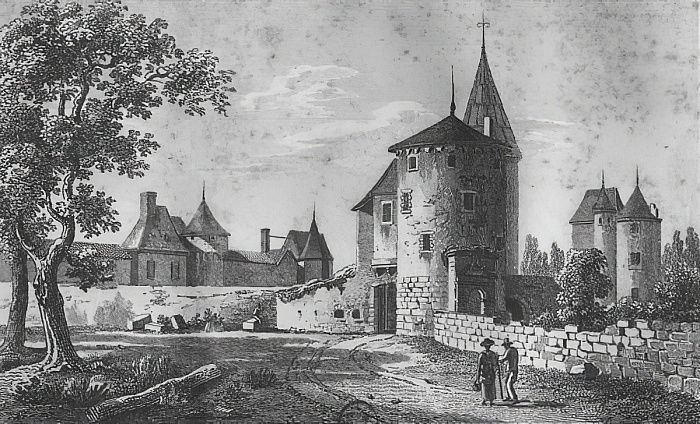
Picture above: Jean-Jérôme Baugean, View of Château de Montaigne, c. 1800. The round tower at centre is where Montaigne retired at age 38 to write Les Essais — his library of over a thousand books, with sixty-seven maxims inscribed on the beams overhead. Public domain.