Stoicism Is Not “Growth Mindset” in a Toga
Modern productivity culture loves Stoicism. In podcasts, tech roundtables, and morning routine breakdowns, ancient Roman philosophy is frequently packaged as the ultimate lifehack: a tool for resilience, focus, and career optimization. But treating Stoicism as a productivity framework leaves out the very thing that gives it gravity: it was never written to help people get ahead. It was written to help people hold themselves together when everything else was taken away.
When Tim Ferriss began evangelizing Seneca to entrepreneurs in 2009, and Ryan Holiday crystallized the movement with The Obstacle Is the Way (2014), they made ancient texts accessible to a generation that would never have opened them otherwise. But the version that spread across social media—motivational, achievement-oriented, success-adjacent—is a sanitized reduction of a philosophy forged in exile, plague, and enslavement.
The whole picture is much harder.
Primary Source Context: The Three Roman Stoics
- Seneca (c. 4 BC–AD 65): Exiled to Corsica for eight years by Claudius; recalled to tutor Nero; ordered to open his veins by that same student. The Letters to Lucilius were written in his last two years, after he withdrew from the court he knew would kill him.
- Marcus Aurelius (AD 121–180): A private notebook (Ta Eis Heauton / To Himself), written during the Marcomannic Wars on the Danube frontier while the Antonine Plague tore through the empire he governed.
- Epictetus (c. AD 50–c. 135): Born into slavery in Hierapolis, Phrygia; lame for life; freed sometime after Nero's death. He taught that the body, property, and reputation are not ours to control. His lectures were recorded by his student Arrian.
Who Actually Wrote These Texts
In AD 41, Emperor Claudius exiled Seneca to Corsica on a charge of adultery with the emperor's niece Julia Livilla—almost certainly a political purge dressed as a morals case. He spent eight years there. Agrippina had him recalled in AD 49 to tutor her son, the future emperor Nero. Sixteen years later, Nero ordered him to open his veins.
The Letters to Lucilius come from the narrow window at the end: written after Seneca withdrew from a court he could read clearly enough to know how it would finish. Letter I is about time, and it is not gentle. He is not offering a scheduling tip. He is telling a friend that the accounting has already started.
"While we are postponing, life speeds by."
— Seneca, Letters to Lucilius, Letter I.2, tr. Richard Gummere (1917)
Marcus Aurelius wrote the private notes we now call Meditations while on military campaign. Book Two carries the note "Among the Quadi, at the Granua." Book Three: "At Carnuntum"—a legionary fortress on the Danube, where Marcus sat out the grinding Marcomannic Wars at the same time the Antonine Plague was killing Romans faster than anyone could count. He was the most powerful man alive and he could not stop any of it. What he could do was keep an eye on what was happening inside his own head.
"Such as are thy habitual thoughts, such also will be the character of thy mind; for the soul is dyed by the thoughts."
— Marcus Aurelius, Meditations V.16, tr. George Long (1862)
The verb is baptetai—dipped, dyed, the same root that gives us baptism. Long reaches for a dyer's vat because Marcus did: cloth goes in one color and comes out another, and it does not come back.
But the word Long translates as "thoughts" is doing something else in the Greek. It's phantasiai—impressions. In Stoic usage that's a technical term: the thing that presents itself to you, before you've agreed to it or refused it. Marcus reaches for that root twice in one sentence, and Long smooths both into "thoughts." Casaubon, in 1634, went with "fancies, and imaginations." Modern translators tend to just say "impressions."
The difference is not academic, and it is the difference between the productivity reading and the real one. Choose better thoughts is advice for someone whose circumstances are cooperating. What Marcus actually wrote is closer to a warning, and he was in a position to mean it: you do not get to approve what reaches you. Plague reaches you. War reaches you. The report from the frontier reaches you. It goes in the vat regardless. The only question is what you do once it's there.
Epictetus was born into slavery and was lame for life—the ancient sources disagree on whether a master broke his leg or disease did it. Either way, he did not own his own body, and his teaching starts from that fact. The famous opening of the Handbook divides the world in two: what is ours, and what is not. Leading the list of things that are not ours: body, property, reputation, office. Those were not hypothetical bullet points. They were an inventory of what a man born owned by another person had already lost.
What's left, on his account, is what you decide to be. And in Discourses III.23—a lecture aimed squarely at people who read philosophy aloud for applause instead of living it—he puts the whole discipline in one instruction:
"First say to yourself what you would be."
— Epictetus, Discourses III.23
Stoicism Is Not "Growth Mindset" in a Toga
Ancient Stoicism is not about optimizing your morning routine. It is not about reframing quarterly setbacks as feedback. It is not a tool to help you win negotiations.
Stoicism is a framework for maintaining internal integrity when external stability collapses. It was formulated by people with no guarantee of personal safety, civil rights, or survival—one of whom held absolute power and still could not stop a plague. Stripping away the historical conditions turns a tested survival discipline into generic self-help.
And the irony runs deeper than it looks. Epictetus was already annoyed about this in the second century. The chapter that gives us "first say to yourself what you would be" is a lecture against performing philosophy—against people who could quote the material beautifully and had not changed a thing about how they lived. The content-ification of Stoicism is not a modern invention. It's one of the oldest complaints in the tradition.
That doesn't make modern interpretations useless. It makes them incomplete. The lines remain profound; the conditions they were written under are where the weight comes from.
Carrying the Real Words
When Seneca writes that life speeds by while we postpone, he is writing in the last two years of his own, from inside a slow death sentence. When Marcus Aurelius writes that the soul is dyed by its thoughts, he is writing in a fortress on the Danube in the middle of a plague. When Epictetus tells you to first decide what you would be, he is speaking as a man who was legally someone else's property, telling you the one thing nobody was ever able to confiscate.
A philosophy that holds up under those conditions isn't clever rhetoric. It's stress-tested. Every line we print carries its source with it—author, work, section, translator where the record supports one—because the context is not a footnote. It's the argument.
- While we are postponing, life speeds by — Seneca, Letters to Lucilius, Letter I
- The soul is dyed by the thoughts — Marcus Aurelius, Meditations V.16
- First say to yourself what you would be — Epictetus, Discourses III.23
Explore the Stoic Wisdom Collection →
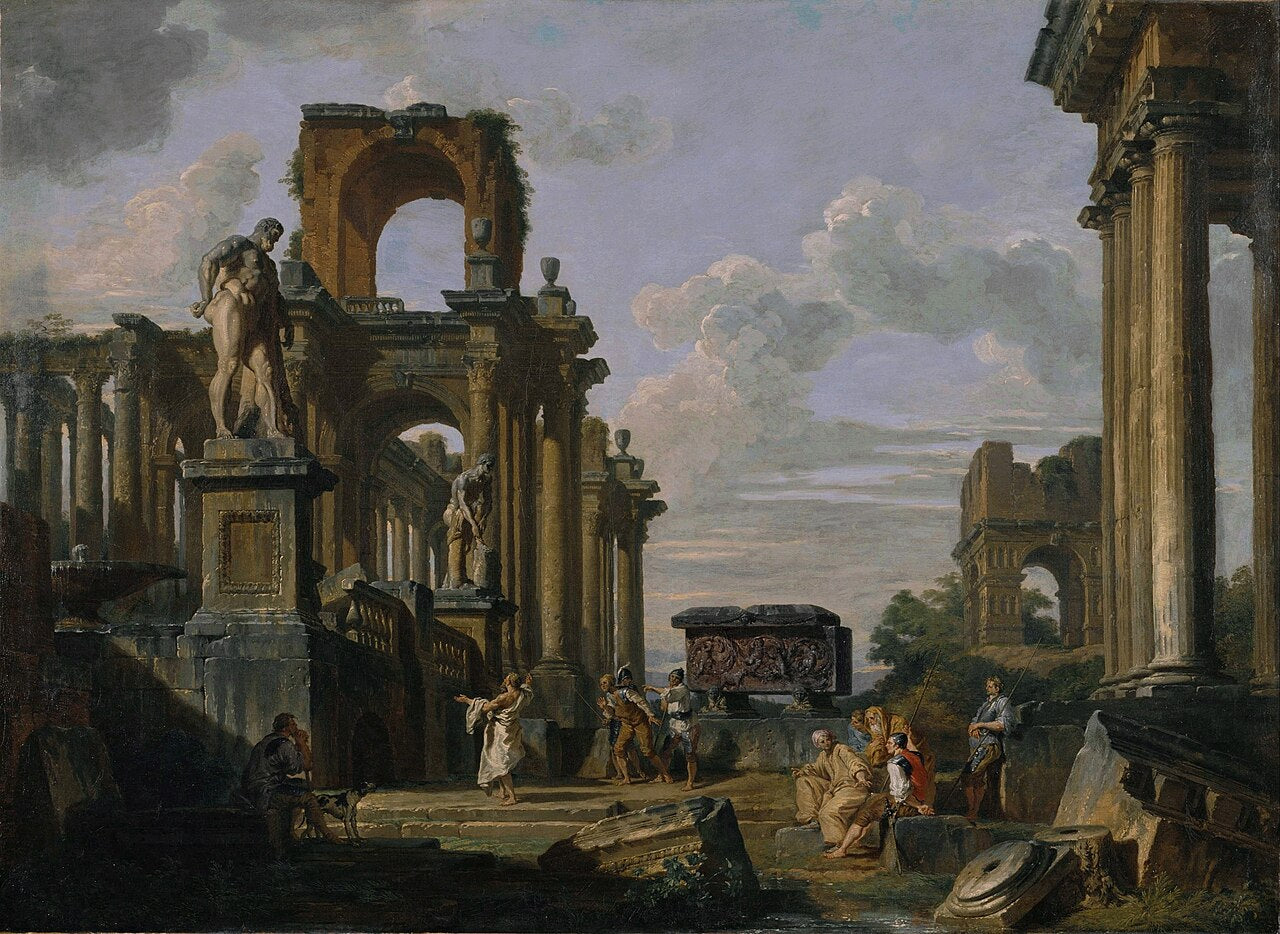
Above: Giovanni Paolo Panini, An Architectural Capriccio of the Roman Forum with Philosophers and Soldiers among Ancient Ruins, ca. 1745–1750. Oil on canvas, 98.4 × 135 cm. National Museum of Western Art, Tokyo. Panini was the eighteenth century's foremost painter of Roman ruins, and his capricci were never documentary—they were invented scenes that dropped figures from antiquity into the wreckage of the world they had built. Public domain; image courtesy of the National Museum of Western Art, Tokyo.