Article: Rilke’s 1918 Translator Was Jessie Lemont — Not Lamont
Rilke’s 1918 Translator Was Jessie Lemont — Not Lamont
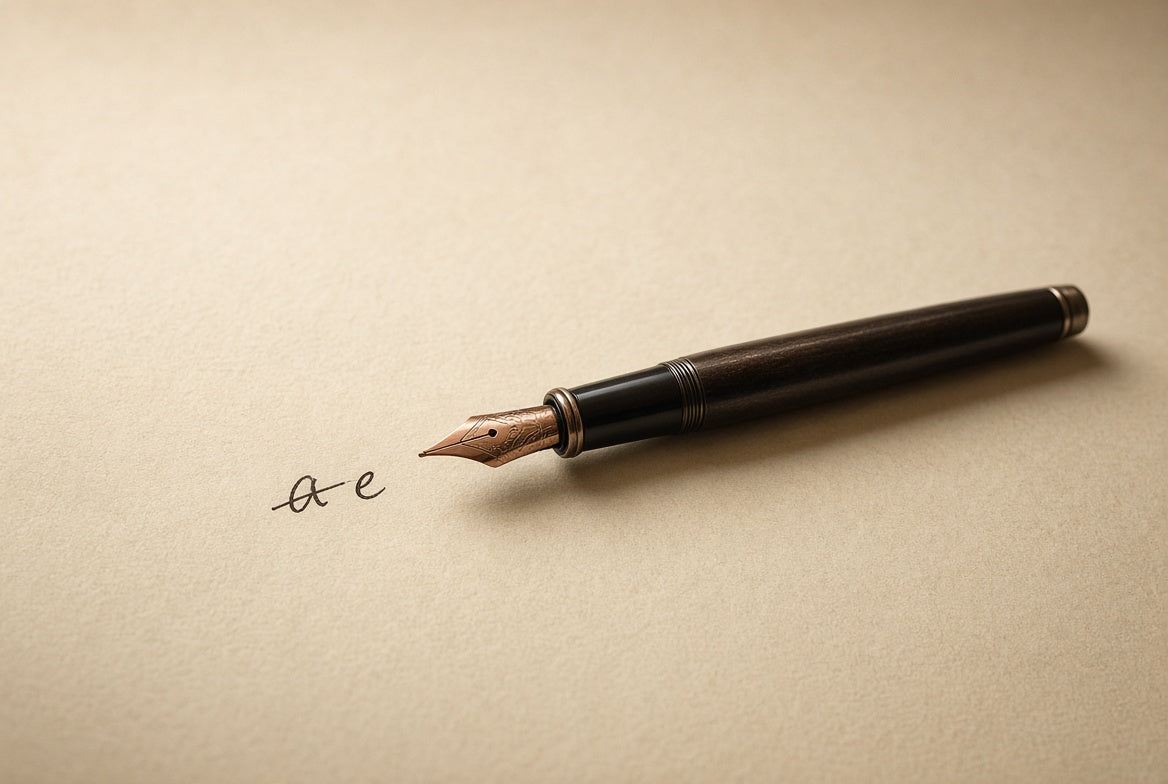
One of the first customers we ever had handed me a pen.
This was years before Quoteiac, back in the promotional-products business. She was thrilled we’d opened — they were nearly out and she needed 10,000 more. Cheap pen. Not a cheap order.
I took it back to the office, turned it over, and read the imprint properly for the first time. Her company name contained the word management. The pen said mangement.
One missing letter. She had already given out around 9,900 of them.
I called her before I told her anything else. She put me on hold, found the last box, and came back on the line with a sound I can still hear. The original distributor had gone out of business. There was nobody left to be angry at.
Nobody had said a word. Not the person who approved the proof. Not the staff handing them out. Not one of ten thousand recipients.
Errors don’t announce themselves. They sit there being wrong while everyone downstream assumes somebody upstream checked.
The same mistake, at internet scale
Someone recently asked about the translator credited on one of our Rilke pieces. Our product page says Jessie Lemont. They had found Jessie Lamont.
Here is what the sources actually show.
The book is Poems by Rainer Maria Rilke, published in New York by Tobias A. Wright in 1918. The physical title page (visible in Internet Archive and HathiTrust scans) reads Jessie Lemont. The Penn Libraries authority record reads Lemont. Project Gutenberg’s own catalog metadata for eBook #38594 correctly lists the translator as Jessie Lemont.
But inside the Project Gutenberg files the transcribed title page looks like this:

Project Gutenberg eBook #38594, transcribed title page. Two errors on the same block: the poet’s first name is misspelled RANIER (should be RAINER), and the translator’s surname reads Lamont (should be Lemont). The printed 1918 edition, Gutenberg’s own catalog metadata, and the Wikisource scan-backed edition all read “Rainer” and “Lemont.”
The line currently reads:
POEMS
by
RANIER MARIA RILKE
Translated by Jessie Lamont
Two errors on a single line: the poet’s first name is misspelled RANIER, and the translator’s surname is given as Lamont. Both are transcription mistakes. The printed 1918 book and the scan-backed Wikisource edition both read “Rainer” and “Lemont.” The file has been online since January 2012.
A plain-text Gutenberg file is not a quiet corner of the internet. It gets scraped, copied into reading apps, pasted into forums, and absorbed into the training data of large language models. Wikipedia’s article on Rilke’s “The Panther” currently lists the translators as Stephen Mitchell, Robert Bly, J. B. Leishman, and Jessie Lamont.
Ask an AI who translated Rilke’s Book of Hours into English in 1918 and there is a real chance you receive “Lamont,” delivered with complete confidence. The model is not inventing. It is repeating a typo faithfully. That is arguably worse.
Ten thousand pens.
Why a single letter is worth the trouble
You could reasonably ask who cares. It is one vowel. Everyone knows who is meant.
Two reasons.
The first is practical. Translations carry their own copyright, separate from the original. Rilke died in 1926, so the German is public domain. The English is public domain only if you can name the specific translation and its date. Jessie Lemont, 1918, is safely public domain in the United States. Later versions (including the well-known Barrows & Macy rendering) are not. If you cannot name the translator correctly, you cannot demonstrate you have the right to print the words. The name is the permission.
The second is simpler. She did the work. Jessie Lemont introduced Rilke to English-language readers when almost no one in America had heard of him. She has been slowly turning into a different person because of one keystroke in 2012. Getting her name right costs nothing and is the whole of what we owe her.
(She later married Hans Trausil, who wrote the introduction to the 1918 volume and co-translated Rilke’s Auguste Rodin with her. The correct full name is therefore also Jessie Lemont Trausil.)
What we print
The lines on our Rilke pieces are hers:
I live my life in circles that grow wide
And endlessly unroll,
Rainer Maria Rilke, from The Book of Hours (Das Stunden-Buch), 1905 — Jessie Lemont translation, 1918. Public domain.
Lemont translates freely, not line for line. She renders Rilke as rhymed English verse in the idiom of her moment. That is a choice, not an error — and it is exactly why the translator’s name belongs on the page next to the poet’s. Two people made the words you are reading.
Before anything goes to print here, the quote is traced to a named source, a named translator, a named edition, and a named year. It is slower. It has killed designs we liked.
I made the other call once — on a pen that already had nearly ten thousand identical siblings in the world. I still remember the sound on the other end of the line. We do not ship the silent error here.
Explore the Rilke collection → The Circles — Rainer Maria Rilke
We reported both transcription errors in Project Gutenberg eBook #38594 (RANIER and Lamont) to their errata team on August 25, 2026.
About the Author
Vickie MacFadden is the founder of Quoteiac. She has years of experience in the swag business. She has seen, firsthand, what happens when a name is wrong on something that’s been printed 10,000 times. That experience is her north star. And why we verify quotes, authors and translators.