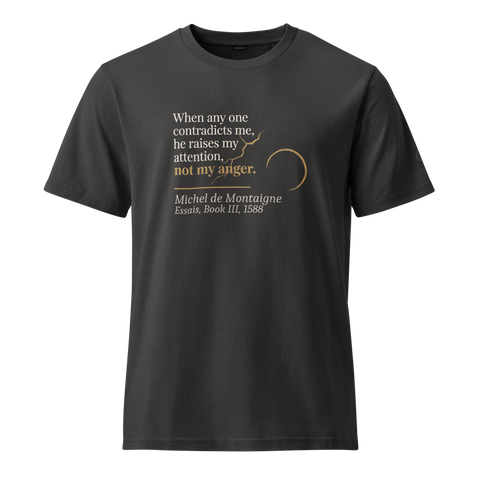
“When any one contradicts me, he raises my attention, not my anger.”
Documented source
Every quote here is traced to a documented source. How we verify →
About this line
It comes from Montaigne's essay on the art of conversation, added in 1588. Much of that essay is a complaint: his contemporaries argued badly, shouting over each other, pulling rank, treating a concession as a defeat. His counter-proposal is here. Being contradicted is the most useful thing that can happen in a discussion, because the person disagreeing with you is the only one teaching you anything.
Why we carry this line
I'd never heard of him. The words sounded like they were written last week, so I looked him up and found the 1500s. Then I stayed to learn how to say his name, because I do that. Ask the question instead of letting the anger drive. It's great advice.
The design
The fracture through “anger” draws on the idea behind kintsugi: a break can become part of what makes something worth keeping. Here, that idea meets the discomfort of being contradicted. A challenge to our thinking might leave us with something better.
The open ensō beside the words gives that possibility a little space. We chose an unfinished mark for a thought about remaining receptive.
These are Quoteiac's visual interpretations, brought to Montaigne's words centuries later.
A note on the excerpt
In Charles Cotton’s translation, the sentence continues after “anger.” We print the opening clause, replacing the colon with a period to let it stand on its own.