Did Emerson Write "Do Not Go Where the Path May Lead"? No. Muriel Strode Did in 1903.
Verdict: Misattributed. The line almost everyone knows as Emerson’s — “Do not go where the path may lead, go instead where there is no path and leave a trail” — was written by Muriel Strode in 1903. It appeared in The Open Court, Vol. 17, No. 8, August 1903, p. 505. The Emerson attribution first appears in 1992. Quote Investigator documented the full history in 2014. Here’s the primary source.
| Quote in circulation | “Do not go where the path may lead, go instead where there is no path and leave a trail” |
| Commonly attributed to | Ralph Waldo Emerson |
| Actual author | Muriel Strode |
| Primary source | The Open Court, Vol. 17, No. 8, August 1903, p. 505 |
| Emerson attribution first appears | 1992 |
| Verification status | ✅ Verified — Strode, not Emerson |
Muriel Strode wrote “I will not follow where the path may lead, but I will go where there is no path, and I will leave a trail” in 1903. It appeared in a prose-poem sequence called “Wind-Wafted Wild Flowers,” published in The Open Court, Vol. 17, No. 8, August 1903, p. 505. The version most people know — “Do not go where the path may lead, go instead where there is no path and leave a trail” — is a later paraphrase that first appears attached to Emerson’s name in 1992.. It appeared in a poem called "Wind-Wafted Wild Flowers," published in The Open Court, Vol. 17, No. 8, August 1903. Strode was an Illinois-born poet who had spent years working as a stenographer, writing on the side. The line was hers. It has never been anyone else's. The Quote Investigator documented the full attribution history in 2014, tracing the line back to its original source with precision.
That is the fact. Everything else in the story of this line is a story about how a fact can be systematically buried and why that burial follows predictable patterns.
What The Open Court Was
The Open Court was a Chicago philosophical journal, founded in 1887 and published until 1936. It was not a fringe publication. It was a serious intellectual venue — it published William James, John Dewey, and other major figures of American philosophical and literary life. When Strode published "Wind-Wafted Wild Flowers" there in August 1903, she was publishing in a respectable magazine with a real readership.
She also published in The Philistine, Elbert Hubbard's magazine out of East Aurora, New York — another small-press venue of its era that took writing seriously. Strode was working. She was not a hobbyist. She was a poet and periodicals contributor who published across multiple venues and went on to produce four books across the first two decades of the twentieth century.
Her Books
Strode's first book was My Little Book of Prayer, published in The Open Court in 1904. Then came My Little Book of Life in 1912. Then A Soul's Faring in 1921. Then At the Roots of Grasses in 1923.
Four collections across nearly twenty years of publishing. That is not the output of a one-hit wonder. That is the work of a writer with a sustained project.
She was born on February 16, 1875, in Bernadotte Township, Fulton County, Illinois — a rural community settled by her grandparents' generation. Her mother died when Muriel was thirteen. At fifteen she left home for a business school in Denver. At sixteen she was in Long Beach, California, working as a stenographer and typist. She wrote poetry alongside the work. In 1908 she married Samuel Lieberman, the Chicago steel executive whose stenographer she had been — he had read her first book and that was apparently enough. They raised one foster daughter. In 1923, oil was discovered on a piece of land in Signal Hill, California she had bought years earlier for a thousand dollars. When the money came in, she gathered seventeen women — one for each year she had owned the land — and took them shopping. Her words: “I want to set people free into beauty.” She and Samuel eventually settled on 640 acres east of Tucson, in a house atop a ridge overlooking the whole valley. She signed her letters from the Ranch of the Gorgeous Sunsets. She died there on January 25, 1964.
Her themes across those books are consistent: action, self-determination, the inner life, the cost of not moving. She is interested in what it takes to begin something — to leave the worn path, to go into territory that hasn't been mapped. The trail metaphor is not decorative but the center of her thinking. The line from 1903 is not an outlier. It is a compressed version of what she spent twenty years saying at greater length.
Her sentences move. They are physical. They are not oracular pronouncements from on high but descriptions of people in motion, making choices, bearing consequences. This is what distinguishes her voice from the writer her line was falsely credited to. But we will get to that.
The Misattribution Timeline
The earliest linkage Quote Investigator has found of this line to another name appears in January 1992, in the Middle School Journal. That same year it was being used in Pennsylvania schools without attribution to Strode. By 1999 it had appeared in syndicated Cryptoquote columns, already detached from her name.
That is the mechanism: a line circulates without its source. Each time it is reprinted, it carries less information about its origin. Each reprinting is an opportunity for a name to be attached — and once a wrong name is attached, it travels with the line because people don't check sources, because the wrong name feels right, because the name that was attached first tends to stick.
By the time the internet made viral sharing a daily fact of life, the line was already loose. It spread through motivational posters, graduation speeches, Instagram captions, hiking website headers. Almost never with Strode's name. Often with someone else's.
This misattribution pattern is not unique to Strode. The Oscar Wilde misattribution story follows almost the same arc — a witty, memorable line circulating without its source, eventually credited to the most plausible-sounding famous person available. The mechanism is identical. The results are identical. Someone's specific work becomes "something people say."
Why Emerson Specifically
When a line about individualism, self-reliance, and striking out on your own path gets separated from its source and someone has to guess who wrote it, the guess is almost always Ralph Waldo Emerson. This is not because Emerson wrote everything. It is because Emerson was codified, in the American imagination, as the canonical voice of exactly those themes.
Self-reliance. The individual against the institution. The importance of trusting your own instincts over the crowd's. These were Emerson's themes in "Self-Reliance" (1841), in "The American Scholar" (1837), in the essays that became the common property of American motivational culture. His name became a container for a whole category of sentiment. When an unattributed line fit that category, the container received it.
Strode's line fits the category. It is about leaving the path, going your own way, making something new. It sounds, to someone who hasn't read Strode, like what people think Emerson sounds like.
But Emerson's sentences do not move the way Strode's do. Emerson is oracular. He deals in grand abstractions stated with maximum authority. Strode is physical. Her 1903 line is built on three first-person verbs in sequence: I will not follow. I will go. I will leave. That construction — refusal, then action, then creation — describes a body in motion making something real. The paraphrase that traveled under Emerson’s name flattened it to an imperative: go instead where there is no path. The voice changes. The defiance in “I will not follow” disappears. Emerson would have written about the principle of the trail. Strode wrote about leaving one.
The Two Versions
The difference between what Strode wrote and what spread is not a matter of paraphrase. It is a different sentence.
Strode, 1903 (The Open Court, Vol. 17, No. 8):
“I will not follow where the path may lead, but I will go where there is no path, and I will leave a trail.”
The version that spread, first traced to 1992:
“Do not go where the path may lead, go instead where there is no path and leave a trail.”
First person becomes imperative. “I will not follow” — an act of refusal — becomes “do not go,” a direction. The speaker disappears. The verb sequence that structures Strode’s original — follow, go, leave — collapses into a command. What was a declaration of intent by a specific person in motion becomes a motivational instruction with no author attached. That is exactly what happened to it.
The Correction as Product
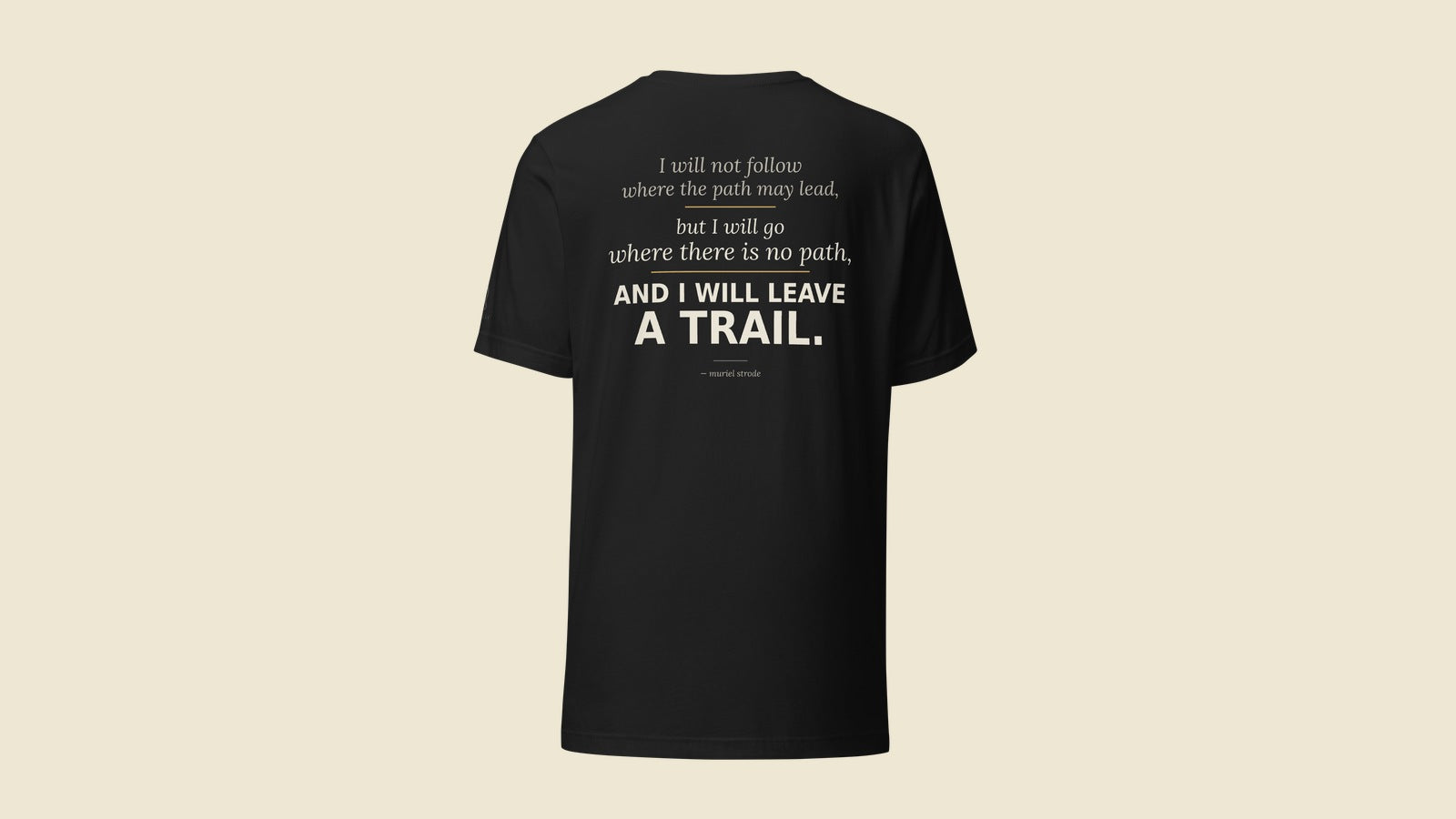
The Quoteiac product carries the line as Strode wrote it in 1903: “I will not follow where the path may lead, but I will go where there is no path, and I will leave a trail.” That wording, from The Open Court, Vol. 17, No. 8, is what’s printed on the tee — not the paraphrase. The correction is built into the product. The Leave a Trail tee names her and cites the year because the intervention is the point: you cannot buy this line without buying her name with it.
This is the simplest possible intervention in the misattribution problem. Put the right name on the thing. Make the correction unavoidable. When someone buys that tee and someone else asks where the line is from, the answer is already there: Muriel Strode. 1903. Chicago. The Open Court.
The Feminist Dimension
When you attach a woman's words to a canonical male name, you do not make a neutral error. You make her invisible. The line survives. She does not come with it.
Strode was a working writer. She had a byline. She published in journals and produced books for two decades. She had a voice that was distinct from Emerson's — more physical, more interested in motion and consequence than in abstract principle. That voice was erased not through any single act of malice but through accumulated indifference. Nobody checked. Nobody asked who actually wrote it. The famous man's name was available and it felt right and that was enough.
This is the mechanism by which women's intellectual work disappears. Not conspiracy. Just the path of least resistance: when in doubt, credit the famous man. The woman's name requires effort to retrieve. The man's name is already in the container.
The correction is not about scoring points. It is about the basic act of telling the truth about who made a thing. Strode made this line. It came from her specific imagination, her specific engagement with the question of how to live. Taking that line back and attaching her name to it is not revisionism. It is accuracy.
More Than One Line
The danger of the trail line is that it might become Strode's only line — the one thing she's known for, even in corrected form. Her four collections suggest otherwise.
My Little Book of Life (1912) is full of short, precise statements about the conditions of living — not aphorisms exactly, more like observations rendered with enough compression to be memorable. A Soul's Faring (1921) has a longer, more lyrical register — less concerned with compression, more interested in duration. She was not a one-register writer. She developed across two decades of publication.
Most of it is out of print. Some of it is digitized in scattered archives. Finding Strode requires effort — the same effort it takes to retrieve any writer who was not famous enough to stay in print through the twentieth century.
That effort is worth making. Not because every forgotten writer is a hidden genius. But because the habit of checking, of asking who actually wrote something, of refusing the easy attribution, is the habit that keeps intellectual honesty alive.
Quoteiac's Purpose in One Line
The Muriel Strode collection at Quoteiac exists because her name belongs on her words. That is the whole argument. The line is hers. The name is hers. The year is 1903. The publication is The Open Court, Chicago.
She wrote it. She left a trail. We are following it back to her.