Who Was George Edward Woodberry? The Story Behind "Defeat Is Not the Worst of Failures"
There is a certain kind of reader who finds a writer by accident. A digitized archive. A search that goes sideways. A footnote in someone else's book that names a name you don't recognize. That is how most people find George Edward Woodberry today — sideways, through the cracks, the way you find anything the literary world has decided isn't worth maintaining on the shelf.
He deserves a better introduction than that.
Woodberry was born in 1855 in Beverly, Massachusetts, a small city on the North Shore, twenty miles up the coast from Boston. He left at eighteen to attend Harvard, graduated in 1877, spent time in Nebraska teaching, and eventually found his way to Columbia University in 1891. That was where he built something. The Department of Comparative Literature — not English, a distinction that mattered enormously — was a new formation when he joined it, and he helped make it real. He taught there for thirteen years.
Thirteen years is long enough to shape a generation of readers.
What He Believed About Literature
Woodberry's argument was simple and, at the time, not universally shared: literature is a living practice. Not a set of historical documents to catalog. Not a philological exercise. A living practice that requires real engagement — intellectual and emotional both — from anyone who wants to understand it.
That sounds obvious now. It was not obvious then, or rather it was obvious but not institutionally dominant. The universities were moving toward systematic, scientific approaches to literary study. Woodberry resisted that. He thought the humanities had to stay humanist. He thought the point of reading was not classification but encounter — the meeting of a mind with a mind across time.
His students knew he meant it. The lectures were remembered as transformative. The care he brought to a sentence — how a line worked, what made the difference between something memorable and something merely competent — was the kind of intellectual attention that changes how you read for the rest of your life.
He wrote about beauty, aspiration, and what he called the life of the mind. His essays collected in Heart of Man (1899) and The Torch (1905) explore the same questions his poetry explored: what does it mean to reach toward something you know you may not achieve? What is the nature of real failure — and is it what we think it is?
He was Beverly through and through. Ten generations of his family had lived there, many of them seamen — the kind of town where you know the sea before you know much else. He entered Harvard in 1872, left for health reasons, came back, and graduated in 1877 with highest honors in philosophy. Two of his professors there were Charles Eliot Norton and James Russell Lowell, who hired him as an undergraduate. He taught briefly at the University of Nebraska before Columbia came calling in 1891. He never married. He lived quietly — summers in Beverly, winters in Boston among a small circle of friends. His closest documented companion was Harry Harkness Flagler; the Columbia archive holds 330 letters from Woodberry to Flagler describing daily life in Beverly and his travels across Europe and North Africa. Those trips became books: A Day at Castrogiovanni in 1912, North Africa and the Desert: Scenes and Moods in 1914. He paid attention everywhere he went. In 1911, his former students founded the Woodberry Society in his honor. He was still alive. They named something after him before he was gone.
The Quote That Carries His Name
The line Woodberry is best known for today comes from an address he delivered in 1911, printed the following year as Wendell Phillips: The Faith of an American:
"Defeat is not the worst of failures. Not to have tried is the true failure."
He wrote that at fifty-six, seven years after he had left Columbia and returned to Beverly. He had tried. He had built something at Columbia. He had watched it get dismantled by institutional politics and walked away rather than participate in its diminishment. The line does not read as abstract wisdom when you know the man who wrote it. It reads as earned.
The Not to Have Tried collection at Quoteiac carries this line on apparel — the verified source, the confirmed text. The quote is his. The 1912 pamphlet is the record. No guessing required. And the True Failure tee takes that concept directly from Woodberry's work — the idea that the only real failure is the one you choose before you begin.
The Department and the Conflict
What happened at Columbia in 1904 is worth understanding on its own terms, not just as backstory to a departure.
President Nicholas Murray Butler was modernizing Columbia — building it into a serious research university. That project had winners and losers. The English department, under Brander Matthews, had institutional backing. Woodberry's Comparative Literature department did not. Resources were redirected. Assistants were removed. The administrative support that made it possible to build what Woodberry was building was quietly withdrawn.
He did not wait to be fired. He saw what was happening, understood what the university had decided to become, and resigned. The New York Times noted the resignation on February 4, 1904. He packed and went back to Beverly.
This is worth naming clearly: he was not a casualty. He made a choice. He chose not to continue within an institution that had decided his project wasn't worth protecting. That kind of exit takes clarity.
Beverly, Again
He lived in Beverly for the remaining twenty-six years of his life. He kept writing. He kept corresponding with the literary world, receiving visitors, working on essays and poems that nobody was going to publish in the quantities that would keep a name in circulation.
The return to his birthplace was not a retreat in the diminished sense. Beverly was where he had learned what serious attention felt like. It was the place that had formed him. Going back was a statement: this is enough. The institution was not the point. The work was the point.
He died in Beverly on January 2, 1930. His poetry is almost entirely out of print.
The People He Influenced
Woodberry was part of a specific American intellectual moment — the generation that came of age in the 1870s and 1880s, working out what serious intellectual life in the United States could look like. George Santayana was at Harvard during these years. William James was building pragmatism. Henry Adams was watching the world change faster than any framework could absorb.
Woodberry belonged to that conversation. He was not its loudest voice — he did not self-promote, and the literary world does not reward reticence — but he was a genuine participant. The work he was doing at Columbia, insisting that literature was a humanist project rather than a philological one, was part of the same argument those men were making.
Van Wyck Brooks, the critic who spent his career writing serious American literary history, invoked Woodberry as a touchstone — a mind that had understood what American intellectual culture was capable of at its best. That kind of influence rarely has a clean ledger. It moves through the people who were in the room, and then through the people those people shaped, diffusing into the literary culture without keeping Woodberry's name attached to it.
Why He Disappeared
Teaching leaves almost no record. The students remember. Some of them write about it. But the actual labor — the way a particular mind engaged with particular students over thirteen years, the specific quality of attention in those lectures — disappears almost entirely once the teacher stops teaching.
Writers who don't self-promote disappear faster than their talent warrants. This is not a new observation, but it is worth making again, because the mechanism keeps running. Woodberry did not cultivate his biography. He did not build a myth around his departure from Columbia or frame his return to Beverly as a principled stand. He simply left and kept working. The literary world moved on.
The result is that most people who read English literature for a living have never heard his name. His work is being digitized and indexed in archives — the Internet Archive holds several of his volumes — processed by systems that have no sense of who he was or what he was trying to do. His sentences exist out there. Whether anyone connects those sentences to the specific person who wrote them is a different question entirely — one that connects directly to broader questions about literary provenance and the ownership of texts.
The Found-Object Quality
There is a specific pleasure in finding a writer the literary world has let go. The bestseller arrives with apparatus — reviews, marketing, the social fact that other people have already read it. The forgotten writer arrives without any of that. You find the work yourself. The discovery is yours. Nobody told you to read it. Nobody curated it into your feed.
Woodberry has that quality. He is obscure not because he was bad, but because he did not perform, because his department lost a political battle, because he went home to Beverly and stayed there. The work waited. It is patient that way.
The full George Woodberry collection at Quoteiac — including the Mankind Artist collection — is an attempt to do something the literary world didn't: keep his name attached to the things he said, in places where someone might find them and feel something.
He paid attention until the end. That is enough to go on.
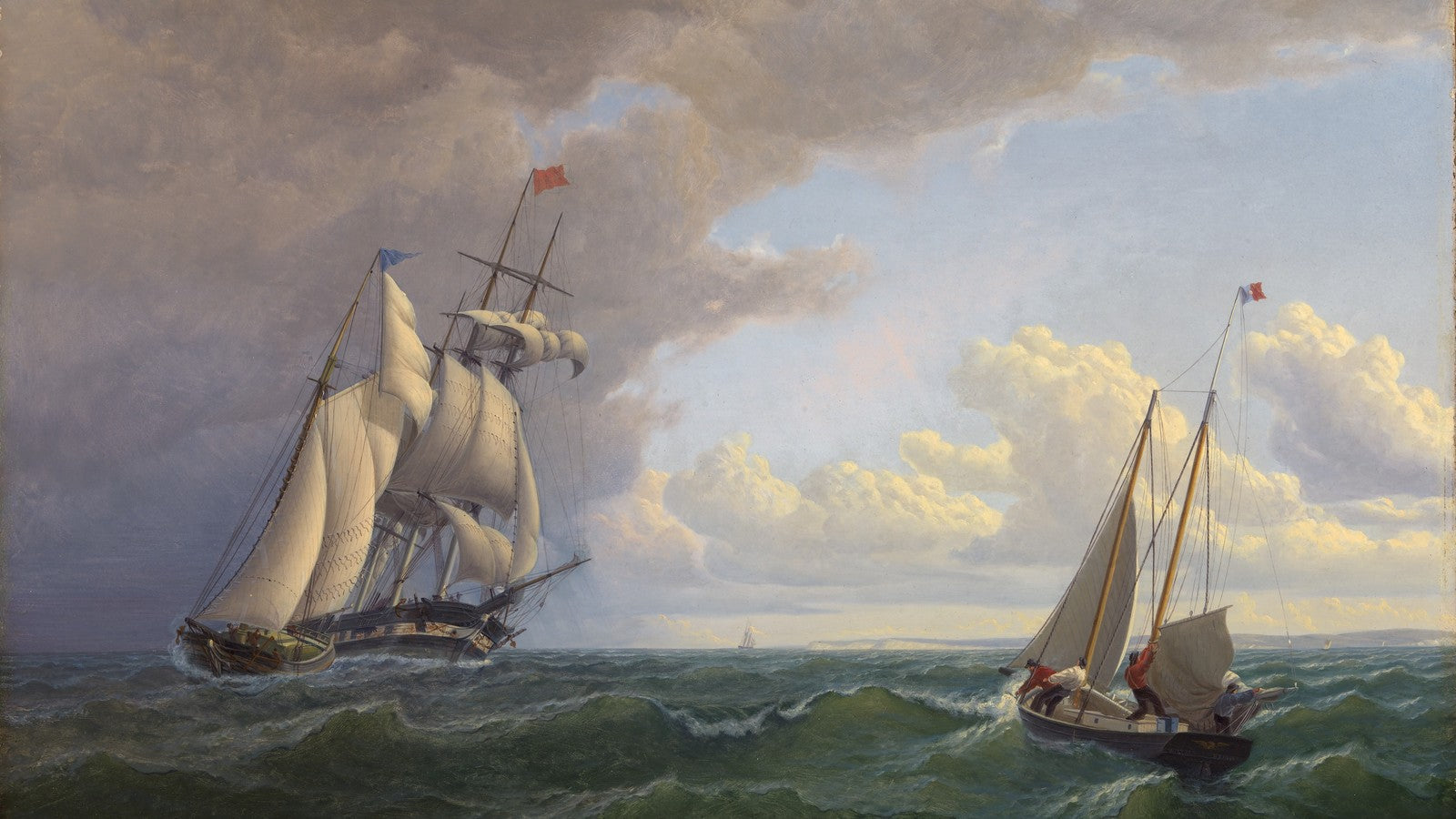
The painting above is William Bradford's Whaler off the Vineyard — Outward Bound (1859). Bradford was born in Fairhaven, Massachusetts, across the harbor from New Bedford — the same North Shore coast Woodberry's family had worked for ten generations. He grew up around whalers and shipyards, left for New York, became one of the most technically precise marine painters of the nineteenth century. He is best known for his Arctic expeditions and the paintings that came from them. He is not as widely exhibited as he should be. The painting is in the Smithsonian American Art Museum, Washington, D.C., and is available under CC0.