The Original Productivity Book Is 118 Years Old: What Arnold Bennett Got Right (and Wrong)
In 1908, an English novelist published a short self-help manual arguing that most clerks and suburban commuters had more time than they realized—and zero idea what to do with it.
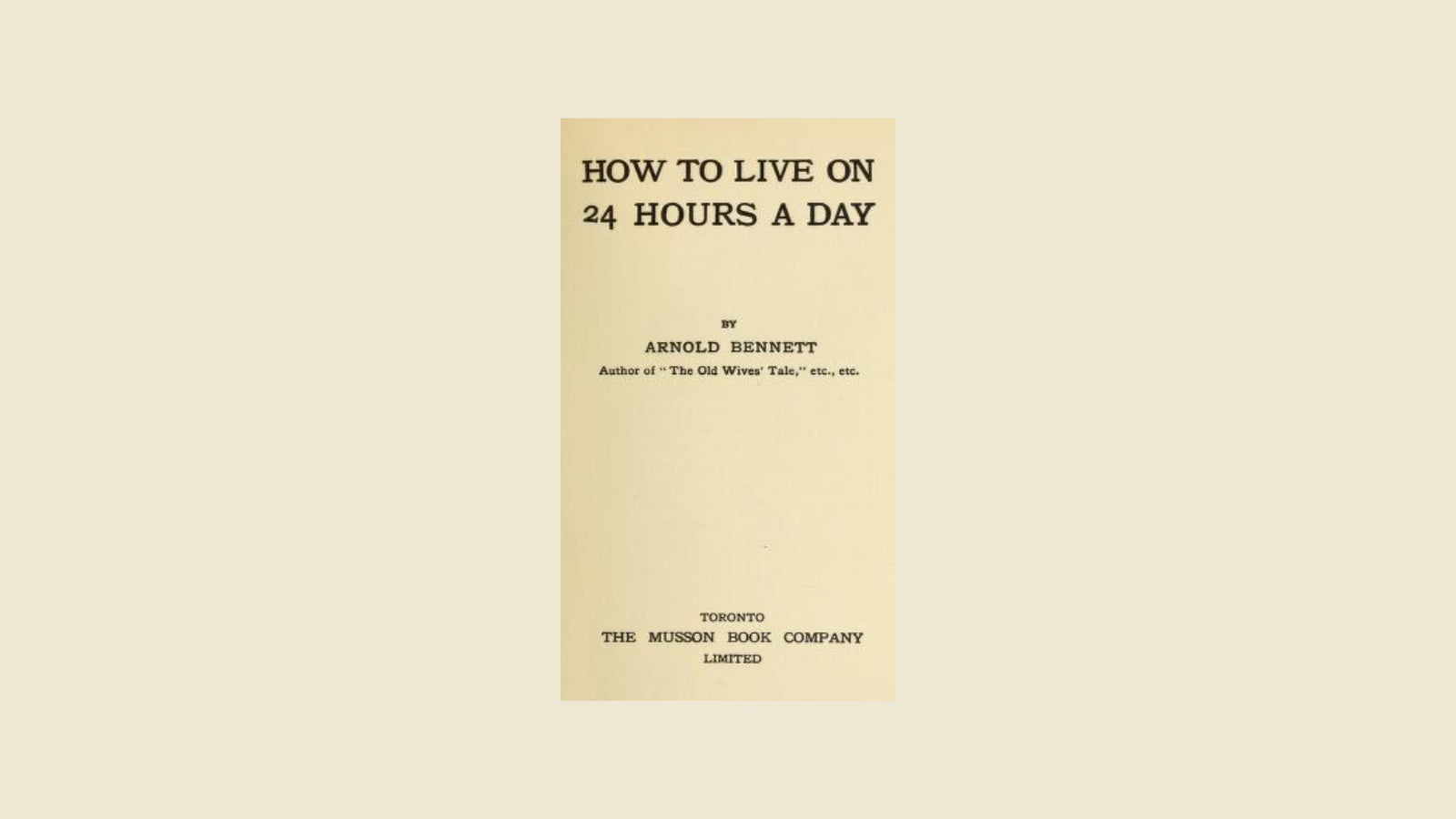
That book was How to Live on 24 Hours a Day by Arnold Bennett. Serialized first in the London Evening News in 1907, it appeared as a book the following year and became the original time-management manual long before productivity was a corporate buzzword or a YouTube genre.
Bennett was right about the basic arithmetic of a daily schedule. But where modern hustle culture misinterprets him—and where his actual genius lies—is in what he thought that time was for.
The Lawyer's Clerk Who Beat Virginia Woolf's Generation
Arnold Bennett was born in 1867 in Hanley, Staffordshire—one of the six pottery towns he compressed into the fictional “Five Towns” of his greatest fiction. He trained as a solicitor's clerk, moved to London, and wrote his way into becoming one of the most successful, best-paid authors of the Edwardian era.
"You have to live on this twenty-four hours of daily time. Out of it you have to spin health, pleasure, money, content, respect, and the evolution of your immortal soul."
— Arnold Bennett, How to Live on 24 Hours a Day
He was so omnipresent that modernists like Virginia Woolf treated him as their primary antagonist. In her 1924 essay Mr. Bennett and Mrs. Brown—first delivered as a lecture at Cambridge, then published by the Hogarth Press—, Woolf dismissed Bennett's painstaking realism, arguing that he focused so much on houses and furniture that he missed the human soul inside them.
It was a sharp critique, but it proved one thing: you only get attacked by the modernists if you dominate the cultural landscape.
What the Book Actually Says (And Doesn't Say)
Bennett's premise was simple: if you work eight hours a day and sleep eight hours a night, you still have eight hours left over.
(Bennett also framed it a second way: the sixteen hours from 6 pm to 10 am—including sleep—form a “day within a day.” That’s the full off-work period. The “other eight hours” is the unaccounted waking surplus inside that window. Both framings point to the same truth.)
Most suburbanites treated those surplus hours as leftover scraps—time spent staring passively out train windows during the commute or slumping in a chair until bed. Bennett argued that your real life happens in those hours, and your day job is merely the price of admission.
His fixes were practical:
- Treat the commute as a study: Bennett’s own note about the train: no newspaper reading. The time was for concentration, not catching up.
- Carve out three evenings a week: Dedicate 90 minutes every other evening to serious intellectual effort.
- Avoid over-ambition: Don't schedule every minute, or you will fail immediately and abandon the project.
Where today's "rise-and-grind" culture gets Bennett wrong is in assuming this extra effort was meant to build a "side hustle" or advance a career. Bennett’s surplus hours weren’t aimed at income. The whole book points toward cultivation — “a little chapter of Marcus Aurelius or Epictetus,” a poem worked over on the morning train — not at advancement. Modern hustle culture borrows his arithmetic and swaps in its own goal.
The Tension: Effort vs. Ease
Bennett understood a truth that modern productivity apps try to hide: self-improvement takes real energy, and ease has a powerful pull.
He didn't pretend that spending an evening wrestling with Marcus Aurelius was as easy as pouring a drink. He knew that discipline required friction. But he also recognized that a life built entirely on relentless ambition leaves you exhausted and hollow.
The Drawbacks tee from Quoteiac captures this exact tension—the subtle realization that while passivity leads to regret, pure, unyielding effort carries drawbacks of its own.
Why He's Worth Reading Today
Bennett isn't remembered today like Dickens or Woolf, partly because he wrote for a popular audience and refused to pretend that literature was an elite, mystical calling. He was pragmatic. He kept journals, managed his time fiercely, earned his money, and enjoyed the rewards of his labor.
If you read him today, skip the modern productivity gurus who quote him out of context. Go straight to the source. Bennett's prose is direct, slightly wry, and remarkably free of fluff. He reminds us that time isn't something you "find"—it's the only raw material you actually own.
Explore the full Arnold Bennett collection at Quoteiac to see how his words continue to challenge how we spend our days.