Ted Lasso Got the Rilke Quote Wrong (And So Did Everyone Else)
Season four is out, which means a lot of us are back at the beginning, watching Ted tape BELIEVE over a doorframe for the second or third time.
Somewhere in season two, Rebecca is texting a stranger on Bantr and gets stopped cold by a line he sends her. She reads it out to Keeley: our deepest fears are like dragons guarding our deepest treasures. She names the poet. Rilke.
It's a good line, and a great character beat — the anonymous man on the dating app turns out to read poetry, which is exactly the thing that undoes her.
It also isn't Rilke. And the story of how it stopped being not-Rilke is better than the quote.
What Rilke actually wrote
There is a real passage. It's in the eighth letter of Letters to a Young Poet, written from a house in the Swedish countryside on 12 August 1904, to Franz Xaver Kappus — a nineteen-year-old military cadet who had sent Rilke his poems and asked whether they were any good. Rilke declined to answer that and answered better questions instead.
He's writing about sadness, the kind that arrives without explanation and sits on you. And he reaches for the old fairy tales:
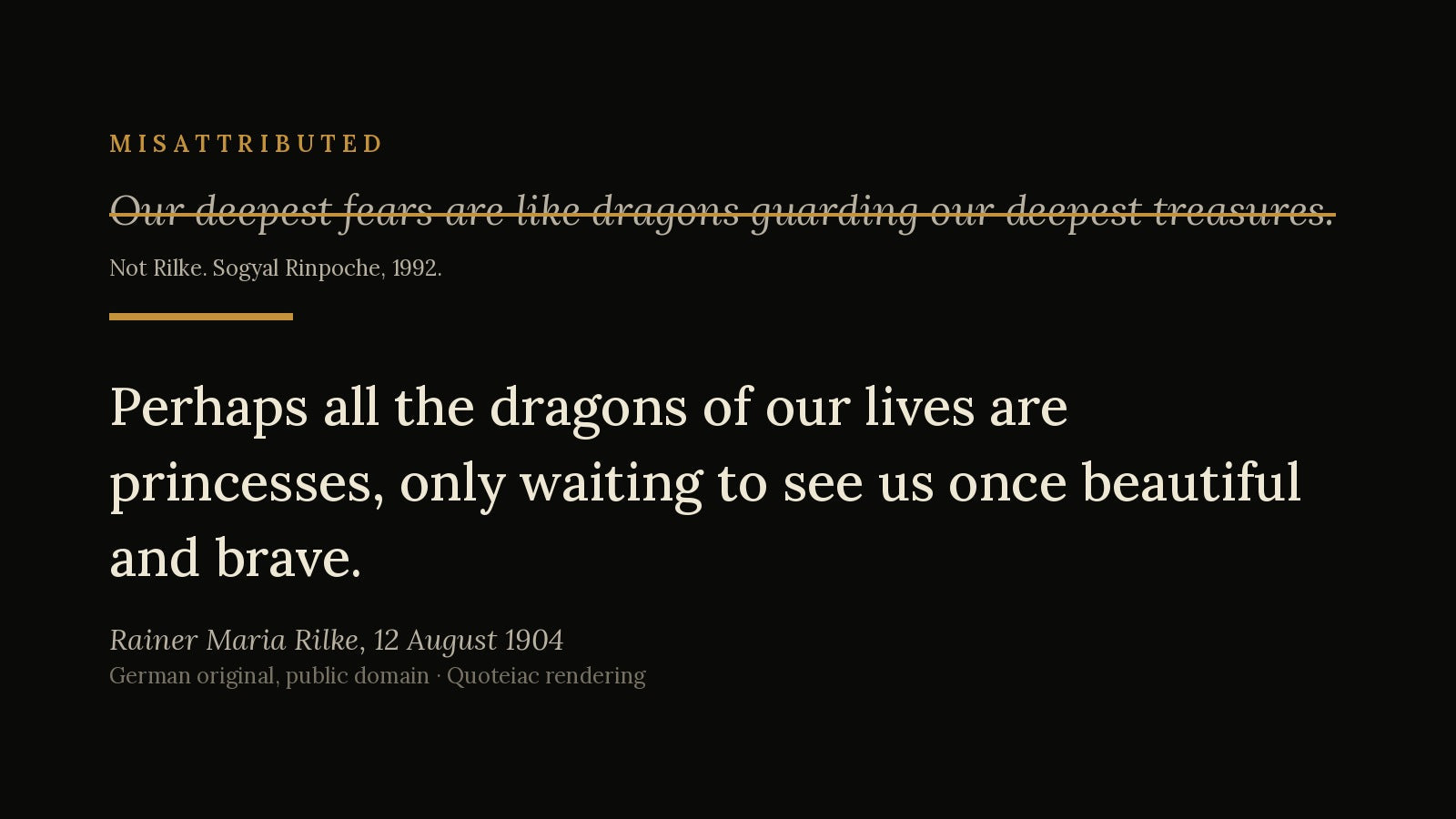
How could we forget those old myths that stand at the beginning of every people; the myths of the dragons that transform, at the last moment, into princesses? Perhaps all the dragons of our lives are princesses, only waiting to see us once beautiful and brave. Perhaps everything terrible is, at bottom, the helpless thing that wants help from us.
Rainer Maria Rilke, letter to Franz Xaver Kappus, 12 August 1904. German original public domain; English rendering by Quoteiac, checked against the Insel Verlag text, Leipzig, page 48.
Put that next to the version Rebecca reads and notice what went missing.
Rilke's dragon is the treasure. It isn't standing in front of something valuable — it becomes the valuable thing the moment you stop running from it. Fear and reward are one object seen from two sides.
The circulating version is a different idea entirely: the dragon is an obstacle, the treasure is behind it, go fight your way through. That's motivational, and it's also the plot of every fantasy novel ever written. Rilke was saying something considerably stranger.
Where the fake version was born
Not on the internet. In a book, in 1992, with a footnote.
Sogyal Rinpoche's The Tibetan Book of Living and Dying came out that year and sold in enormous numbers. On page 39, it says the Western poet Rainer Maria Rilke has said that our deepest fears are like dragons guarding our deepest treasure. No quotation marks — it's presented as a summary of an idea.
But there's an endnote. And the endnote points to page 92 of Stephen Mitchell's translation of Letters to a Young Poet.
Go to page 92. The dragons are there. That sentence is not.
This is the whole mechanism in one artifact. Somebody read Rilke, summarised him accurately enough for their purposes, and attached a citation to the summary. The citation was real. It pointed at a real book, a real translator, a real page. It just didn't support the sentence sitting above it.
The page-by-page trail was documented by Gerald Krieghofer, who runs Zitatforschung — the German-language equivalent of Quote Investigator, and the primary source on misattributed German-language authors. He links the scans.
And a footnote is a very persuasive object. Nobody checks a footnote. It's the step most people skip — open the source, find the page, read the sentence that's actually there.
How a paraphrase became a quotation
Two years later, in 1994, the line turns up in a different book — Dawna Markova's No Enemies Within — this time inside quotation marks, credited to Rilke, with no mention of Rinpoche.
That's the moment. Quotation marks are a claim about someone's exact words, and once they go on, they don't come off. By 1995 it's in a third book. By the 2000s it's in French, Spanish, and German. The German translators of Rinpoche's own book quietly dropped the footnote and changed the wording to say Rilke said it in substance — they could see the problem, and hedged rather than fixed it.
There's a fourth path worth mentioning, because it's the one that reached people who don't read books about dying. The Texas songwriter Ray Wylie Hubbard read Letters to a Young Poet and wrote "The Messenger," in which he passes along a message he credits, by name, to this old poet Rilke — the dragons, the treasure. He's returned to the song repeatedly across his career.
Hubbard read the actual book and compressed it into something that scans in a chorus. That's what songwriters do, and it's a fair thing to do inside a song. But by then the compression was already loose in print, and there's no way to tell whether he found it in Rilke, in the culture, or both.
By 2021 it's in a writers' room, being typed into a fictional dating app, and every single person in that chain is acting in good faith.
Why we care about this more than most people do
We print quotes on things. Shirts, mugs, journals. Once a line is printed it's fixed — you can't quietly edit a shirt the way you can edit a web page. So before anything goes to production here, it gets traced to a primary source: the actual book, the actual edition, the named translator, the year. If we can't get there, we don't print it.
The dragons line fails on the first step. And it fails in the most instructive possible way — not because nobody cited it, but because somebody did, and the citation was wrong, and thirty years of people trusted the citation instead of opening the book.
There's a second problem, and it's why you won't find this line in our shop. Rilke's German is public domain. The English translations are not. The wording most people love — the one with "beauty and courage" in it — is Stephen Mitchell's, from 1984, and it's his. Norton's and Snell's are spoken for too. That leaves translating from the public-domain German ourselves, which is what's on this page, and which we'd want to get properly right before printing it on anything. The Rilke lines we can verify are in the shop — the dragons aren't there yet, for exactly this reason.
None of which is a knock on the show
Ted Lasso is about a man who is relentlessly good and also frequently wrong, and it seems fitting that it passed along a beautiful sentence the poet didn't write.
That's usually how misattribution works. It's almost never a lie. It's a summary, then a footnote, then a set of quotation marks, then thirty years — each step reasonable, adding up to a sentence nobody wrote.
Rebecca was right to be moved. She was just moved by a paraphrase with a bad address on it.
The Ted Lasso series got another one wrong, too, if you're keeping score.
About the Author
Vickie MacFadden is the founder of Quoteiac. She started the company because she couldn’t find literary quotes on things she actually wanted to own — and because most of what was out there hadn’t been checked. Once you’re in the business of printing words on objects, the footnote problem becomes personal: you can correct a webpage, but you can’t edit a shirt. That’s the standard everything here gets measured against.