Did Walt Whitman Write "Be Curious, Not Judgmental"? No — Ted Lasso Got It Wrong
Verdict: Misattributed. The line “be curious, not judgmental” appears in Ted Lasso attributed to Walt Whitman. Whitman never wrote it. The co-director of the Walt Whitman Archive confirms it is not in the archive.
| Quote in circulation | “Be curious, not judgmental” |
| Attributed to | Walt Whitman (via Ted Lasso) |
| Verified source | None in Whitman’s published or unpublished work |
| Authority | Ed Folsom, co-director, Walt Whitman Archive — confirms not in archive |
| Earliest found | Shearer advice column, The Charlotte Observer, January 16, 1986 |
| Verification status | ❌ Misattributed — Whitman did not write this |
Ted Lasso is standing at a dartboard in a London pub, one throw from taking the owner's box away from a man who has spent the whole season making him feel small. One of my favorite scenes.
If you follow any Ted Lasso account on social, you have likely seen the clip over and over. It never gets old.
He tells the room he's been underestimated his entire life. He tells them about driving his son to school and seeing a quote painted on a wall by Walt Whitman: be curious, not judgmental. Then he explains what it took him years to work out — that not one of the men who wrote him off had ever asked him a single question.
Then he throws.
It's one of the best scenes in the show, and it turns on four words Walt Whitman never wrote.
The scholarship is unambiguous
This isn't a case where the source is merely hard to find. Ed Folsom is a professor of English at the University of Iowa and co-director of the Walt Whitman Archive — the definitive scholarly repository of Whitman's published and unpublished work. Asked directly, he confirms Whitman neither wrote nor said it.
When the man who co-runs the archive tells you it isn't in the archive, that's the end of the inquiry. It's also how we verify every quote before anything goes to print.
Where it actually came from
On 16 January 1986, a syndicated advice column by Marguerite and Marshall Shearer ran in newspapers across the country, including The Charlotte Observer.
A parent had written in. They had found birth control pills in their seventeen-year-old daughter's bedroom and wanted to know what to do about it.
The Shearers advised them to try to find out what their daughter was actually worried about. Be curious, they wrote, not judgmental.
That's the earliest known appearance of the exact phrasing. Snopes found the general sentiment circulating as far back as the 1970s — but this is where those four words land in print. Not a poem, not a preface, not a notebook.
Which is — and this is the part worth sitting with — better advice in its original setting than as a poster. In the column it isn't a slogan. It's a specific instruction to a specific person about to do something they'd regret. Curiosity as de-escalation. The parent is the one who has to change.
The line lost its context, picked up a nineteenth-century poet, and became wall art. It's why we don't print what we can't verify.
And it is, in fact, wall art
Search any print-on-demand marketplace for "be curious not judgmental Whitman" and you'll find framed prints, canvases, and posters, sold in oak and walnut and blacks, all crediting Walt Whitman.
We sell printed goods for a living, so we'll put it plainly: those sellers have taken a 1986 newspaper column, put a dead poet's name under it, and sold it as heirloom decor. Almost none of them know. Almost none of them checked. That's how this works — misattribution is very rarely a lie. It's a chain of people who each assumed someone earlier in the chain had done the work.
What Whitman actually wrote about this
Here's the frustrating part: he had a line for it, and it's better.
The 1855 first edition of Leaves of Grass opens with an unsigned preface — Whitman at thirty-six, self-published, setting out what a person should do with a life. In the middle of it comes a long, accumulating instruction, and this is part of it:
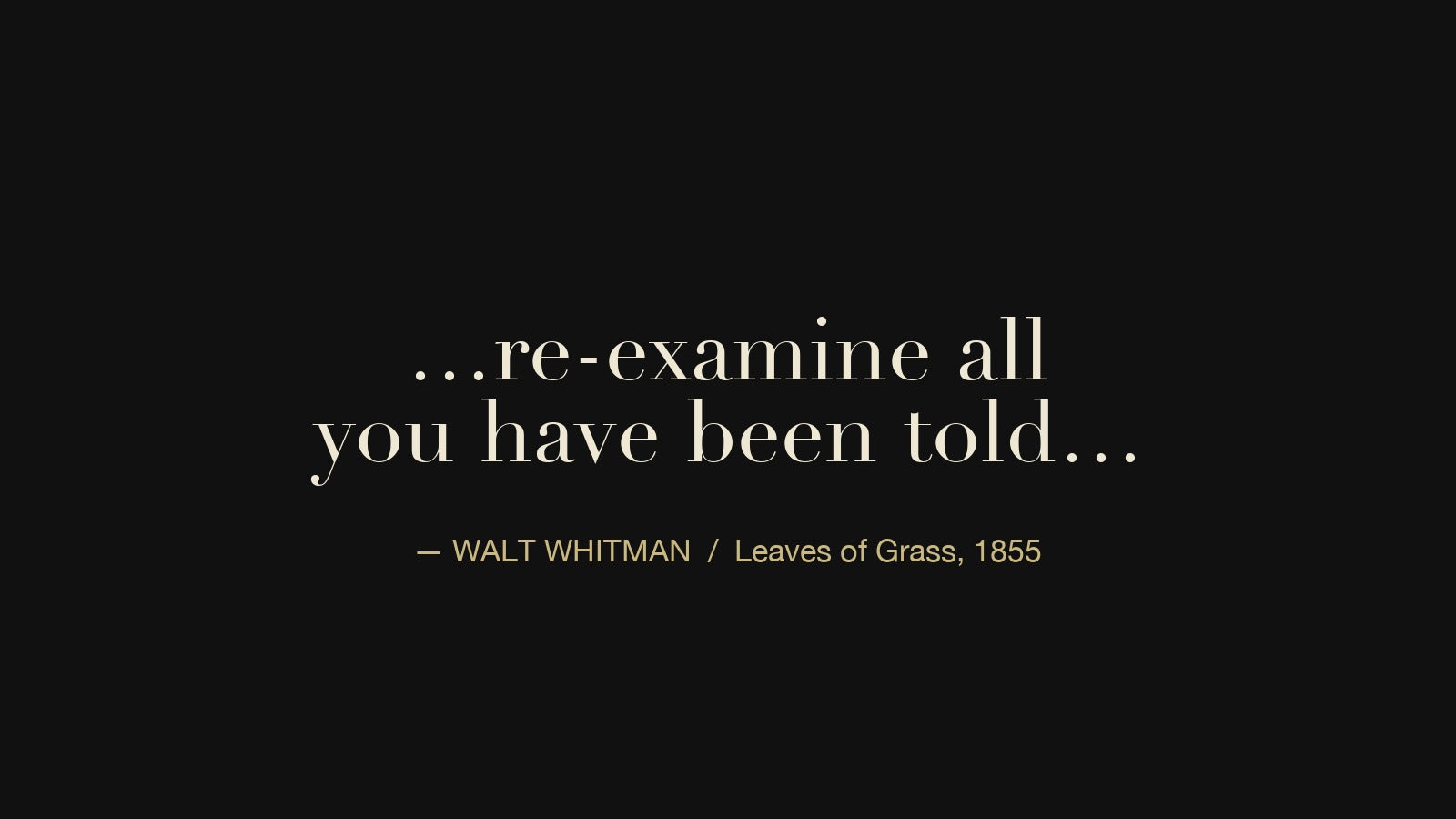
…read these leaves in the open air every season of every year of your life, re-examine all you have been told at school or church or in any book, dismiss whatever insults your own soul; and your very flesh shall be a great poem…
Walt Whitman, Preface to Leaves of Grass, first edition, Brooklyn, 1855. Public domain.
Note the wording. Most reprints you'll find online read "in school." The 1855 first edition reads at school. The clauses just pile up without connectives, which is the whole engine of his rhythm.
That passage is the real version of what Ted was reaching for. It isn't "be curious." It's harder than that. Re-examine everything you were told by every institution that told you anything, and throw out whatever insults your soul. Not a mild suggestion to ask more questions. An instruction to audit your entire inherited worldview, annually, outdoors.
Whitman didn't ask you to be curious instead of judgmental. He asked you to be curious about the things you were most sure of.
We print that line: the Re-examine tee and phone case, 1855 wording, cited on the artifact.
None of this is a knock on Ted
Ted saw it on a wall at a school. That's exactly how he says he got it — he isn't citing a book, he's citing a mural. A man repeating something he read on a wall and found true is not a fraud. He's most of us.
And the sentiment is fine. The advice is good. The Shearers were right in 1986 and Ted was right in 2020.
It just isn't Whitman. And Whitman, as it turns out, said something considerably more dangerous.
The Ted Lasso show got a poet wrong twice, if you're keeping score.
About the Author
Vickie MacFadden is the founder of Quoteiac. She has been rewatching Ted Lasso from the beginning — working through every season before the new one starts — which is exactly how she ended up down a rabbit hole about a dartboard, a mural, and a quote that belongs to a 1986 advice column. She writes about misattribution because she has to verify every line before it goes to print. That tends to make you notice when other people haven’t.