Article: The Night America Thought Martians Had Landed. Or Did It?
The Night America Thought Martians Had Landed. Or Did It?
On October 30, 1938, Orson Welles put Martians on the radio. The story of what happened next may be almost as interesting as the fiction.
At 8 p.m. on a Sunday night in 1938, music on the radio appeared to be interrupted by a news bulletin.
Astronomers had observed explosions on Mars.
Then came another report. Something had fallen from the sky near Grovers Mill, New Jersey.
A correspondent arrived at the scene.
The object opened.
And before long, Martians were supposedly loose in New Jersey.
It was, of course, fiction.
Orson Welles and the Mercury Theatre on the Air were performing an adaptation of H. G. Wells’s 1898 novel The War of the Worlds. But they had made an inspired change. Instead of simply dramatizing Wells’s story, they presented much of it in the familiar language of live radio news.
For some listeners, fiction and reality briefly collided.
What happened after that is where the story gets interesting.

Model photo created with AI. The printed line is real.
H. G. Wells wrote this line in When the Sleeper Wakes in 1899, decades before radio, television, social media, or the viral stories that now shape how we imagine the future. Shop the H. G. Wells tee →
The panic became part of the legend
The following morning, newspapers described something close to national hysteria.
The San Francisco Chronicle splashed “PANIC SWEEPS U.S.” across its front page. Other accounts described frightened listeners calling police stations, fleeing their homes, praying, or preparing for an attack.
And those reports hardened into cultural memory.
Generations grew up hearing some version of the same story: Orson Welles broadcast a fake Martian invasion and terrified America.
There is no serious question that some people were frightened.
Police departments, newspapers and radio stations received anxious calls. Contemporary letters describe listeners who had believed at least part of what they heard. Some reactions were intense.
But was the entire country running into the streets?
Probably not.
And this is where a very good story begins to collide with evidence.
How many people were actually listening?
A contemporary telephone survey of 5,000 households reportedly found that only about 2 percent were listening to the Mercury Theatre broadcast, and most of those listeners understood that it was a drama. The program was also competing against one of the most popular programs on American radio, Edgar Bergen’s Chase and Sanborn Hour.
That alone makes the familiar picture of an entire nation simultaneously losing its mind difficult to sustain.
Later scholarship has also questioned early estimates of the panic. Some of the best-known numbers came from Princeton researcher Hadley Cantril, whose 1940 study concluded that a very large audience had heard the broadcast and that many had been frightened by it. Subsequent researchers have challenged both his audience estimates and the way different emotional responses were categorized. Being startled, excited or disturbed by a broadcast is not necessarily the same thing as believing Martians have arrived.
But there is a temptation here to replace one beautifully simple story with another.
America panicked becomes America didn’t panic at all.
The surviving evidence doesn’t require either extreme.
More than 1,300 letters complicate the story
The University of Michigan holds something more revealing than a headline or an audience estimate: the responses of people who were actually there.
Its War of the Worlds Fan Mail collection contains more than 1,300 letters sent to Welles and CBS after the broadcast. The university has digitized and transcribed them, preserving reactions that range from admiration to anger to firsthand descriptions of fear and confusion.
Taken together, the letters don’t describe a country reacting in one uniform way.
Some people were furious.
Some thought the broadcast was brilliant.
Some knew immediately that it was theater.
Some were genuinely frightened.
And some apparently knew it wasn’t real while still finding the experience deeply unsettling.
That messier version feels considerably more human.
PBS’s American Experience reached much the same conclusion in its 2013 film. Most listeners understood the program was a radio drama. But the film also argues that Welles struck fear into “an already anxious nation.” Something real had happened that night.
The reaction was real.
Its size became a story of its own.
Newspapers had a story they couldn’t resist
Radio was still a relatively young competitor to newspapers.
So when an unusually realistic radio drama appeared to frighten listeners, print journalists had an irresistible narrative: look what happens when people trust this new medium.
Some media historians have suggested that competition between newspapers and radio helped inflate the coverage. The Library of Congress notes that sensational newspaper stories played an important part in establishing the idea that widespread panic had swept the country.
That doesn’t require us to believe newspaper editors gathered in a smoke-filled room and decided to invent a panic.
Something much more ordinary can do the job.
A few dramatic incidents make better copy than thousands of households quietly listening to something else.
One frightened family is a story.
Someone calling the police is a story.
“Most Americans did not hear the program, and most of those who did knew it was fiction” is considerably less exciting over breakfast.
The dramatic version won.
And then it kept winning.

Model photo created with AI. The printed line is real.
“We were making the future, and hardly any of us troubled to think what future we were making.” H. G. Wells, When the Sleeper Wakes (1899) Shop the tee →
A story about a story about a story
There is something wonderfully appropriate about all of this.
H. G. Wells wrote a fictional invasion.
Orson Welles turned that fiction into fictional news.
Some listeners mistook the fictional news for real news.
Real newspapers then reported the reaction.
And over time, the reporting itself helped create another enduring story: the night an entire nation panicked over Martians.
Nearly nine decades later, we are still sorting the layers apart.
That makes The War of the Worlds more than a marvelous piece of radio history. It is a small lesson in how stories become facts in the public imagination.
Not necessarily because someone deliberately invents them.
Sometimes a story begins with something true.
Some listeners really were frightened.
Then the sharp edges disappear.
The qualifiers fall away.
“Some” becomes “many.”
“Many” becomes “America.”
And a complicated event acquires the satisfying shape of a legend.
H. G. Wells had been thinking about the future all along
There is another Wells line we carry at Quoteiac, from his 1899 novel When the Sleeper Wakes:
“We were making the future, and hardly any of us troubled to think what future we were making.”
In the novel, a man falls asleep in the nineteenth century and wakes two hundred years later inside a future his own generation helped create without stopping to imagine it.
The line wasn’t written about radio, newspapers, social media, algorithms or viral stories.
It doesn’t need to have been.
Wells understood something larger: we participate in building the world that comes next, often without noticing what we’re constructing.
On October 30, 1938, one Wells story became something he could hardly have anticipated.
A novel became a radio play.
A radio play became news.
The news became legend.
And the legend is still being repeated.
Maybe the most interesting question isn’t whether America panicked that night.
It’s how certain we became that we knew what happened.
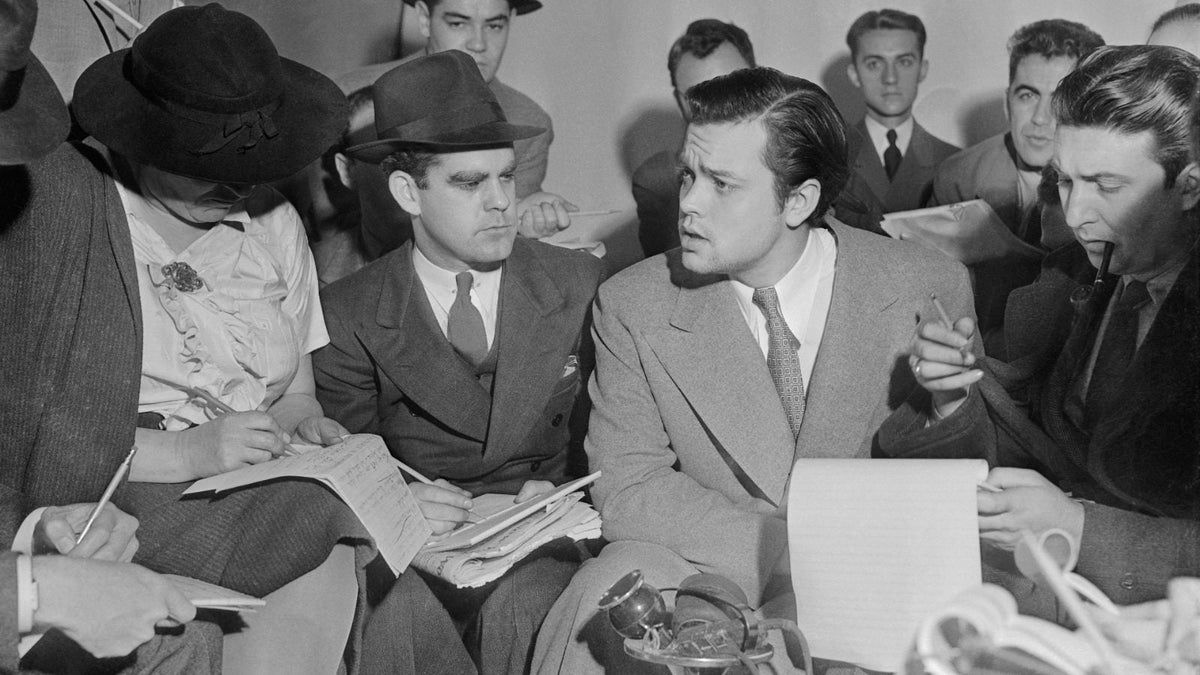
Top image: Orson Welles meets reporters, October 31, 1938. Public domain, via Wikimedia Commons.
We were making the future
H. G. Wells wrote the line in When the Sleeper Wakes in 1899. Quoteiac prints it with its source because the words are better when you know where they came from.
Shop the H. G. Wells quote T-shirt →
Also explore the quote page and the full H. G. Wells collection.