Article: Gifts for English Teachers That Aren't Another Apple Mug
Gifts for English Teachers That Aren't Another Apple Mug
You know the person. They have a classroom library they paid for themselves, one paperback at a time. They write "say more" in the margin and mean it. They can tell when a kid has actually read the book and when the kid read a summary of it.
They already own the apple mug. Probably three.
So here are four lines they could put in front of a class and defend: Milton on good books, Dickinson on the brain, Brontë on letting things go, and Chesterton on knowing where to cut. We went back to the page each one came from: the 1644 pamphlet, the hand-tied booklet, the 1847 novel, the 1928 newspaper column. Below each one is what we found there.
This one is personal. Our founder had an English teacher with a reputation for being tough. She asked to have her again the next year. "She made me think," she says. One line from that class stayed with her, from John Greenleaf Whittier's poem "Maud Muller":
"For of all sad words of tongue or pen,
The saddest are these: 'It might have been!'"
It took her years to understand it. She wasn't raised on "just do it" or "go for it." Quite the opposite. The line waited until she was ready. Good teachers hand those lines over anyway.
Good gifts start with the person, not the product. So we've sorted these by the kind of teacher, not the format.

Model photo created with AI. The printed line is real.
For the one who lends the book knowing it won't come back. Shop the tee →
Where each one goes:
- The classroom library or the book-fair table: Milton, on a tee, a journal or an organic tote.
- Grading night: Dickinson, on a mug.
- The hard year: Brontë, on a mug or a journal.
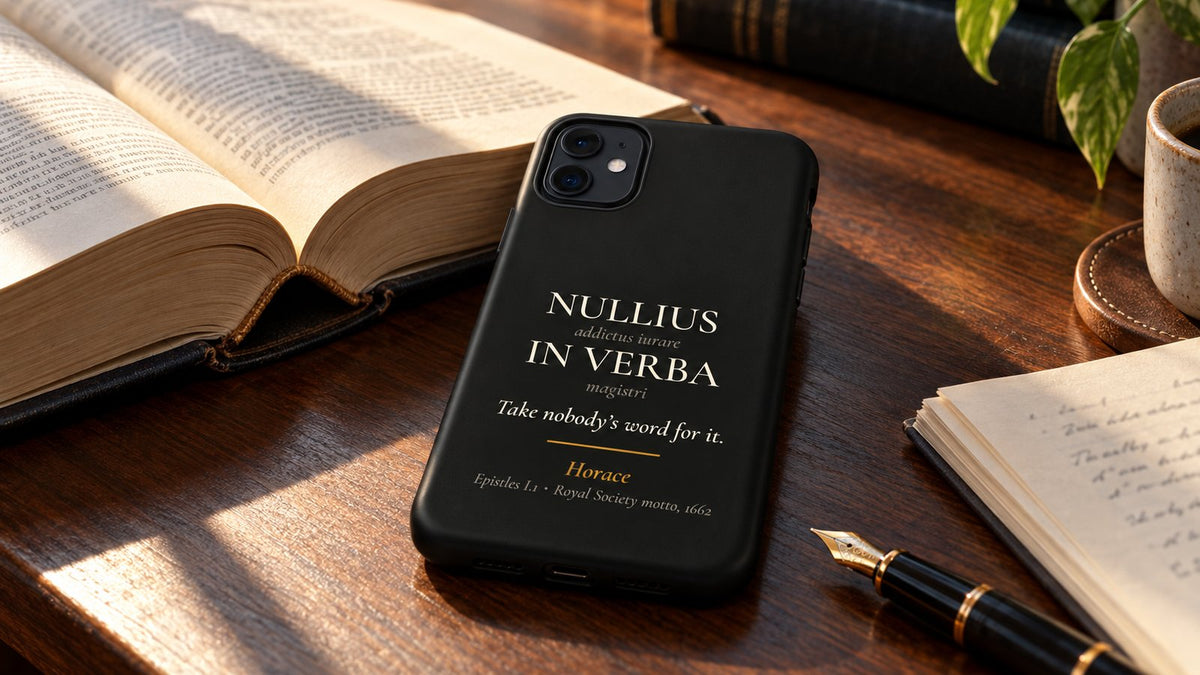
- The writing workshop: Chesterton, on a tee or a phone case.
For the one who guards the classroom library
"…but a good book is the precious life-blood of a master spirit…"
— John Milton, Areopagitica (London, 1644)
The shelf by the window. The checkout clipboard. The book they lend knowing it won't come back, and lend anyway.
The sentence starts with a swipe: "Many a man lives a burden to the earth; but a good book is the precious life-blood of a master spirit." The ellipsis on the tee marks where we cut in. In the 1644 printing it reads "a good Booke is the pretious life-blood of a master spirit, imbalm'd and treasur'd up on purpose to a life beyond life."
Here's the part English teachers will love: a lot of Areopagitica is about teaching. Milton is arguing against a rule that every book be approved by a licenser before printing. His complaint is that it treats grown writers like schoolboys. What is the point of being a man, he asks, "if we have only escaped the ferula" (the schoolmaster's rod) only to have serious writing checked "as if they were no more than the theme of a grammar-lad under his pedagogue"? A few lines later: "how can a man teach with authority, which is the life of teaching," if a censor can blot whatever he likes?
He knew the job. Samuel Johnson's Life of Milton records that, back from Italy, Milton "undertook the education of John and Edward Philips, his sister's sons," then took a house in Aldersgate Street, where "he received more boys, to be boarded and instructed." The same year as Areopagitica, he published Of Education, an eight-page pamphlet with no title page, addressed to the reformer Samuel Hartlib. Johnson, who had run a small school of his own near Lichfield, added a line every teacher will recognize: "how much patience it requires to recall vagrant inattention, to stimulate sluggish indifference, and to rectify absurd misapprehension."
If they've ever walked into the New York Public Library's main reading room, they've walked under this line. The Library's own 1916 Handbook records it inscribed over the door from the catalogue room into the Main Reading Room, keeping Milton's old spelling of "Booke." The Library also owns a 1644 first edition, in its Berg Collection. Its title page names Milton but no printer.
We wrote about Milton's other famous line here, and the full story of this one is on its quote page.
It's also on a journal and an organic tote, which is big enough for a library run.

Model photo created with AI. The printed line is real.
Donated paperbacks, one very full tote. Shop the tote →
For grading night
"The Brain—is wider than the Sky—"
— Emily Dickinson, Poem 598, from her manuscript
It's 10:40 on a Sunday. The stack is forty essays tall, there's a rubric clipped to the top, and the coffee went cold an hour ago. This mug is for the refill.
Dickinson copied this poem into one of her hand-made booklets of folded sheets. Amherst College still has that booklet: six sheets, "tied with string," as its catalog record puts it. It holds twenty-one poems. One of them is "I heard a Fly buzz—when I died—."
Here's what makes it a grading-night poem. In line three, Dickinson wrote "The one the other will contain" and then added a second word, "include," keyed to the first with a small plus sign. She didn't choose between them. She left both standing.
Every English teacher has written "word choice?" in a margin. Dickinson's answer, on her own page, was both, for now. That is a good thing to show a class that thinks revision means the first draft was wrong.
The first printed version, in 1896, picked "include." It also replaced her "Heft them—Pound for Pound—" with "lift them, pound for pound." That wasn't the only time her "Heft" got smoothed out. In "There's a certain Slant of light," her manuscript has "the Heft / Of Cathedral Tunes." The 1890 Poems printed "weight."
The mug keeps her dashes and her capital S. We wrote about why we made this line twice, and about how close her poems came to not surviving at all.

Model photo created with AI. The printed line is real.
Essay 23 of 40. Refill. Shop the mug →
For the one with the hard class this year
"Life appears to me too short to be spent in nursing animosity or registering wrongs."
— Charlotte Brontë, Jane Eyre (1847), Chapter VI
The period after lunch. The parent email that came in at 9 p.m. The student who is going to be a problem until, one day, he isn't. Some years you need to start every morning with a clean slate, and some years that's hard.
Look at what happens in Chapter VI just before Helen Burns says this line. The washbasins at Lowood school are frozen, so Helen can't clean her nails. Her teacher, Miss Scatcherd, calls her "dirty" and sends her to fetch "a bundle of twigs tied together at one end." Then she strikes Helen a dozen times on the neck, in front of the class. Helen doesn't cry. Later, when Jane pours out every grievance against the aunt who raised her, Helen says: "how minutely you remember all she has done and said to you!"
Brontë didn't make it up. Ten years after the novel, her friend and biographer Elizabeth Gaskell wrote that Helen Burns "is as exact a transcript of Maria Brontë," Charlotte's older sister, "as Charlotte's wonderful power of reproducing character could give." She added that Miss Scatcherd was based on a real teacher at Cowan Bridge, the school the sisters attended, "whose real name I will be merciful enough not to disclose."
Then Brontë became a teacher herself. Gaskell dates it: on July 29, 1835, Charlotte, "now a little more than nineteen years old, went as teacher" to Roe Head school.
She gave Jane the job too. Jane stays at Lowood eight years, "six as pupil, and two as teacher." Later, running a village school, she writes after the first day: "I had twenty scholars. But three of the number can read: none write or cipher." The next chapter opens with what every first-year teacher eventually says out loud: "It was truly hard work at first."
That's who the line is for: someone who knows both sides of the teacher's desk, and chooses not to keep a list. More on Brontë and the dark she wrote through.

Model photo created with AI. The printed line is real.
Clean slate tomorrow. Shop the mug →
It's also on a journal.
For the one who teaches cutting
"Art, like morality, consists of drawing the line somewhere."
— G.K. Chesterton, "Our Note Book," Illustrated London News (5 May 1928)
Creative writing. AP Lang. The yearbook room on deadline. This is the teacher who hands back your favorite paragraph with one line through it, and is right.
Chesterton printed it on page 780 of the May 5, 1928 issue. The paper has it as "consists of drawing," and so does the tee. Within weeks, other papers were reprinting it with a small change. On May 29, 1928, the Boston Herald ran it as "consists in drawing," and that's the version you'll still find on many quote sites.
We also checked the version credited to Oscar Wilde: "Morality, like art, means drawing a line someplace." Quote Investigator found no evidence Wilde ever said or wrote it. Their search began when a reader saw it credited to Wilde on an educator's web page. So an educator's misquote is what led back to the real source.
On the tee, a thin gold rule sits under "the line." Below it, "somewhere." stands on its own. That's how the sentence works.

Model photo created with AI. The printed line is real.
Your favorite paragraph. One line through it. Right again. Shop the tee →
It's also on a phone case.
Not sure which line is theirs?
Take Find Your Line and choose For someone else. Answer five quick questions with them in mind, and it'll point you to lines that might fit.
Or browse the Quote Library and wait for the line that makes you think, that's them. If they're the kind of reader who writes in margins, start with gifts for people who underline books.
If we can't verify it, we don't print it.
Questions we get
When do I need to order for Christmas?
We can't guarantee holiday delivery. For your best shot at Christmas, order by Thursday, November 26.
What's a good gift for an English teacher from a parent?
Something that lives on the desk. A mug gets used every day. Add a note naming one book your kid actually finished this year. That's the part they'll keep.
Did Oscar Wilde say "Art, like morality, consists of drawing the line somewhere"?
No. G.K. Chesterton wrote it in his Illustrated London News column on May 5, 1928. The Wilde version uses different words and has no source.
Which is right, "contain" or "include"?
Both are Dickinson's. Her manuscript has "contain" in the line, with "include" written in as an alternate. The first printed edition chose "include."
Can the mugs go in the dishwasher?
Hand washing is recommended. It keeps the print looking new longer. Each one is a 15 oz ceramic mug.
Free shipping on orders over $50.
The Quoteiac Team: Posts with this byline are researched, written, and edited by different members of our team, each working from their own interests and strengths. Every quote is checked against its original source before it goes up.