Emily Dickinson's Poems Almost Didn't Survive
Emily Dickinson died on May 15, 1886, leaving behind nearly 1,800 poems in a cedar chest at the Homestead in Amherst, Massachusetts. Most had never been seen outside her immediate circle. Many were hand-sewn into small booklets. She had not arranged for their publication, and what she asked of her sister — according to that sister — was that her papers be burned. Read the full argument for why she was anything but fragile.
They weren't. And that fact — that narrow escape — is the actual story of Emily Dickinson's poetry.
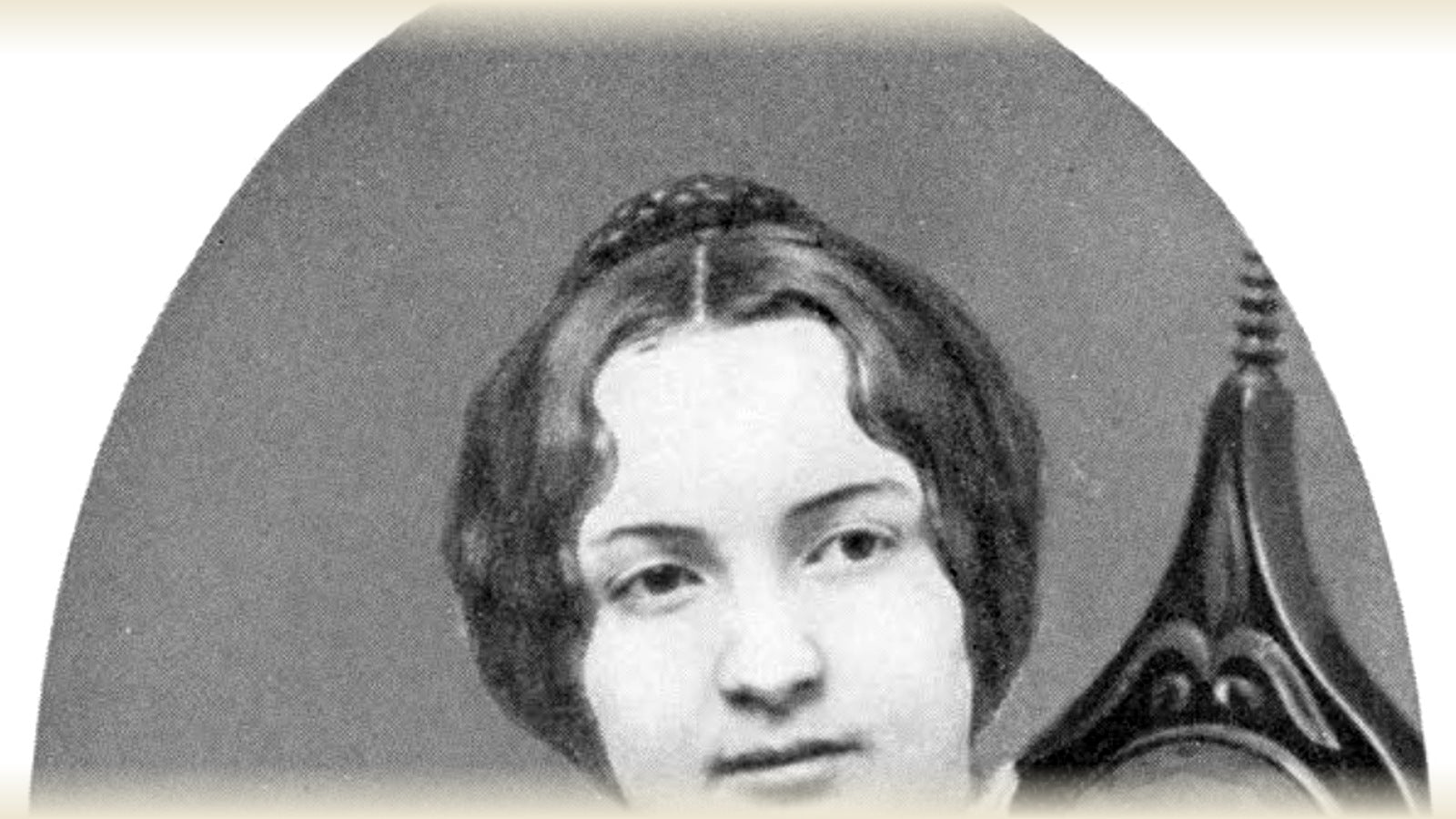
Image above is Lavinia Dickinson, Emily's sister — frontispiece from The Life and Letters of Emily Dickinson by Martha Dickinson Bianchi, 1924. It was Lavinia who opened the cedar chest, decided the poems would not burn, and spent the next thirteen years fighting for their publication. Public domain.
What Lavinia Found
It was Lavinia Dickinson, Emily's younger sister, who opened the chest. What she found were forty fascicles: sheets of poems copied out in Emily's hand, folded and stitched together with a needle and thread. There were also loose manuscripts, scraps, worksheets — hundreds of poems in various states. Lavinia had burned the correspondence as requested. The poems, she decided, were different. They would not burn. Read about why Dickinson made those books for herself in the first place.
Lavinia had no editorial experience and no literary connections of her own. What she had was conviction — stubborn, relentless conviction that the world needed to read what her sister had made. She spent the next thirteen years of her life making that happen. She died in 1899 still fighting for it.
Her first move was the obvious one: she went next door. Susan Gilbert Dickinson, Emily's sister-in-law and the person Emily had trusted most as a reader during her lifetime, lived at the Evergreens — a few hundred feet from the Homestead. Susan had received more than 250 poems from Emily over the course of their friendship, sometimes with small revisions scrawled in the margins, sometimes with requests for Susan's opinion. She knew the work better than almost anyone. Lavinia handed her the manuscripts and asked her to edit them for publication.
Susan moved slowly. Too slowly for Lavinia. The reasons are still debated — Susan's grief, her own complicated feelings about Emily's legacy, the sheer difficulty of the task. Whatever the cause, Lavinia grew impatient. She retrieved the manuscripts and turned elsewhere.
The Editors Who Got There
Lavinia approached Thomas Wentworth Higginson, the literary critic and Atlantic Monthly contributor who had corresponded with Emily for more than twenty years. Emily had first written to Higginson in 1862, asking whether her verse was "alive." He had been cautious, even skeptical — he had advised her against publication during her lifetime. But he recognized what was in front of him now. He agreed to help.
Lavinia also enlisted Mabel Loomis Todd — a writer, painter, and musician who had moved to Amherst in 1881. Todd had never met Emily. Emily had refused most visitors. But she had played piano and sung at the Homestead while Emily listened from the next room, and she had fallen in love with the poems Emily sent down in thanks. She threw herself into the editorial project with an intensity that would define the next decade of her life and fuel a family feud that would outlast her.
Together, Todd and Higginson edited the first posthumous collection, Poems by Emily Dickinson, published in November 1890 by Roberts Brothers of Boston. It sold out its first print run within weeks. A readership that had never heard of Emily Dickinson suddenly couldn't get enough of her.
What that readership didn't know — what wouldn't become clear for another sixty-five years — was how heavily the poems had been altered. Todd and Higginson smoothed out Emily's punctuation, regularized her capitalization, added titles she had never given her poems, and adjusted line breaks and rhymes that didn't conform to nineteenth-century conventions. They were not being careless. They were being editors of their time, making a strange and difficult body of work accessible to a Victorian audience. But in doing so, they gave the world a version of Dickinson that was, in crucial ways, not quite Dickinson.
The Archive Splits
The story grew more complicated before it grew clearer. A property dispute between Mabel Loomis Todd and the Dickinson family — rooted in a land transfer that Austin Dickinson, Emily's brother, had promised Todd and that Lavinia's estate later contested — ended in a lawsuit and a lasting rupture. Todd, embittered, locked away her portion of the manuscripts. They sat largely untouched for decades.
The Dickinson papers fractured along family lines. The manuscripts held by the Dickinson side eventually made their way to Harvard's Houghton Library, acquired in 1950. Todd's daughter, Millicent Todd Bingham, donated the Todd family's share to Amherst College in 1956. For years, the two halves of a single archive sat in separate institutions, their relationship to each other unresolved — a divided inheritance that reflected the human drama underneath it.
Meanwhile, Emily's niece Martha Dickinson Bianchi published her own editions, drawing on Susan's collection. The result: multiple competing editions, each shaped by the priorities of whoever had controlled the papers.
The Poems, Restored
It wasn't until 1955 that the full, unaltered scope of Dickinson's work came into view. That year, Thomas H. Johnson published his three-volume variorum edition through Harvard University Press — 1,775 poems, arranged chronologically, with variant readings compared against the manuscripts. For the first time, the dashes were there. The capitalization was there. The poems looked the way Emily had written them.
Johnson's edition was a revelation. It showed, among other things, that the Dickinson the nineteenth century had published was a tidied-up approximation of a far stranger, more rigorous, more formally radical poet. The dashes weren't errors. The capitals weren't accidents. Every mark was deliberate — and every editorial "correction" had cost something.
R.W. Franklin's 1998 variorum edition went further still, reassembling the fascicles in their original sewn order and refining the chronology of composition. The work of preservation had become, finally, the work of restoration.
The People Behind the Poems
The poems on the Quoteiac Emily Dickinson page carry what Quoteiac calls provenance — verified sources, confirmed texts, nothing paraphrased and printed as though it were real. That standard exists because of what the archival history of Dickinson's work actually cost. The poem on our "I dwell in Possibility —" shirt (Fr466, c. 1862) and the one on the "The Brain — is wider than the Sky —" shirt (Fr598, c. 1862) exist in verified form because Johnson sat with the manuscripts in 1955 and refused to guess.
So did Lavinia, in 1886, standing over a chest of poems with no instructions and a promise to burn them.
The poems almost didn't exist. That they do is not a miracle — it's a record of human effort, human stubbornness, and human love for language. Explore the full Emily Dickinson collection at Quoteiac, where every quote carries its source.
Words with provenance. If we can't verify it, we don't print it.
About the Author
Vickie MacFadden is the founder of Quoteiac. She uses em dashes freely and encourages everyone else to — the argument that they signal AI writing is one she finds unpersuasive, given that Dickinson built an entire poetic system around them a hundred and fifty years before there was such a thing.