Emily Dickinson Wasn't Fragile. She Was Volcanic.
The story most people know about Emily Dickinson goes something like this: a shy, sensitive woman who never left her house, wrote poems in her room, and published almost nothing in her lifetime. A tragic figure. A fragile one.
Almost none of that holds up.
Dickinson did spend much of her adult life in her family home in Amherst, Massachusetts. She did publish very little — fewer than a dozen poems appeared in print while she was alive. But the conclusions people draw from those facts — that she was timid, that she was damaged, that she was somehow less than fully present in her own life — are a projection. They say more about what people expected a 19th-century woman poet to be than about who Dickinson actually was.
She chose her life deliberately
Dickinson wasn't confined to her house. She withdrew from it — gradually, and on her own terms. She had a full social life well into her twenties. She corresponded prolifically with editors, poets, friends, and thinkers throughout her life. The decision to contract her world was a considered one, not a collapse.
She wrote to a friend: "I do not go from home." Not "I cannot." Not "I am afraid." She did not go. The distinction matters.
The poems are not gentle
Read the actual work and the "fragile" reading becomes impossible to sustain. Dickinson wrote about death with a clinical precision that unsettled her contemporaries. She wrote about God with a skepticism that bordered on argument. She wrote about her own mind as a thing she was simultaneously living inside and studying from the outside.
"The Brain — is wider than the Sky —" she wrote. "For — put them side by side — / The one the other will contain / With ease — and You — beside —" See why we printed that line twice — and in two completely different registers.
That is not the voice of a woman who thought small of herself.
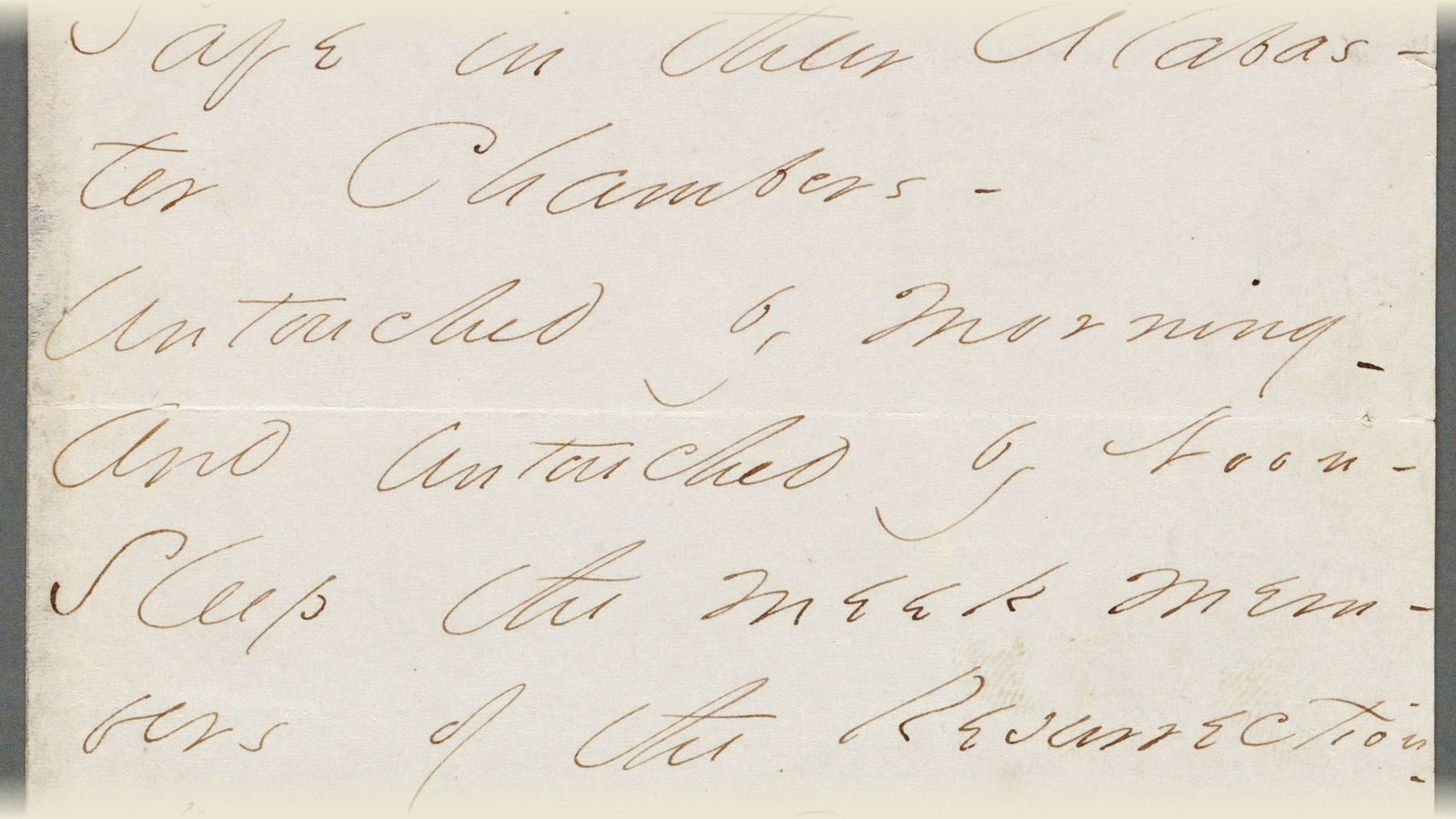
Her punctuation alone — the em dashes that interrupt and redirect every line — is an act of control. She wasn't writing in the conventions of her time. She was dismantling them and building something new in the gaps. No editor who saw her work in her lifetime knew what to do with it. That's usually a sign that someone is ahead, not behind.
She understood exactly what she was doing
Dickinson sent poems to Thomas Wentworth Higginson, an influential literary editor, asking if her work was "alive." He wrote back with suggestions for revision — to make the meter more regular, the poems more conventional. She thanked him warmly and kept writing exactly as she had been.
She knew. She wasn't asking for permission. She was, perhaps, looking for a witness. Read the argument she was making by keeping her poems off the market.
The nearly 1,800 poems she left behind — tied in packets, kept in a locked box, discovered after her death — weren't the accumulation of a woman who gave up. They were the output of someone who worked at a volume and intensity that most writers, published and celebrated in their own time, never approached. Read about how close her nearly 1,800 poems came to never existing at all.
What the myth costs
When we flatten Dickinson into the fragile recluse, we make her easier to dismiss. We turn her choices into symptoms. We make the strangeness of her work into evidence of damage rather than evidence of vision.
She deserves better than that. So do the people who love her work — many of whom recognize something in it that the "fragile" framing can't account for. A ferocity. A precision. A willingness to look directly at the things most writers look away from.
That's not fragility. That's the opposite of it.
Dickinson's work lives in our Dark Romanticism collection — alongside the writers who understood that the most honest art doesn't look away. Explore the Emily Dickinson collection.
The image at the top of this article is Emily Dickinson's autograph manuscript of “Safe in their Alabaster Chambers” (1862) — written during the most prolific year of her life, when she composed nearly 400 poems. The dashes are hers, exactly as she wrote them. Held at Amherst College Archives & Special Collections. Public domain.