Did Edgar Allan Poe Write "There Is Eloquence in True Enthusiasm"? No. It's Washington Irving's.
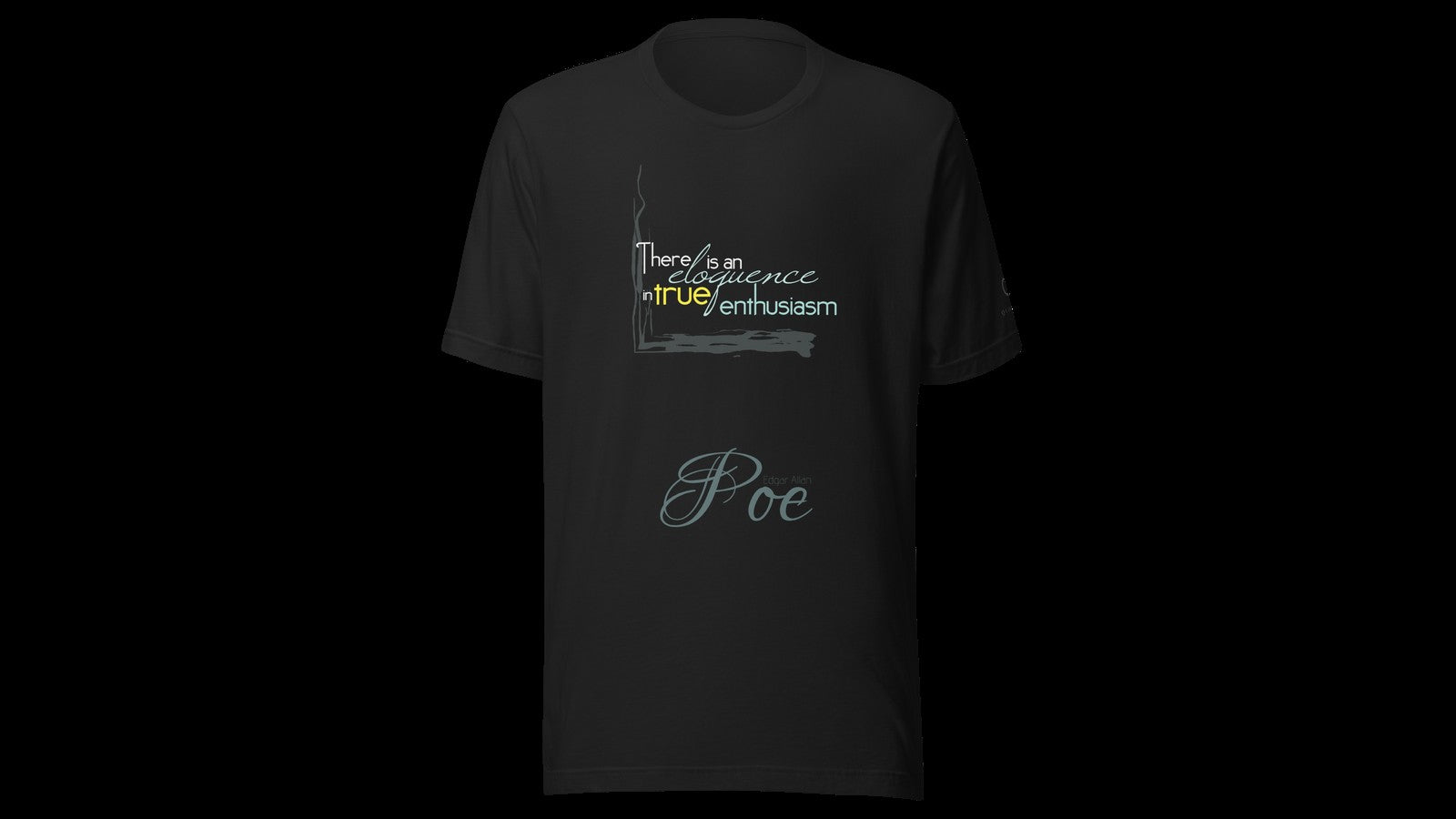
Verdict: Misattributed. We sold three products with this line — “There is an eloquence in true enthusiasm” — attributed to Edgar Allan Poe. It isn’t Poe’s. The line comes from Washington Irving’s Tales of a Traveller (1824), from a story called “The Adventure of the German Student.” Irving wrote it when Poe was fifteen years old. Here’s how we missed it and what the primary source actually says.
| Quote in circulation | “There is an eloquence in true enthusiasm” |
| Attributed to | Edgar Allan Poe |
| Actual author | Washington Irving |
| Primary source | Tales of a Traveller, “The Adventure of the German Student,” 1824 |
| Verification status | ❌ Misattributed — removed from site |
We sold three products with this line on them:
"There is an eloquence in true enthusiasm."
The attribution on every one of them read: Edgar Allan Poe.
It isn't Poe's. It's Washington Irving's — and we missed it. This is the story of how that happens, and what we're doing about it. For the verification standard we run before anything goes on a shirt, see the full process.
What Irving Actually Wrote
The line comes from Tales of a Traveller, published in 1824. Specifically, from a story called "The Adventure of the German Student" — one of the darker pieces in the collection, about a young scholar in revolutionary Paris who becomes obsessed with a mysterious woman. The full sentence reads:
"Indeed, there is an eloquence in true enthusiasm that is not to be doubted."
It's a narrator's observation about the student's manner — not a standalone aphorism, not a line Poe ever wrote, not even close to Poe's voice. Irving wrote it when Poe was fifteen years old.
How It Got Attached to Poe
This is the part worth understanding, because it's not random.
"The Adventure of the German Student" is gothic. It involves obsession, a severed head, and a question about whether the woman the student loves is actually dead. Strip the context from the line — pull "there is an eloquence in true enthusiasm" out of Irving's narrative and float it on a black background — and it sounds like something from Poe's world. Dark romanticism. Brooding intensity. The kind of line that would fit in a letter from a tormented 19th-century writer.
So somewhere in the internet era, someone attached Poe's name to it. Quote aggregator sites picked it up. Products got made. The attribution calcified. Quote researcher Sue Brewton documented this specific misattribution as early as 2014 — noting that she'd found greeting cards and mugs printed not only with the wrong author, but with misspellings of both "eloquence" and "Poe."
Nobody checked. Nobody cared. It felt right, so it became right.
The Primary Source Is Easy to Find
This isn't an obscure case. The full text of Tales of a Traveller is on Project Gutenberg. "The Adventure of the German Student" is right there — you can search for the line and find it in seconds. The Library of America's official Irving collection confirms it. The Edgar Allan Poe Society of Baltimore, which catalogs every verified Poe text, has no record of it.
Washington Irving. 1824. Not Poe.
What We Did With the Products
We've archived the Eloquence Tee, the Eloquence of Enthusiasm Tee, and the Eloquence Insulated Tumbler. All three are gone from the store.
We're not keeping them with a corrected attribution. Irving is worth selling — and we may build something around him properly one day. But slapping a new name on the same design and calling it fixed isn't how this works. The products were built around a wrong idea. They need to start over.
Why This Is Worth Writing About
We started Quoteiac on the premise that words deserve to be handled with care — that the attribution matters, that the source matters, that the difference between what someone actually said and what the internet decided they said is worth knowing.
We missed one. Three products, live on the site, with the wrong name on them. See also: the Marie Curie case — the other quote we couldn’t verify.
The honest response isn't to quietly fix it and hope nobody noticed. It's to write it up plainly: here's what was wrong, here's how it happened, here's what we found, here's what we did. That's what taking words seriously actually looks like — not perfection, but the willingness to check, and when you miss, to say so out loud.
The words shape you. We make sure the words are real. And when we get that wrong, we own it. See also: the lines Poe actually wrote.
— The Quoteiac Team
Washington Irving (1783–1859) wrote "The Adventure of the German Student" as part of Tales of a Traveller (1824). The full text is freely available at Project Gutenberg. The misattribution to Poe was documented by quote researcher Sue Brewton in 2014.