Why Emily Dickinson Valued Private Journals Over Public Fame (And What It Teaches Modern Creators)
“The Brain — is wider than the Sky —” by Emily Dickinson does not mean that human intelligence is superior to nature, or that genius transcends the physical world. It was written in 1862 to describe the mind’s capacity for interiority — the idea that everything you encounter outside yourself can be absorbed, held, and contained within the space behind your eyes.
The poem is not a boast. It is an argument for interior life—and it goes a long way toward explaining why Dickinson spent decades writing poems she never tried to publish. See also why we made that line twice — and what the design difference tells you about the poem.
A Stark Publication Record
The publication record is stark. During Emily Dickinson’s lifetime, fewer than twelve of her poems appeared in print—most of them without her full consent and nearly all of them with her punctuation “corrected” by editors who found her dashes excessive. She did not fight them. She also did not stop writing. By the time she died in 1886 at age fifty-five, she had produced approximately 1,800 poems. The ratio is almost absurd: one published for every 150 written.
The conventional reading of this fact is that Dickinson was shy, or that the literary world was hostile to women, or that she simply lacked the connections to get her work into the right hands. All three things carry some truth. But they miss the more interesting explanation: she may not have wanted what publication offered.
Her letters suggest a writer who understood, earlier than most, that the moment a poem becomes public property, it stops being yours. The editor’s pen arrives, and suddenly your dash—that loaded pause, that breath mid-thought—becomes a comma, and the poem means something slightly different. Something flatter.
The Fascicles: Finished Work, Hidden Deliberately
What Dickinson did instead was make books for herself. Between roughly 1858 and 1864, she copied her poems onto folded sheets of letter paper, stacked them in groups of around twenty, and sewed them together with thread along the left-hand spine. Scholars call these hand-sewn booklets fascicles—a word borrowed from botanical taxonomy, meaning a small bundle. She made approximately forty of them.
These were not drafts. They were not work-in-progress scraps waiting for a publisher’s eye. The poems in the fascicles are polished, ordered, and in several cases arranged with what looks like deliberate sequencing—the way a poet arranges a collection. Dickinson bound them herself, kept them in her dresser drawer, and showed them to almost no one.
The fascicles are the closest thing we have to what she actually intended her work to look like: unpunctuated by anyone else’s taste, unsmoothed by anyone else’s sense of how a line should end.
The fascicle is not a private journal in the diary sense—there is no “Dear journal, today I felt sad.” It is a private archive. A completed body of work that she chose, deliberately, not to release into the world’s hands. Read about the woman who almost never published.
What Editors Did After Her Death
When Thomas Wentworth Higginson—the literary critic Dickinson had corresponded with for twenty-four years—and Mabel Loomis Todd published the first posthumous collection in 1890, they did what nineteenth-century editors did: they normalized.
Her dashes were smoothed into conventional punctuation. Her capitalization (which she used structurally, to give weight to nouns the way German does) was regularized. Her line breaks, which carry enormous sonic meaning in her compressed stanzas, were occasionally rearranged. The poems that reached readers for the following sixty years were, in a precise editorial sense, not quite hers.
It took until Thomas H. Johnson’s 1955 scholarly edition—and further corrective work through the 1980s and 1990s by R. W. Franklin, whose variorum edition appeared in 1998—to restore what Dickinson had actually written. Franklin worked from the original manuscripts and fascicles.
What he found confirmed what close readers had long suspected: the dashes are not careless. They are the poem. Remove them and you remove the timing, the ambiguity, the white space where the reader’s mind is supposed to do something.
The editorial violence committed against Dickinson’s work is not a minor footnote. It is the central irony of her legacy: a poet who kept her work private specifically to preserve its integrity had that integrity compromised the moment her work became public. She was right to be cautious. She was right in ways she never got to see vindicated.
What This Means for Anyone Who Makes Things Now
The pressure on creators to publish constantly—to post, to share, to get the work out and build an audience before the algorithm decides you’re irrelevant—is not a new kind of pressure. It is the same old pressure dressed in newer clothes.
Dickinson’s editors wanted her to smooth the dashes. The note to “make it more accessible” or “keep it under 200 words” or “can you add a hook in the first three seconds” — the language changes, the pressure does not. The request is always the same: make it easier for an audience to consume, even if that means making it less true.
Dickinson’s answer was to keep the work in her drawer. Not out of fear or failure, but out of a clear-eyed understanding of what publication costs. She carried her poems—sometimes literally, folded in her apron pocket—as private objects. Things she had made, that meant what she meant them to mean, before anyone else’s interpretation arrived to complicate them.
That instinct—to hold a line close before you release it, or to hold it close forever—is what the Fleur de Brainiac phone case is built around. It carries “The Brain — is wider than the Sky —” framed by fleurons—those small leaf-and-vine ornaments (hedera, Latin for ivy) that typesetters used on 15th-century printing presses to mark pauses and divisions in a text. The fleuron was a printer’s way of saying: something significant is happening here. On a phone case, that framing turns the quote back into a private object—something carried in your hand, not published to a feed.
There is a version of Dickinson scholarship that treats her reclusiveness as a pathology, or her refusal to publish as a failure of nerve. That reading has not aged well. What the fascicles and the letters and the full arc of her work suggest instead is a poet who made a deliberate wager: that the integrity of the work mattered more than its reach. She lost 60 years of accurate publication. She gained a body of work that, once restored, turned out to be exactly what she made it.
The Argument the Poem Was Always Making
“The Brain — is wider than the Sky —” is not a poem about intelligence. It is a poem about containment—about the fact that the mind can hold the sky, the sea, the weight of God, and still have room. Dickinson’s private practice was the literal enactment of that claim: she put 1,800 worlds into hand-sewn booklets and kept them. The work was complete. The audience was optional.
That is still a position available to anyone who makes things. You can finish something without publishing it. You can decide that a line belongs in your pocket rather than on a platform. The work doesn’t become less real because fewer people see it. Dickinson proved that at scale—years of scale.
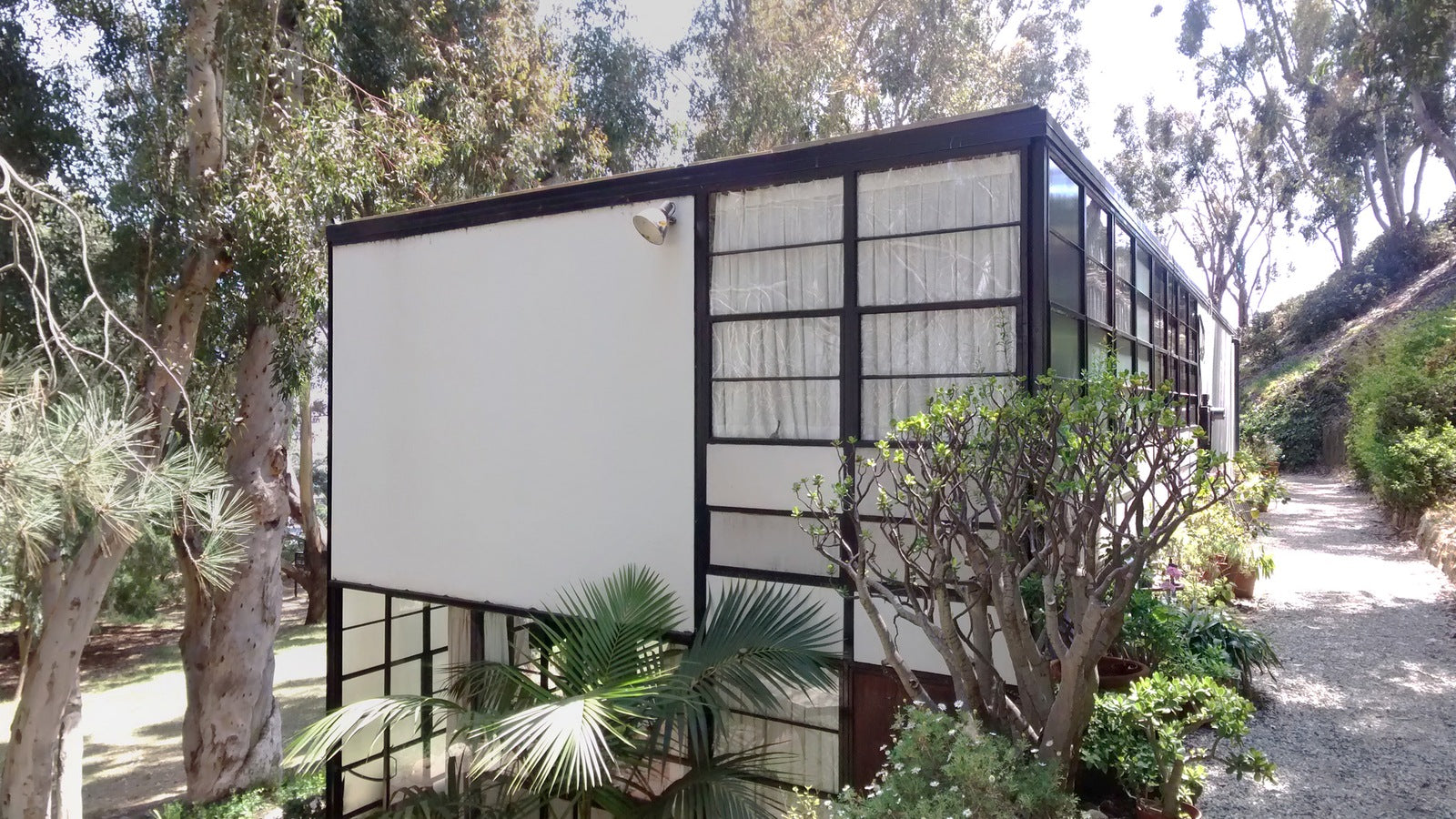
Hero image: The Dickinson Homestead, Amherst, Massachusetts — the house Emily Dickinson rarely left. She wrote nearly 1,800 poems here, published fewer than a dozen in her lifetime, and chose the work over the world. Photograph by Carol M. Highsmith, 2019. Library of Congress, public domain.
Shop the Dickinson Collection
- Possibility — Emily Dickinson T-Shirt — “I dwell in Possibility —” on organic garment-dyed cotton.
- Possibility — Emily Dickinson Mug — the same line, close at hand for the first cup.
- Fleur de Brainiac — Emily Dickinson T-Shirt — “The Brain — is wider than the Sky —” with Victorian hedera.
- Fleur de Brainiac — Emily Dickinson Phone Case — the hedera design carried in hand.