Gifts for Lawyers and Law Students: The Line John Adams Used to Defend the Boston Massacre Soldiers
You know the person. They read the fine print. They ask "says who?" at dinner. They spent years learning to argue both sides, and they're not about to stop at Thanksgiving.
Maybe they just passed the bar. Maybe they're one semester in and sleeping next to a casebook. Maybe they've been on their feet in court since before you met them.
Someone who lives on evidence should get a gift that has some. So every line below comes with its receipts: who said it, where, and when. We checked each one against the original text before it went on anything.
Here are four: John Adams defending the Boston Massacre soldiers. Horace on taking nobody's word for it. Montaigne on welcoming an argument. And Samuel Butler, who hated inaccuracy more than lying.
Good gifts start with the person, not the product. So we've sorted these by the person, not the format.

Model photo created with AI. The printed line is real.
For the one still reading the transcript on the last train home. Shop the tee →
For the one who took the hard case
"Facts are stubborn things; and whatever may be our wishes, our inclinations, or the dictates of our passions, they cannot alter the state of facts and evidence…"
— John Adams, argument for the defense, Rex v. Wemms, Boston (December 3–4, 1770)
Public defender. Legal aid. The first-year associate handed the client nobody else wanted. They know what it feels like when the room has already made up its mind. They show up anyway, with the file.
Adams opened his closing by apologizing for his clients in someone else's words. He quoted the Marquis Beccaria: "If I can but be the instrument of preserving one life, his blessing and tears of transport, shall be a sufficient consolation to me, for the contempt of all mankind."
The jury that heard him didn't include a single Bostonian. He ended with Algernon Sidney on the law, then added his own last word: "On the one hand it is inexorable to the cries and lamentations of the prisoners; on the other it is deaf, deaf as an adder to the clamours of the populace."
On the third anniversary of the shooting, he wrote in his diary that the case "procured me Anxiety, and Obloquy enough." He still called the verdict "exactly right." The full trial story is here.
For the law student who checks every citation
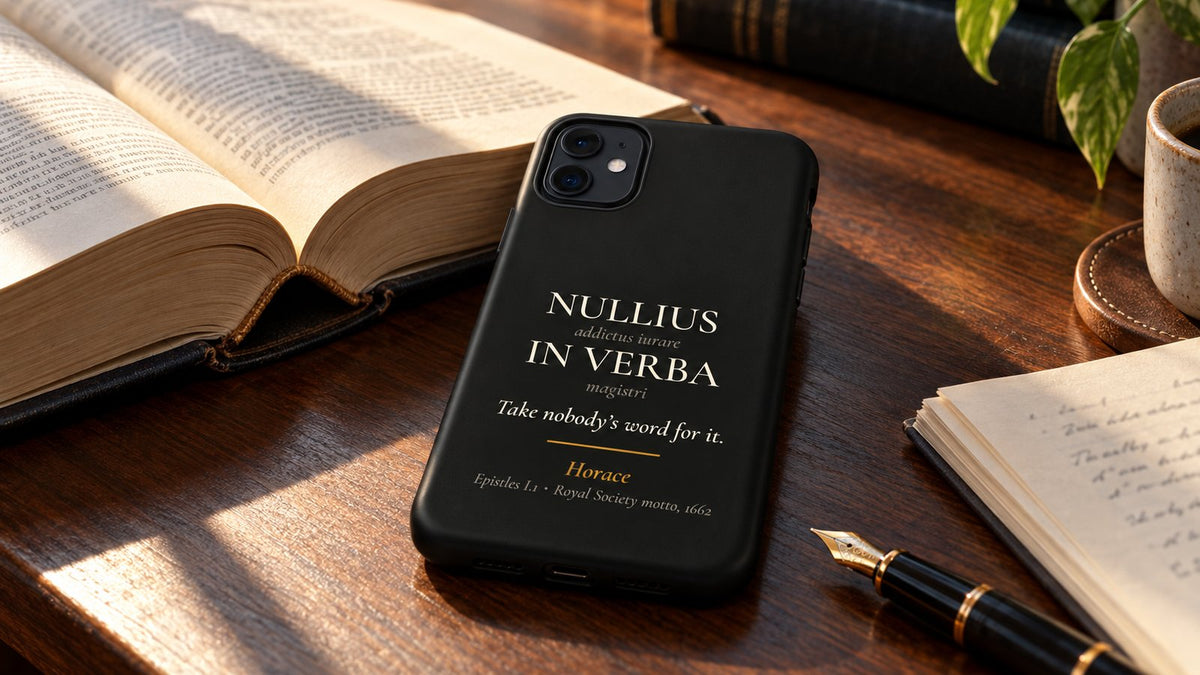
"Nullius in verba — Take nobody's word for it."
— Horace, Epistles I.1, line 14 (c. 20 BC). The Royal Society's motto since 1662.
They pull the case instead of trusting the summary. They read the footnote. They asked the professor where that holding came from, then went and found it. Exhausting in a study group. Exactly who you want on your side later.
In the full line, Horace says he isn't bound to swear by the words of any master. Three lines earlier, he tells his patron what he's after instead: "quid verum atque decens," what is true and fitting. "Curo et rogo et omnis in hoc sum." Roughly: I care about it, I ask about it, I'm all in.
The Royal Society chose the phrase for its coat of arms in 1662, the year of its first charter. Its own history notes that the early Fellows weren't professional scientists. They were lawyers, merchants, physicians, aristocrats and landowners. Some of the first people to sign up for "take nobody's word for it" practiced law.
The tee prints the full Latin line, with Horace's missing words set small between the big ones. Here's more on what Horace meant.

Model photo created with AI. The printed line is real.
For the one who pulls the case instead of trusting the summary. Shop the tee →
It's also on a journal and a phone case.
For the litigator who welcomes the objection
"When any one contradicts me, he raises my attention, not my anger."
— Michel de Montaigne, "Of the Art of Conference," Essais, Book III, Chapter 8 (1588), translated by Charles Cotton
Opposing counsel stands up. Some lawyers bristle. This one leans in, because now we're getting somewhere. They can argue all afternoon and still grab a drink with the other side after.
Montaigne opens this essay with a line any lawyer would recognize: "'Tis a custom of our justice to condemn some for a warning to others." Then he turns to the craft of arguing well. Right after the line on the tee, he writes: "I advance towards him who controverts, who instructs me; the cause of truth ought to be the common cause both of the one and the other."
He even floats keeping score. It wouldn't be amiss, he writes, to settle disputes by wager, so the losses leave a mark and his servant could tell him: "Your ignorance and obstinacy cost you last year, at several times, a hundred crowns." Anyone who bills by the hour will appreciate the bookkeeping.
On the tee, a crack runs through "anger," next to an open ensō. We wrote more about this essay here.

Model photo created with AI. The printed line is real.
For the night before the hearing, rehearsing both sides. Shop the tee →
It's on an organic tee and a sweatshirt.
For the one who redlines everything
"I do not mind lying, but I hate inaccuracy."
— Samuel Butler, The Note-Books of Samuel Butler (1912), "Truth and Convenience"
Contracts. Briefs. The group-chat dinner plans. They catch the wrong date, the missing comma, the "its" that should be "it's." They're not trying to be difficult. They just can't let a wrong thing stand.
Butler started carrying a notebook early in life, and this line sits in a run of short notes under the heading "Falsehood." The first one plays on a maxim every law student meets: de minimis non curat lex, the law doesn't concern itself with trifles. Butler wrote: "Truth consists not in never lying but in knowing when to lie and when not to do so. De minimis non curat veritas."
Truth, he's saying, can let the small stuff go. A few notes later, he makes clear that accuracy can't.
On the tee, a small measuring bracket sits under "lying."

Model photo created with AI. The printed line is real.
For the one who catches the typo in the closing argument. Shop the tee →
It's also on a long sleeve tee.
Not sure which line is theirs?
Take Find Your Line and choose For someone else. Answer five quick questions with them in mind, and it'll point you to lines that might fit.
Or browse the Quote Library and wait for the line that makes you think, that's them.
If we can't verify it, we don't print it.

Model photo created with AI. The printed line is real.
For the one who took the case nobody wanted. Shop the tee →
Questions we get
When do I need to order for Christmas?
We can't guarantee holiday delivery. For your best shot at Christmas, order by Thursday, November 26.
Did John Adams coin "Facts are stubborn things"?
No. The phrase was already in print in 1717, decades before the trial. Adams is the reason people still quote it. Here's where it came from.
Are those Adams's exact words?
They're the closest record we have. His argument survives in John Hodgson's shorthand report of the trial, printed in Boston in 1770. The reporter summarized some passages instead of printing them in full, and the editors of Adams's legal papers warn the transcript may hold errors. The tee uses the wording that record gives.
What's a good gift for a law student?
Something they'll use at a desk. The Nullius in Verba journal is made for the notes they check twice.
Free shipping on orders over $50.
The Quoteiac Team: Posts with this byline are researched, written, and edited by different members of our team, each working from their own interests and strengths. Every quote is checked against its original source before it goes up.