What the Founders Actually Said (And Why It Matters in 2026)
America’s 250th anniversary runs all of 2026 — the official celebration launched in January and runs through December, well past July 4. If you have history buffs in your life, that is a full year to find something that honors the milestone without resorting to the usual merchandise. Which is a reasonable occasion to go back to the actual words.
Not the decorative versions that appear on mugs and posters without context, but the sentences the Founders wrote in specific places, under specific pressure, for specific reasons. What is striking, reading them now, is how precisely their problems map onto ours. Not because the Founders were prophets. Because the problems of self-governance, it turns out, are perennial.
Every quote below is verified against a primary source. Every attribution is documented. That is not a footnote — it is the point.
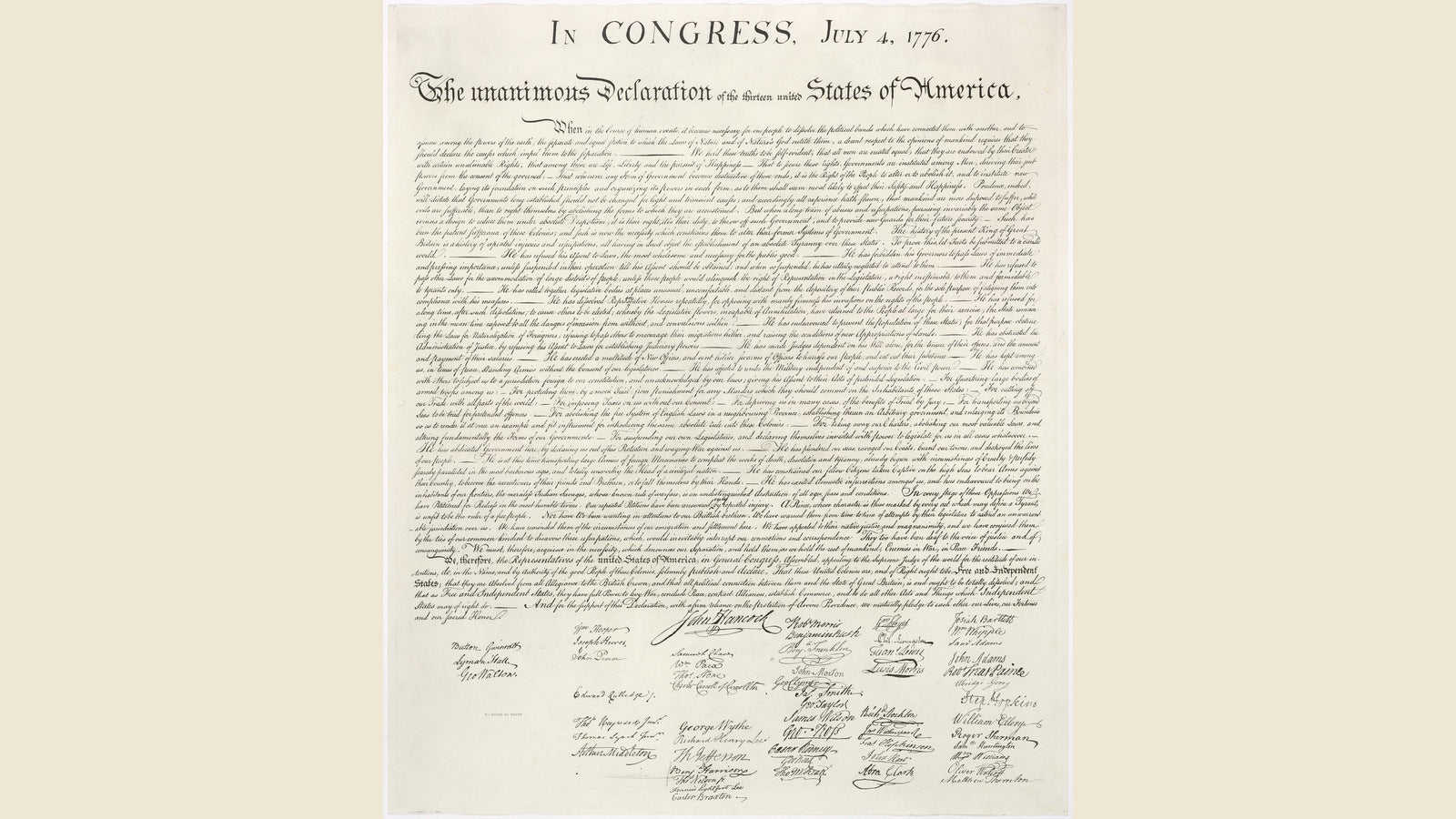
The Declaration of Independence, 1776 — this reproduction is from the 1823 William Stone facsimile, made while the original parchment was still legible. Stone may have used a wet-press process to transfer ink directly from the original document. The National Archives holds both.
John Adams: “Facts are stubborn things.”
Closing argument for the defense, Boston Massacre Trial, December 4, 1770.
Adams said this defending British soldiers. Eight redcoats had fired into a crowd on King Street in Boston, killing five colonists. Public opinion was volcanic. Adams, a committed patriot and future president, took the case anyway — because he believed the law required it. His closing argument is where he planted the flag: “Facts are stubborn things; and whatever may be our wishes, our inclinations, or the dictates of our passions, they cannot alter the state of facts and evidence.”
The ellipsis on the Quoteiac design is intentional. The full sentence is an argument — the first clause is a challenge, the second is the explanation. Cutting at the ellipsis invites the reader to finish the thought themselves. Adams was not making a philosophical observation. He was arguing, in a room full of people who wanted a conviction, that what you want to be true and what is true are two different things.
In an era when “alternative facts” became a phrase and AI-generated misinformation is the daily backdrop, the 1770 version hits harder than it should have to.
Thomas Jefferson: “I cannot live without books.”
Letter to John Adams, June 10, 1815.
Jefferson wrote this to Adams — his old rival, then late-life correspondent — a few months after selling his entire personal library of 6,487 volumes to the federal government to replace the Library of Congress, which the British had burned in 1814. He was 72. He was in debt. He had just given away his library. And his next sentence was about starting a new one.
“I cannot live without books.” He wrote it as a plain statement of fact, not a literary flourish. The man had just sold his library and was already planning the next one. That is not a quote about reading. That is a personality type.
Thomas Jefferson: “I like the dreams of the future better than the history of the past.”
Letter to John Adams, August 1, 1816.
The Adams–Jefferson correspondence is one of the great epistolary records in American history — two men who had been political enemies for decades, reconciled in old age, writing each other letters that read like the notes of two people who have been through a great deal and are trying to make sense of it. Jefferson wrote this at 73. Adams was 80. Both were aware they were in the final chapter. See also: Jefferson on reading, books, and the education of a republic.
The line is not nostalgia and it is not optimism. It is a position statement from a man who had built things and was still more interested in what comes next. For a country turning 250, it is a useful posture.
James Madison: “If men were angels, no government would be necessary.”
Federalist No. 51, published February 8, 1788, in The New-York Packet.
Madison wrote the Federalist Papers anonymously, under the pen name Publius — alongside Alexander Hamilton and John Jay — to argue for ratification of the new Constitution. Federalist No. 51 is the one about checks and balances. Its central argument is that you cannot design a government assuming the people who run it will be virtuous. You have to design it assuming they won’t be.
“If men were angels, no government would be necessary. If angels were to govern men, neither external nor internal controls on government would be necessary. In framing a government which is to be administered by men over men, the great difficulty lies in this: you must first enable the government to control the governed; and in the next place oblige it to control itself.”
That last clause — oblige it to control itself — is the entire architecture of the American system. The sentence on the shirt is the premise. The Constitution is the argument that follows from it.
James Madison: “Knowledge will forever govern ignorance.”
Letter to William Taylor Barry, August 4, 1822.
Madison wrote this five years after leaving the presidency, in a letter advocating for public education funding in Kentucky. He was 71. The full passage: “Knowledge will forever govern ignorance: And a people who mean to be their own Governors, must arm themselves with the power which knowledge gives.”
Madison’s argument was specific: publicly funded education is not a luxury. It is the precondition for self-government. A population that cannot read, evaluate evidence, or understand the institutions it is supposed to govern cannot actually govern. He wrote this in 1822. The ellipsis on the design signals that the sentence continues — and that the continuation matters.
The pairing of this line with the Federalist No. 51 quote is not accidental. One explains why we need institutional constraints on power. The other explains why we need an educated public to make those constraints work. Madison wrote both. They belong together.
Theodore Roosevelt: “…who at the worst, if he fails, at least fails while daring greatly…”
“Citizenship in a Republic,” Sorbonne, Paris, April 23, 1910.
Roosevelt delivered a 10,000-word address at the Sorbonne and one paragraph — roughly 100 words — is what survived. He had been out of the presidency for fourteen months and had spent the intervening time being criticized from a safe distance by people who had never run anything. The Man in the Arena passage is what that felt like from the inside, written by someone who had also been shot in the chest and kept talking.
The phrase “fails while daring greatly” is the hinge of the whole passage. It is not an argument that failure is good, or that effort automatically produces achievement. It is an argument that the attempt — the genuine, committed, skin-in-the-game attempt — is categorically different from the observation of the attempt. The critic watches from safety. The person in the arena bleeds. Those two positions are not equivalent, and Roosevelt said so plainly.
For the full history of the speech — where Roosevelt was, what he was responding to, and why it has lasted — read The History of the Man in the Arena Speech.
What They Have in Common
All five sentences were written under pressure. Adams wrote his in a courtroom where the crowd wanted the wrong verdict. Jefferson wrote his in debt, in old age, having just given away his library. Madison wrote his trying to get a skeptical public to ratify a radical new document, and later trying to argue that public education was not optional. Roosevelt wrote his after being out of power and under sustained criticism.
None of them were writing for posterity. They were writing for the specific problem in front of them. The fact that the problems recur — that evidence still requires defending, that institutional constraints still matter, that an informed public is still the prerequisite for self-government — is not a coincidence. It is the nature of the project.
Every quote on a Quoteiac product is verified from a primary source. These five are no exception.
The Quoteiac Founders line is live now. Browse the John Adams collection, the James Madison collection, and the Thomas Jefferson collection. The Theodore Roosevelt collection carries the Man in the Arena products. All quotes verified from primary sources — no mythology, no decoration.