The Best Oscar Wilde Quotes — Verified, Sourced, and Worth the Weight
Oscar Wilde (1854–1900) was an Irish playwright, poet, and essayist — and the most quoted writer in the English language whose words are routinely misattributed, decontextualized, or invented wholesale.
The lines that survive him are not accidents. They are precision instruments, designed to disarm first and wound second. What follows is a curated selection of his most verified lines, restored to the works that produced them.
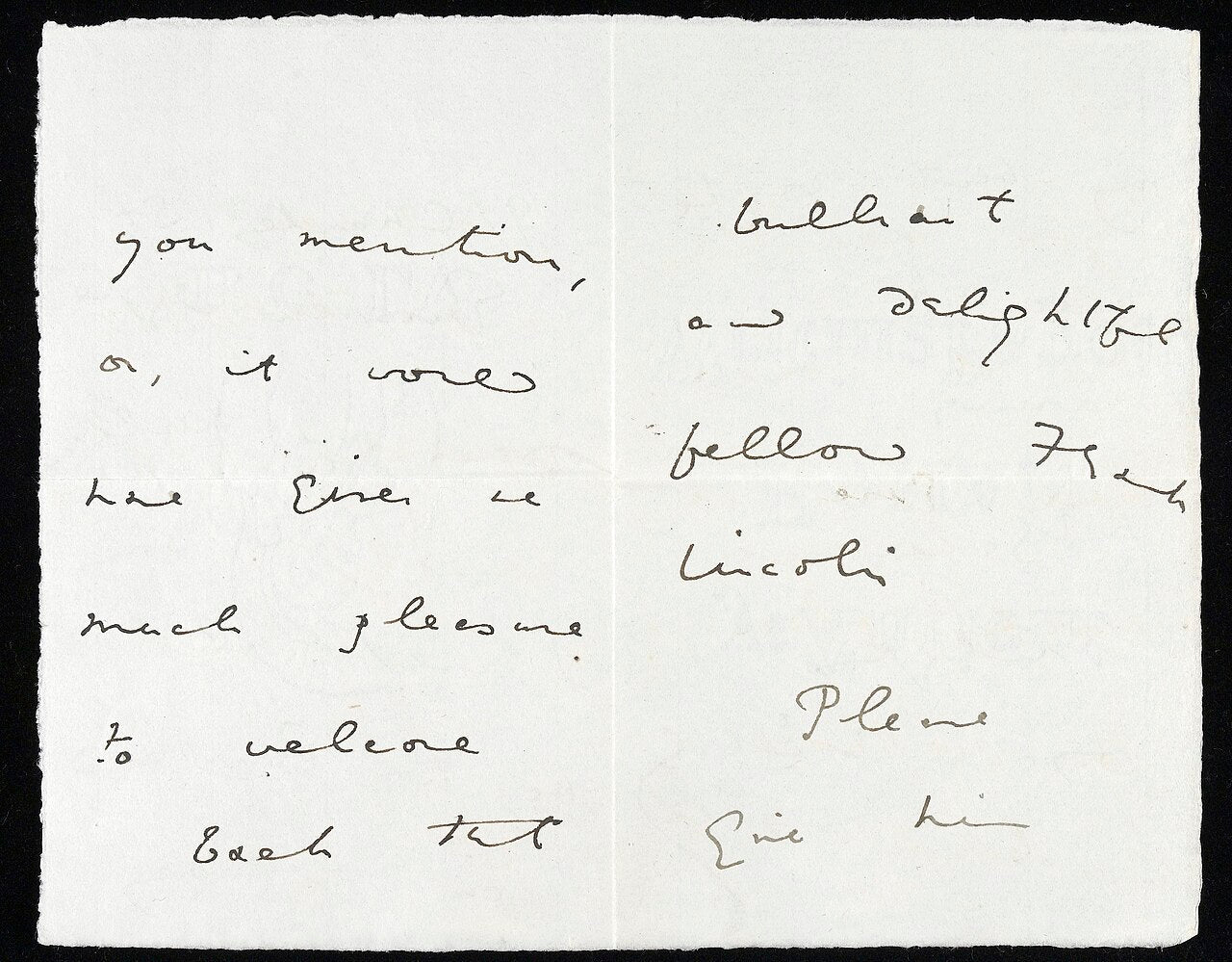
The image above is a letter Wilde wrote to pharmacist and collector Henry Wellcome in the 1890s, held by Wellcome Images (CC BY 4.0). It is not a portrait. That choice is deliberate.
Why Wilde's Wit Is Structurally Different
Most epigrams make a point. Wilde's reverse the point you were already holding. He understood that the most effective critique of a value system is not a frontal argument but a sentence that makes the system contradict itself — out loud, in public, in front of people who agree with it.
That is not charm. That is a technique. And it is why his lines travel so well across centuries: they are not about Victorian society. They are about how any society defends its preferences by calling them principles.
What gets lost in the Pinterest version is the cost. Wilde died in Paris in 1900, at forty-six, three years after his 1897 release from Reading Gaol, where he had served two years of hard labor for gross indecency. The man who wrote these lines was not untouchable. He was destroyed, precisely, for saying things this clearly.
"I can resist everything except temptation."
Lady Windermere's Fan, 1892
Lord Darlington delivers this in Act I, and it reads as a bon mot — light, self-deprecating, forgettable in lesser hands. But Wilde is doing something specific: he is exposing how moral language functions as performance. The line does not celebrate weakness. It mocks the social theater of resistance — the idea that announcing one's virtue is the same as having it.
"The truth is rarely pure and never simple."
The Importance of Being Earnest, 1895
This line is on the The Truth — Wilde Literary Phone Case if you want to carry it. Algernon says this early in Act I, almost offhandedly, which is exactly when Wilde plants his most important ideas. The line is a direct challenge to the Victorian faith in sincerity as moral bedrock. Earnestness — being in earnest — was not just a virtue; it was an identity. The play's title is the joke. And this line is its thesis: anyone who tells you the truth is simple has not examined it carefully enough.
"A cynic is a man who knows the price of everything and the value of nothing."
Lady Windermere's Fan, 1892
Lord Darlington again — handed the most durable definition of cynicism in the English language. What makes it precise is the economic vocabulary: price versus value, not truth versus lies. Wilde understood that the Victorian market was reordering what counted as real. A man who priced everything and valued nothing was not an aberration. He was the system's ideal product.
"To live is the rarest thing in the world. Most people exist, that is all."
The Soul of Man under Socialism, 1891
This is Wilde in his least theatrical register — the essayist, not the playwright. The Soul of Man under Socialism is not widely read, which is a loss. It is one of the most lucid arguments for individual artistic freedom produced in the nineteenth century, and this line is its emotional core. Wilde was not being inspirational. He was making an accusation: that the social machine produces existence as a substitute for life, and most people accept the trade without noticing it has been made. The The Genius Exception — Wilde Literary T-Shirt carries a line from the same argument.
"We are all in the gutter, but some of us are looking at the stars."
Lady Windermere's Fan, 1892
Lord Darlington's third appearance in this list — which tells you something about how Wilde distributed his philosophy. Darlington is not the hero. He is the character who says the true things at the wrong moment. The line is not comfort. It is a map of position: we are in the gutter, full stop. The looking-up is not escape. It is orientation. These are not the same thing, and Wilde knew the difference.
"The books that the world calls immoral are books that show the world its own shame."
The Picture of Dorian Gray, Chapter XIX, 1891 — spoken by Lord Henry Wotton
Wilde gave his most dangerous line not to a letter or a preface, but to his most charming character. Lord Henry delivers this in Chapter XIX — the line that makes the novel’s case against moral censorship through the voice of a man who never suffers the consequences. Dorian Gray was entered as evidence against Wilde at his trials. The preface was read aloud in court. He had been right about what the book would reveal — just not about who would survive the revelation. The The Last Refuge — Wilde Literary T-Shirt carries this lineage forward.
"Most people are other people. Their thoughts are someone else's opinions, their lives a mimicry, their passions a quotation."
De Profundis, written 1897, published 1905
Written in Reading Gaol — a long letter to Lord Alfred Douglas, a document of accounting, grief, and something that does not resolve cleanly into either forgiveness or blame. This line arrives not as a quip but as a verdict, delivered by a man who had paid for his originality in full. It is the bleakest of his great lines, and the truest. If you're building a reading list that includes Wilde's darker registers, the piece on why Dark Romanticism is having a moment sits close to this territory.
"A little sincerity is a dangerous thing, and a great deal of it is absolutely fatal."
The Critic as Artist, 1890
Gilbert delivers this in Wilde's dialogue-essay arguing that criticism is itself an art form. The line is not ironic in the way it is usually read. Wilde believed that sincerity unmediated by intelligence was not virtue but violence — that it flattened the complexity of experience into something the speaker could manage. Too much honesty, unexamined, becomes a weapon aimed at whatever resists it. He was honest, publicly, in 1895 — and it ended him.
What It Cost
The question worth sitting with, after reading these lines in their actual contexts, is not what Wilde meant. It is what it took. These sentences are the output of a man who understood consequence clearly and chose precision anyway — in plays performed in the West End, in essays published in mainstream journals, in a novel submitted to a family magazine.
He was not writing in a drawer. He was writing in public, with his name attached, in a society that had very specific ideas about what public men were allowed to say.
The wit was not armor. It was exposure. And the sharpness of the language did not protect him — it made him a target with clear edges.
For readers who want to trace how language functions as both power and liability across literary history, the piece on why Nietzsche gets misquoted more than anyone covers adjacent ground. Both men were reduced to captions. Neither survives the reduction intact.
If you carry a Wilde line, carry the whole sentence. It was written that way on purpose — and the The Genius Exception Wilde Literary Mug keeps one of his sharpest close at hand. Anything shorter is someone else's summary of what he said.
Wilde’s reputation for wit has also made him a magnet for words he never wrote. “Be yourself; everyone else is already taken” is one of the most persistent examples. We traced the evidence behind that attribution in The Famous Oscar Wilde Quote That Isn’t His. For more on how Wilde’s wit worked in its original social and biographical context, read The Wildest Oscar Wilde Quotes and Why He Got Away With It.
Peter ‘Dash’ Stage is a writer and researcher at Quoteiac whose work focuses on tracing literary quotations to their primary sources. He writes about what writers actually said, where they said it, and what was happening in their lives when they said it.