Charlotte Brontë and the Art of Writing Through the Dark
There is a moment in Jane Eyre when the heroine — cold, dismissed, standing on the wrong side of every social calculation — draws herself up and speaks. Not to ask for something. Not to apologize. To declare the terms of her own existence. Charlotte Brontë wrote that moment in 1847. She had been writing versions of it her entire life.
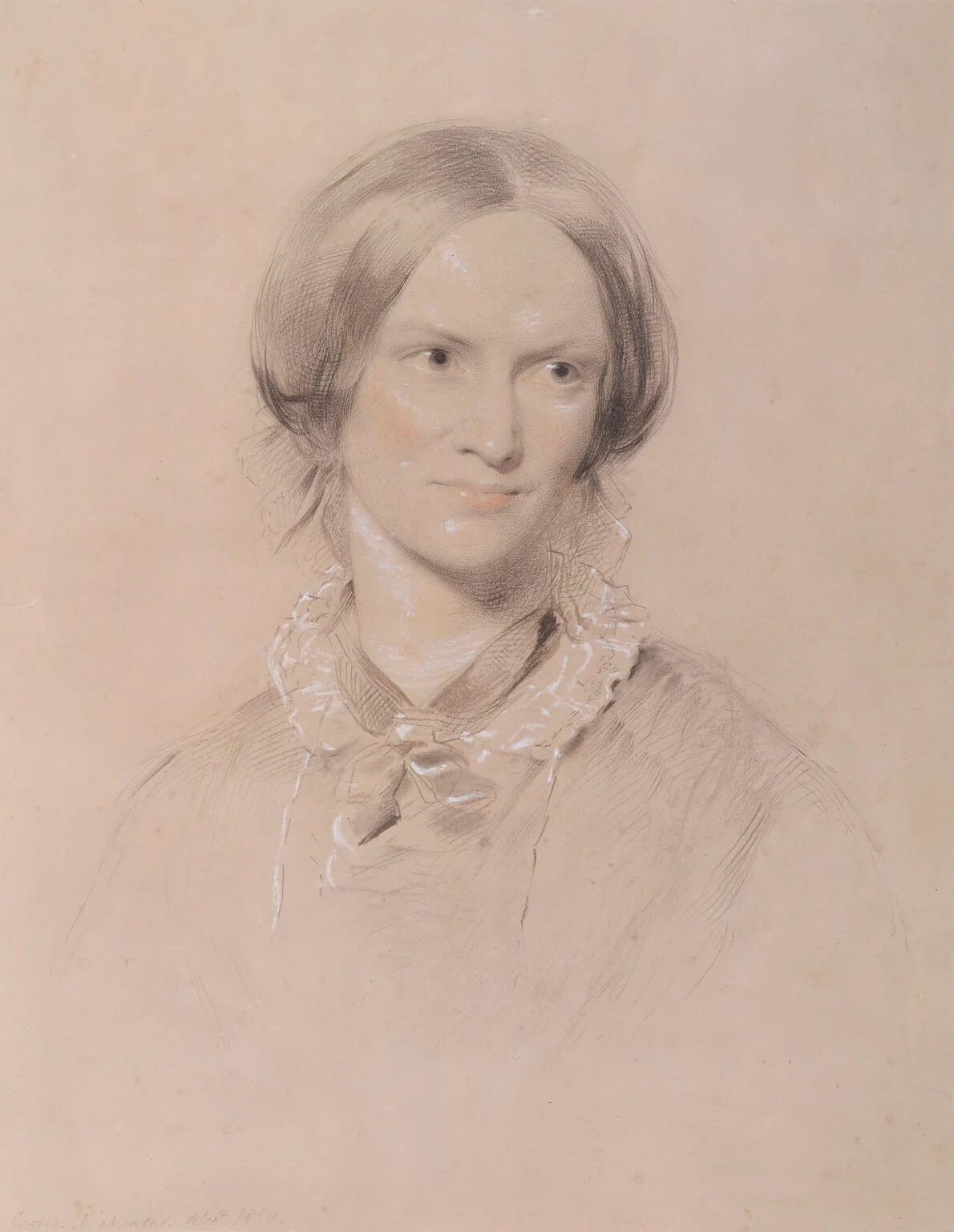
George Richmond's chalk portrait of Charlotte Brontë, 1850 — commissioned by her publisher George Smith shortly after the success of Jane Eyre and described by Elizabeth Gaskell in her biography. Held at the National Portrait Gallery, London (NPG 1452). Public domain.
The Interior as Engine
Charlotte grew up at the Brontë Parsonage in Haworth, on the edge of the Yorkshire moors — a landscape that pressed itself into everything she wrote. Gothic fiction was in the air of the Romantic period, and Charlotte absorbed it and sharpened it. Where the Gothic genre often used darkness as atmosphere, she used it as psychology. The darkness in Jane Eyre is not decorative. It is structural. It maps the inside of a person who refuses to accept that the inside doesn't count. See also: why that Dark Romanticism tradition is resonating again now.
What Jane Eyre Actually Argues
Jane is not a passive heroine who survives long enough to be rewarded. She is a person with an argument. In Chapter 23, when Rochester tries to hold her in place — emotionally, socially, physically — she answers him with one of the most precise declarations in the English novel:
“I am no bird; and no net ensnares me; I am a free human being with an independent will, which I now exert to leave you.”
— Charlotte Brontë, Jane Eyre, Chapter XXIII
That sentence is not an outburst. It is a philosophy. Jane is not claiming freedom as something she has been given. She is claiming it as something she already possesses — the will — and she is choosing, in this moment, to use it. Charlotte Brontë understood the difference between freedom as circumstance and freedom as decision. She lived that difference.
She wrote most of Jane Eyre in the same parsonage where she had spent years caring for others, managing a household, watching opportunities narrow. She wrote it anyway. She published it under the name Currer Bell — not because she was ashamed, but because she wanted it to be read on its own terms, without the discount the market applied to women. It was read. It changed things.
Two Lines That Carry Weight
The quotes Quoteiac carries from Charlotte Brontë are not the most famous lines from Jane Eyre. They are the truest ones — the ones that survive being pulled out of context because they were built to last.
Helen Burns, Jane's first moral teacher, speaks one of them early in the novel. She is young, she is ill, she is being punished unjustly — and she says this:
“Life appears to me too short to be spent in nursing animosity or registering wrongs.”
— Charlotte Brontë, Jane Eyre, Chapter VI (Helen Burns)
That line belongs to a character who will not survive the book. Charlotte Brontë knew what she was doing when she gave it to her. The brevity of life is not, in Helen's mouth, a reason for despair. It is a reason for precision — for choosing what you carry and what you put down. That distinction is the whole of Dark Romanticism's argument: not that darkness doesn't exist, but that you decide what to do inside it.
The other line is Jane's own, much later, in Chapter 34 — a moment so small it almost goes unnoticed:
“I would always rather be happy than dignified.”
— Charlotte Brontë, Jane Eyre, Chapter XXXIV (Jane)
Eight words of preference. But they collapse an entire social architecture. Jane is not choosing happiness as ease — she has never had ease. She is choosing it as a value that she ranks above the performance of propriety. In 1847, in print, under any name, that was an act of creative defiance.
Both quotes are available on the store — the Life Too Short journal and mug carry Helen's line; the Dignified t-shirt carries Jane's. These are words with provenance. If we can't verify it, we don't print it.
Explore all Charlotte Brontë words on Quoteiac at the Charlotte Brontë author page.
About the Author
Vickie MacFadden is the founder of Quoteiac. She has been known to read Jane Eyre in a single sitting and come away feeling steadier than when she started.