The Man Who Defined the Devil Out of Language
Ambrose Bierce did not invent cynicism. He simply refused to let the language keep lying about it.
Most people meet him the same way: a sharp little definition on a shirt or a phone case that lands harder than it should. “Alone, adj. In bad company.” “Philosophy, n. A route of many roads leading from nowhere to nothing.” “Admiration, n. Our polite recognition of another’s resemblance to ourselves.” The words feel contemporary, almost thrown. They are not. They were written by a man who spent four years watching men die for abstractions and then another forty years watching the survivors invent prettier names for the same old motives.
Born in 1842 in a log cabin in Meigs County, Ohio, the tenth of thirteen children whose names all began with A, Ambrose Bierce enlisted at eighteen in the 9th Indiana Infantry. He fought at Shiloh, Chickamauga, Chattanooga, and Kennesaw Mountain, where a Confederate bullet creased his skull and left him partially deaf for the rest of his life. He returned to the line anyway. Those years did not make him a pacifist in the soft modern sense. They made him allergic to the gap between what people said and what actually happened when the saying stopped.
After the war he drifted into journalism in San Francisco, the perfect city for a man who preferred clarity to comfort. He became the “Town Crier,” then the editor of the satirical weekly The Wasp, and finally the long-running columnist “Prattle” for William Randolph Hearst’s San Francisco Examiner. For decades he wrote about politicians, poets, preachers, and the general public with a precision that earned him the nickname Bitter Bierce. The bitterness was real, but it was secondary. What mattered more was the refusal to play along.
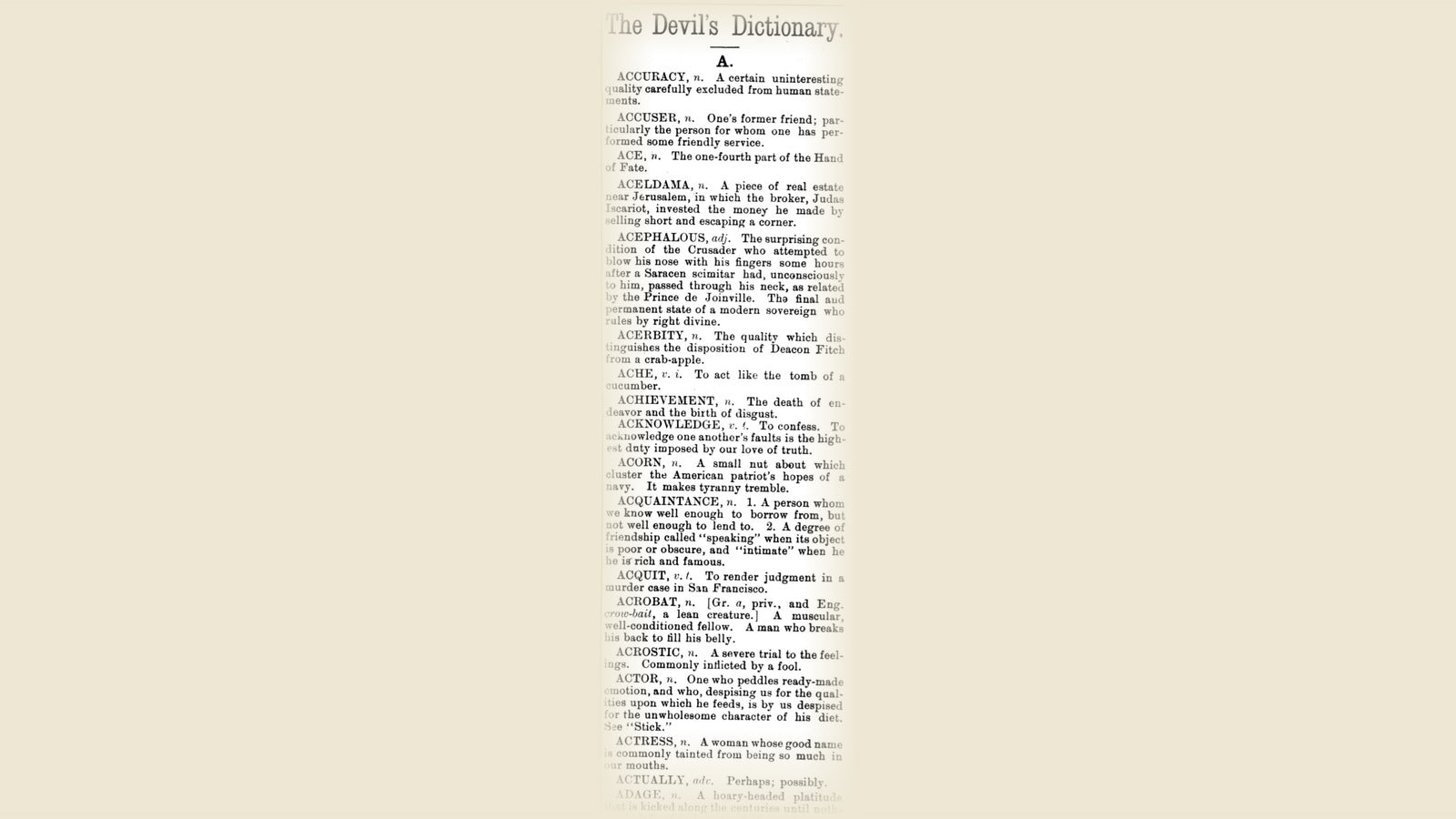
The Devil’s Dictionary did not begin as a book. It began as a recurring irritation. As early as 1867 Bierce was already rewriting Webster in the margins of his columns. In 1875 he offered a short list under the title “The Demon’s Dictionary.” By 1881, while editing The Wasp, he formalized the project as “The Devil’s Dictionary” and published installments for years—79 columns in that paper alone. Later, under Hearst, more appeared as “The Cynic’s Dictionary.” The definitions arrived in irregular bursts, sometimes weeks apart, sometimes years. They were never a systematic project so much as a running audit of the language people used to hide from themselves.
When a partial collection finally appeared in 1906, the publisher forced the title The Cynic’s Word Book. Bierce hated it. Religious scruples, they said. The word “devil” was too much. The softer title backfired spectacularly: the market flooded with imitation “cynic” books of varying quality, most of them dull. Bierce’s own work had already been freely plagiarized for years; definitions circulated without credit long before they were gathered between covers. In 1911, as volume seven of his Collected Works, he finally restored the proper name. The Devil’s Dictionary contained roughly a thousand entries, many of them polished across decades, some of them still carrying the heat of the original newspaper column.
What makes the book different from most satire is that it does not shout. It adopts the calm, authoritative voice of a real dictionary and then quietly removes the moral padding. A bore is “a person who talks when you wish him to listen.” Positive is “mistaken at the top of one’s voice.” The effect is not cheap cynicism. It is the opposite of cheap. Bierce had seen enough of death and enough of rhetoric to know that language is often a social technology for avoiding the facts. His definitions do not invent new meanings so much as strip the official ones down to the bone.
That is why the lines still work on a T-shirt or a phone case more than a century later. They do not require a footnote. They do not need a context lecture. You read “Alone, adj. In bad company” and you either recognize the truth of it or you do not. The recognition is private, almost physical. The same is true of the quieter ones. Philosophy as a road system that never arrives. Admiration as polite self-recognition. These are not jokes. They are diagnoses delivered in the form of definitions.
Bierce’s other writing—especially the Civil War stories collected in Tales of Soldiers and Civilians—shows the same temperament. “An Occurrence at Owl Creek Bridge” remains one of the most perfectly engineered short stories in American literature, a study in the mind’s last desperate fiction. The war stories are not sentimental. They are exact. He had no interest in the noble death or the consoling abstraction. He was interested in what the mind does when the ground gives way.
In 1913, at seventy-one, he crossed into Mexico to observe the revolution. His last known letter, dated December 26, ends with a characteristic shrug: if he were stood against a wall and shot, he considered it a better exit than old age or a fall down the cellar stairs. Then he vanished. No body, no reliable account. It is almost too perfect an ending for the man who spent a lifetime refusing tidy narratives. The disappearance has invited every theory imaginable, most of them more romantic than the man himself would have tolerated.
What remains is the dictionary and the temperament that produced it. In an era that treats language as branding, Bierce’s method feels newly useful. He treated words as evidence. He assumed that people would prefer the flattering version of themselves and then wrote the unflattering one anyway. That is not bitterness for its own sake. It is a form of respect for the reader’s capacity to handle the actual case.
The pieces we have printed from his work are not nostalgia. They are working tools. A definition that still cuts after a hundred years is rarer than most new slogans. Wear one if the line already lives in your head. Carry one if you want the reminder close. Bierce would probably have mocked the idea of merchandise, then defined the mockery with precision, then gone back to work. That, finally, is the point. The dictionary was never meant to comfort. It was meant to keep the language honest when almost everything else preferred the softer lie.
If these particular definitions speak to you, they are doing exactly what Bierce designed them to do.
The image above is the first published column of The Devil's Dictionary as it appeared in The Wasp, a San Francisco satirical weekly, on March 5, 1881 — then titled "The Devil's Dictionary." Bierce contributed definitions sporadically for over two decades before they were collected into a single volume in 1906. The original run of columns is held in various newspaper archives. Public domain.