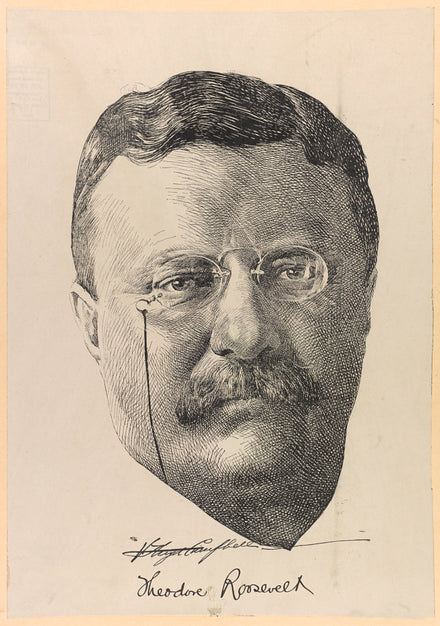
Theodore Roosevelt. White House portrait, c. 1904.Library of Congress.
Theodore Roosevelt
He ran toward everything. Battlefields, wilderness, the presidency, the written word — Roosevelt moved through the world as if time itself were running out, and wrote dozens of books between campaigns to prove it.
Words We Carry
Every quote here is traced to a documented source. How we verify →
“…who at the worst, if he fails, at least fails while daring greatly…”
“Citizenship in a Republic,” the Sorbonne, Paris, April 23, 1910. Text as printed in African and European Addresses (1910).
About Theodore Roosevelt
Theodore Roosevelt was born in New York City in 1858 into a wealthy family and a body that refused him. Asthma kept him bedridden through childhood, watching the world from windows while other boys ran in it. His response was to remake himself — deliberately, systematically, through boxing and rowing and riding until the body became something he could trust. He went to Harvard. He wrote a naval history at twenty-three. Then his wife and mother died on the same day — Valentine’s Day, 1884 — and he did not wait for grief to finish him. He went west to the Badlands of Dakota Territory and ranched for three years, working cattle, reading law, writing. When he came back, the physical transformation was complete and so was something else — a way of moving through catastrophe that had nothing to do with acceptance and everything to do with velocity. He entered New York politics, then the Civil Service Commission, then the police board. He was building toward something.
In 1898, Roosevelt resigned as Assistant Secretary of the Navy to raise a volunteer cavalry regiment for the Spanish-American War. The Rough Riders were cowboys, Ivy League athletes, and Native American scouts, thrown together and pointed at Cuba. The charge up San Juan Hill — on foot, as it turned out — made him a national figure overnight. Three years later, the assassination of William McKinley made him president at forty-two, the youngest in American history. What followed was eight years that reshaped the country’s relationship to its own land and its own corporations. He designated 230 million acres as protected public land — forests, monuments, wildlife refuges — at a moment when that land was actively being stripped. He broke up the railroad trusts. He mediated the Russo-Japanese War and won the Nobel Peace Prize in 1906, the first American to do so. He understood power as something to be used, not merely held.
The “Man in the Arena” passage comes from Citizenship in a Republic, a speech delivered at the Sorbonne on April 23, 1910 — the year after he left the White House. The address is a sustained argument about what a democracy actually requires of its citizens: not just the vote, but the willingness to enter the contest and risk being wrong in public. Roosevelt had been that man. He had lost elections, lost family, started wars, lost a primary to a man he had mentored. The line is not instruction. It is a record.
The Work
From the Journal
The History of the Man in the Arena Speech
On April 23, 1910, Roosevelt stood at the Sorbonne and delivered the address that changed everything.
ReadThe Architecture of Action: Roosevelt on the Failure of the Cynical Spectator
What the Man in the Arena passage actually argues — and why it still lands.
ReadWhat the Founders Actually Said (And Why It Matters in 2026)
Adams, Madison, Jefferson, Roosevelt — what the record shows when you check the sources.
ReadIn Their Orbit