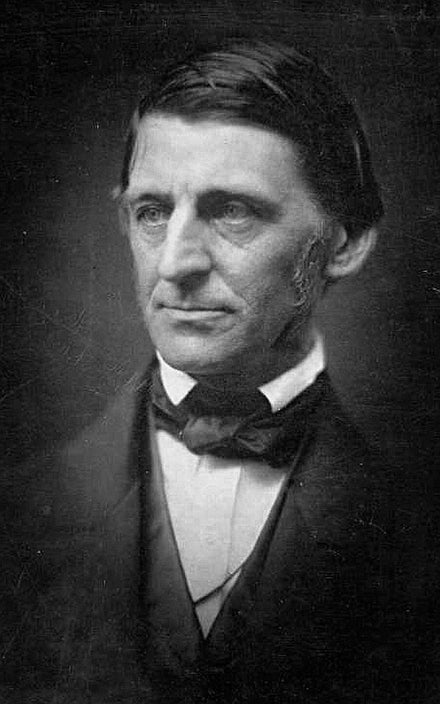
Ralph Waldo Emerson. Photograph, c. 1857.
Public domain.
Ralph Waldo Emerson
Boston & Concord, Massachusetts
He quit the pulpit, buried his wife, and sailed to Europe to argue with the men whose ideas had stopped satisfying him. What he came back with became the intellectual backbone of American literature.
Words We Carry
Every quote here is traced to a documented source. How we verify →
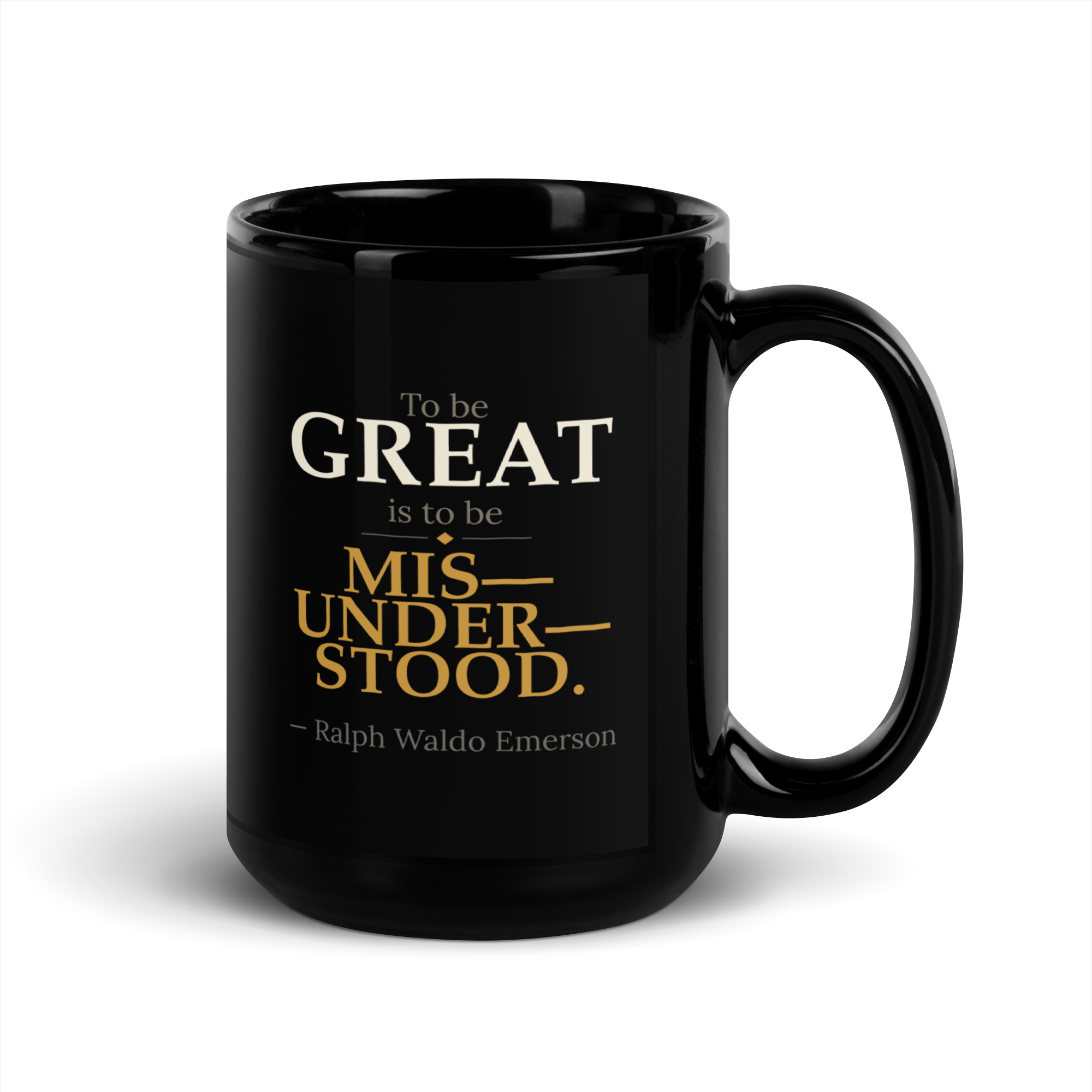
“To be great is to be misunderstood.”
Ralph Waldo Emerson · Self-Reliance, Essays: First Series, 1841
About Ralph Waldo Emerson
Ralph Waldo Emerson was born in Boston on May 25, 1803, into a family of ministers and a world of expectation. His father died when Emerson was seven, leaving the household in near-poverty, but the trajectory held — Harvard at fourteen, teaching to pay his way through, then Harvard Divinity School and ordination as a Unitarian minister in 1829. He married Ellen Tucker that same year. She died of tuberculosis in 1831, eighteen months later, at nineteen. Emerson was twenty-seven. He would walk to her tomb every morning for a year. In 1832, with grief still fresh and his doubts no longer manageable, he resigned from Second Church Boston over the communion sacrament — a dispute about whether the ritual held any meaning at all. It was not a procedural argument. It was a confrontation with the question of whether inherited doctrine could survive contact with actual experience. He concluded it could not. He sailed for Europe to think it through.
What he found in Europe confirmed his doubts and pointed toward something else. He met Carlyle, Coleridge, Wordsworth — men who had mounted serious arguments against the received authorities, who insisted that the individual mind was a legitimate site of truth. He came back and began lecturing. Nature appeared in 1836, a compressed and strange manifesto arguing that direct experience of the natural world was more reliable than secondhand spiritual inheritance. The American Scholar address followed in 1837 — called by Holmes “America’s intellectual declaration of independence.” Then Self-Reliance, 1841, the center of the first Essays collection: an argument, across every page, that conformity to the opinion of others is a moral failure, not a social convenience. Around him, Transcendentalism gathered: Thoreau, Margaret Fuller, Bronson Alcott. With Fuller, Emerson co-founded The Dial, the movement’s journal. They were arguing, collectively, that individual intuition was not arrogance, that direct experience outranked doctrine, and that the self was a legitimate starting point for any serious thought.
Emerson lectured for fifty years — across the United States and England, on platforms that ranged from mechanics’ institutes to university halls — and the lectures became the essays, and the essays became the intellectual infrastructure that Thoreau, Whitman, and eventually William James built on. His house in Concord burned in 1872. The town raised money to rebuild it without telling him; friends sent him to Europe while the work was done, so he would not see it in ruins. He came home to a restored house and neighbors lining the road. He was sixty-nine. In his final decade, aphasia closed in — the condition that takes words before it takes everything else — and a man who had built his life on finding the exact right sentence found himself unable to retrieve them. He died in Concord on April 27, 1882. Thoreau had died twenty years before him. Emerson delivered the eulogy.
The Work
From the Journal
The Quote on Your Shirt Is Probably a Lie
On famous misattributions — and why it matters who actually said it.
ReadWalden Was an Experiment. Thoreau Published the Data.
The man Emerson mentored went to the woods to test an argument.
ReadThe Philosophy of Doing Hard Things — From People Who Actually Did Them
What the thinkers who changed the world actually believed about difficulty.
ReadIn His Orbit
Filters