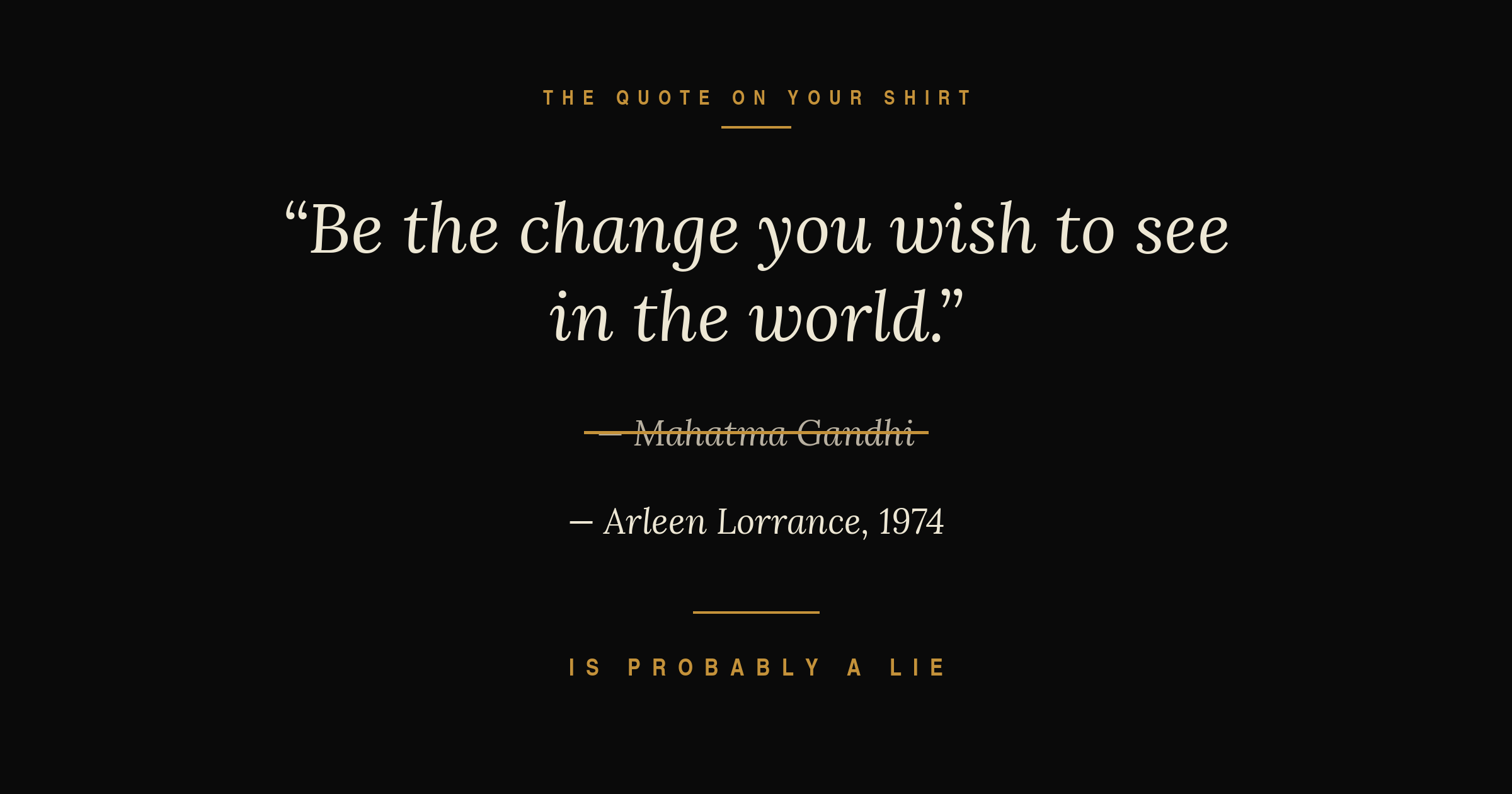
The Quote on Your Shirt Is Probably a Lie
"Be the change you wish to see in the world." — Gandhi.
Except he never said it.
The line traces to Arleen Lorrance, an American educator, in 1974 — not to Gandhi. Gandhi's actual words on the subject, published in Indian Opinion in 1913, are longer, more exacting, and ask more of you. But you'll find "Gandhi" printed on mugs, totes, water bottles, dorm posters, gym walls, and the insides of greeting cards in every airport in America. Nobody checks. Nobody cares. The quote feels true, so it becomes true.
This is the enemy.
The Inspiration Industrial Complex
There's an entire economy built on flattening serious ideas into bumper stickers, stamping a famous name on them, and selling them at a discount.
Einstein said it. Aristotle said it. Buddha said it. Mother Teresa said it. Marilyn Monroe said it.
They mostly didn't.
The machinery runs like this: a phrase goes viral with a famous attribution. Brands print it on anything that holds ink. Nobody reads the source — the source often doesn't exist. The lie gets bigger every time it sells. And what you end up wearing is a feeling dressed up as wisdom.
You tell yourself, every time you put it on, that this is who you are.
Why It Matters
Words shape people. That isn't a marketing line — it's the reason any of this exists. The sentences you repeat to yourself become the scaffolding of how you think. If the scaffolding is built on someone else's lie, on a paraphrase nobody verified, on a sentiment sanded down until it fit a three-inch design area — you're building a self on rumor.
The inspiration industrial complex doesn't care what you become. It cares what you'll buy this quarter, at 40% off, printed on the cheapest blank available.
What We Do Instead
We verify every quote before it touches a design. Seneca's Letter 13. Blake's Proverbs of Hell, 1790. Curie’s Pierre Curie, 1923. Emerson's Self-Reliance, 1841. The actual source. The actual wording. Confirmed before a single pixel gets placed. See also: how we check attribution — and what primary sourcing actually requires.
When we can't verify, we say so — out loud, in the product copy, on the page. The "Be the change" piece still exists in our shop. It's sold with the real story: who actually wrote it, and what Gandhi actually published in 1913. We don't pretend. We don't round up. We don't scrub the doubt to make the sale easier.
We also don't discount. Not because we're precious — because a philosophy you bought on sale is a philosophy you'll forget about by Thursday. The words are meant to be earned.
The typography does the work of the meaning, not the decorating of it. The weight of the serif, the space between lines, the depth of ink on black cotton — each choice is built around the sentence, not around what's cheapest to mass-produce.
And yes — we'll also be wrong sometimes. Language is old. Sources get lost. Attributions harden into lore before anyone thinks to question them, and scholarship shifts — what passed for verified in 1998 doesn't always hold up in 2026. Somewhere in our catalog there is probably a line we haven't caught yet. When we find it, or you do, we fix it out in the open, with the real story attached. The difference between us and the inspiration industrial complex isn't that we're perfect. It's that we check. And when we miss, we say so. For how to verify a quote yourself before the t-shirt is ordered, see our sourcing guide.
The Tribe
If you've ever flinched at a Pinterest quote that felt too clean to be real — that's us.
If you'd rather wear a verified sentence than a fake paragraph of Gandhi — that's us.
If you believe the words on your body should stand up to the words in your head — that's us.
We're the readers. The source-checkers. The ones who suspect the motivational calendar. The ones who know an earned idea costs something, and who are willing to pay it.
The words shape you.
We make sure the words are real.
— Quoteiac
A note on sourcing: Quoteiac's founder was among the original inquirers credited in the 2017 Quote Investigator investigation that traced the "Be the change" misattribution. The full Gandhi story is in the Journal: "Be the Change" — The Most Famous Quote Gandhi Probably Never Said.