Did Gandhi Say “Be the Change You Wish to See in the World”? No. Here’s What He Wrote
Verdict: No. Gandhi never wrote "Be the change you wish to see in the world." What he did write, in a 1913 column on health, is this: "When we change our nature, the world around should also inevitably change." That’s the 1921 English translation, and it’s the line we print now.
| Quote in circulation | "Be the change you wish to see in the world" |
| Attributed to | Mahatma Gandhi |
| Earliest match in print | Arleen Lorrance, 1974: "be the change you wish to see happen." No mention of Gandhi. |
| Gandhi’s name attached | By 1989 |
| What Gandhi wrote | "When we change our nature, the world around should also inevitably change." A Guide to Health, Part II, Ch. XII, 1921, translated by A. Rama Iyer |
| Verification status | ❌ Misattributed |

"When we change our nature, the world around should also inevitably change." Mahatma Gandhi, 1921. Shop the tee →
The line everyone knows
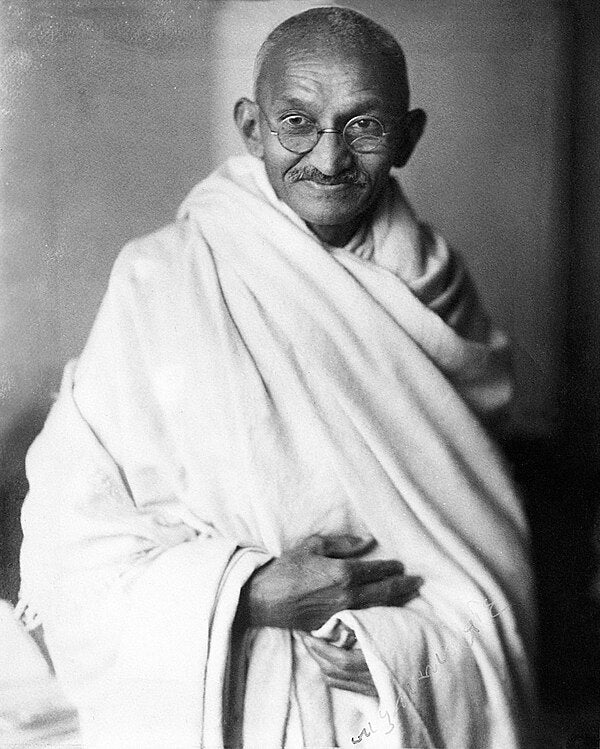
You’ve seen it on mugs, totes, posters and a thousand Instagram bios. It usually comes with Gandhi’s name and a sepia photo. It never comes with a source.
That’s because there isn’t one. The sentence isn’t in his writings. For the broader industry of wrong attribution, and two cases where we got burned ourselves, see the follow-up investigation.
Where it actually came from
The earliest close match turns up in 1974, in a piece called "The Love Project" by Arleen Lorrance. It was reprinted that year in a collection of readings for teachers and parents. Her version: "One way to start a preventative program is to be the change you wish to see happen."
No Gandhi. No "world." In 1976, another writer quoted the same idea as "Be the change you want to see happen instead of trying to change everyone else."
By 1989 the line had grown "in the world" and picked up Gandhi’s name. That year a health and fitness book credited him with "You must be the change you wish to see in the world." The Yale Book of Quotations found it in the Los Angeles Times the same year.
The researchers who traced this trail include Fred Shapiro, editor of the Yale Book of Quotations, and Garson O’Toole of Quote Investigator.
What Gandhi did write
In August 1913, Gandhi was running a newspaper in South Africa called Indian Opinion. He wrote a series of columns for it on health, in Gujarati. In 1921 they came out in English as A Guide to Health, translated by A. Rama Iyer.
The passage sits, of all places, in the chapter on snakebite:
"For, we are but the reflection of the world around us; all the features of the external world are found reflected in the inner world of our mind. When we change our nature, the world around should also inevitably change. Do we not find that the world assumes a totally different aspect to those individual men and women who change their own nature by strenuous self-discipline? This is the great mystery of God’s creation as well as the great secret of true happiness. Our happiness or otherwise rests entirely upon what we are; we have no need to depend on other people at all in this matter."
That’s the real thing. It’s longer than the bumper sticker, and it asks more of you. The work starts with your own nature.
A later English translation, published in 1964, words it differently. That version is still under copyright, so we don’t print it. The 1921 words are in the public domain.
Why the fake one stuck
The short version is close to his idea. That’s why it travels so well. But close to his idea is not the same as his words.
Most fake quotes work this way. They’re tidier than the truth, so they’re easier to print, share and believe.
What we did about it
For a while we sold "Be the change" and labeled it honestly: widely attributed to Gandhi, not found in his writings. It was the honest version of a fake quote. It was still a fake quote.
So we went looking for the line he wrote. Our tee, journal and tumbler now carry "When we change our nature, the world around should also inevitably change." Read the full story of that line, or see where "Be the change" really came from.
Shop the line he wrote: the tee · the journal · the tumbler
A note on sourcing: Quoteiac’s founder was among the original inquirers credited in the 2017 Quote Investigator investigation that traced the "Be the change" misattribution.