Percy Bysshe Shelley. Portrait by Alfred Clint, c. 1819.
National Portrait Gallery, London.
Percy Bysshe Shelley
Field Place, Sussex — Bay of Spezia, Italy
Percy Bysshe Shelley arrived at radical thought young and never retreated from it — atheism, free love, vegetarianism, the dismantling of tyranny — and spent a short life turning those convictions into some of the most charged verse in the English language.
Words We Carry
Every quote here is traced to a documented source. How we verify →
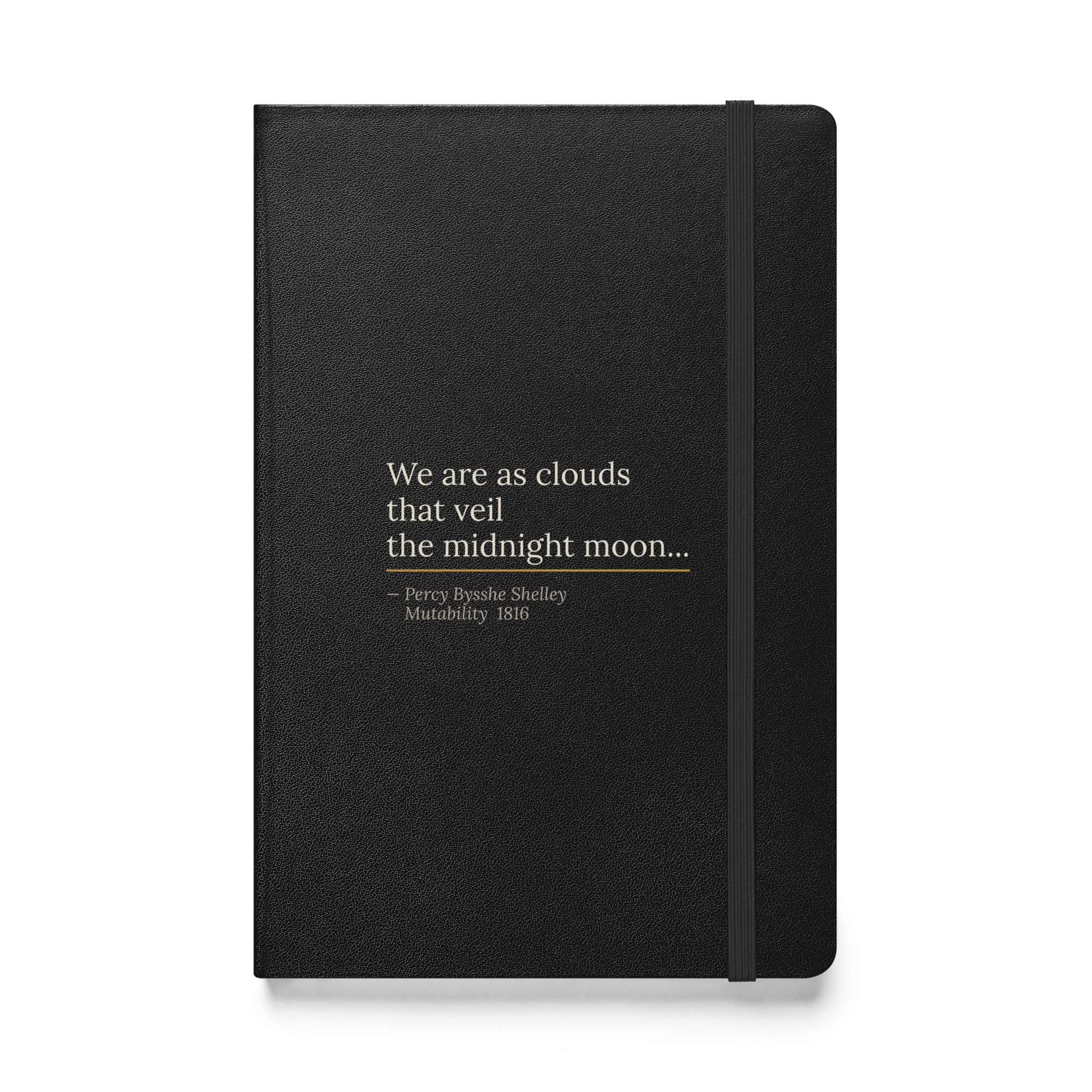
“We are as clouds that veil the midnight moon…”
Percy Bysshe Shelley · ‘Mutability,’ Alastor (1816), opening line
About Percy Bysshe Shelley
Percy Bysshe Shelley was born on August 4, 1792, at Field Place in Sussex, the eldest son of a Sussex baronet — a background that gave him entry to Eton and, from there, to University College, Oxford. He did not stay long. In March 1811, five months into his first year, he was expelled for publishing and distributing a pamphlet called The Necessity of Atheism and refusing to disavow it when the college authorities demanded he do so. He was eighteen. He had not written it for shock. He had written it as an argument, and the argument was serious: that belief without evidence is not a moral foundation, and that a society built on compelled belief is not a free one. He was already writing political pamphlets, advocating for Irish independence, circulating tracts on vegetarianism. That autumn he eloped with Harriet Westbrook, a schoolfellow of his sisters, and married her in Scotland. The intellectual commitments were not separate from the personal ones. He believed that free love, the rejection of established religion, and the dismantling of inherited power were part of the same project — and he was willing to live as if that were true, whatever the cost. Harriet drowned herself in the Serpentine in November 1816. Shelley married Mary Godwin five weeks later.
In July 1814, Shelley eloped to the Continent with Mary Godwin — daughter of William Godwin and Mary Wollstonecraft, two of the most radical thinkers England had produced — accompanied by her stepsister Claire Clairmont. He did not return permanently. The years that followed were nomadic and extraordinarily productive. The circle formed around him: Byron in Geneva in 1816, the summer of the ghost story competition that produced Frankenstein, then Italy in 1818 — Pisa, Rome, Florence, Livorno — where Shelley lived until his death. The Italian years were the great work. Prometheus Unbound (1820), a lyrical drama of liberation, argued that tyranny survives only by the consent of the enslaved mind, and that the will to resist is already the act of resistance. Ode to the West Wind (1819) — written in a single afternoon in a wood outside Florence — bound political urgency to natural force in a way no one had managed before him. To a Skylark (1820), Adonais (1821), his elegy for Keats. The radicalism was not ornament — it was the structural logic of the work, the thing that made a lyric poem feel like a political demand.
He drowned on July 8, 1822, in a sudden squall in the Gulf of Spezia, off the Italian coast. He was twenty-nine. His body washed ashore ten days later. Byron and Leigh Hunt burned it on the beach at Viareggio, in a ceremony that has become one of the more famous images in Romantic biography. His heart reportedly would not burn. Edward Trelawny pulled it from the fire. Mary Shelley kept it for the rest of her life, wrapped in a page of Adonais — the elegy Shelley had written for Keats the year before. He had been writing at a rate that accelerated until the end: Prometheus Unbound, Ode to the West Wind, Adonais, The Triumph of Life — the last unfinished when the boat went down. He had been published, attacked, exiled, and largely unread in England. The reputation came after.
The Work
From the Journal
Percy Shelley Was Always in Mary’s Shadow. He Shouldn’t Be.
Percy Bysshe Shelley wrote some of the most precise lines in English Romanticism. He died at 29. His wife wrote Frankenstein. That’s the whole problem.
ReadWilliam Blake Saw the Universe in a Grain of Sand
William Blake saw angels in a tree as a child and never walked it back. What he was describing still demands a different quality of attention.
ReadSatan Said It. That’s the Point.
The most quoted line from Paradise Lost is spoken by Satan — not as a villain’s boast, but as a serious philosophical argument.
Read