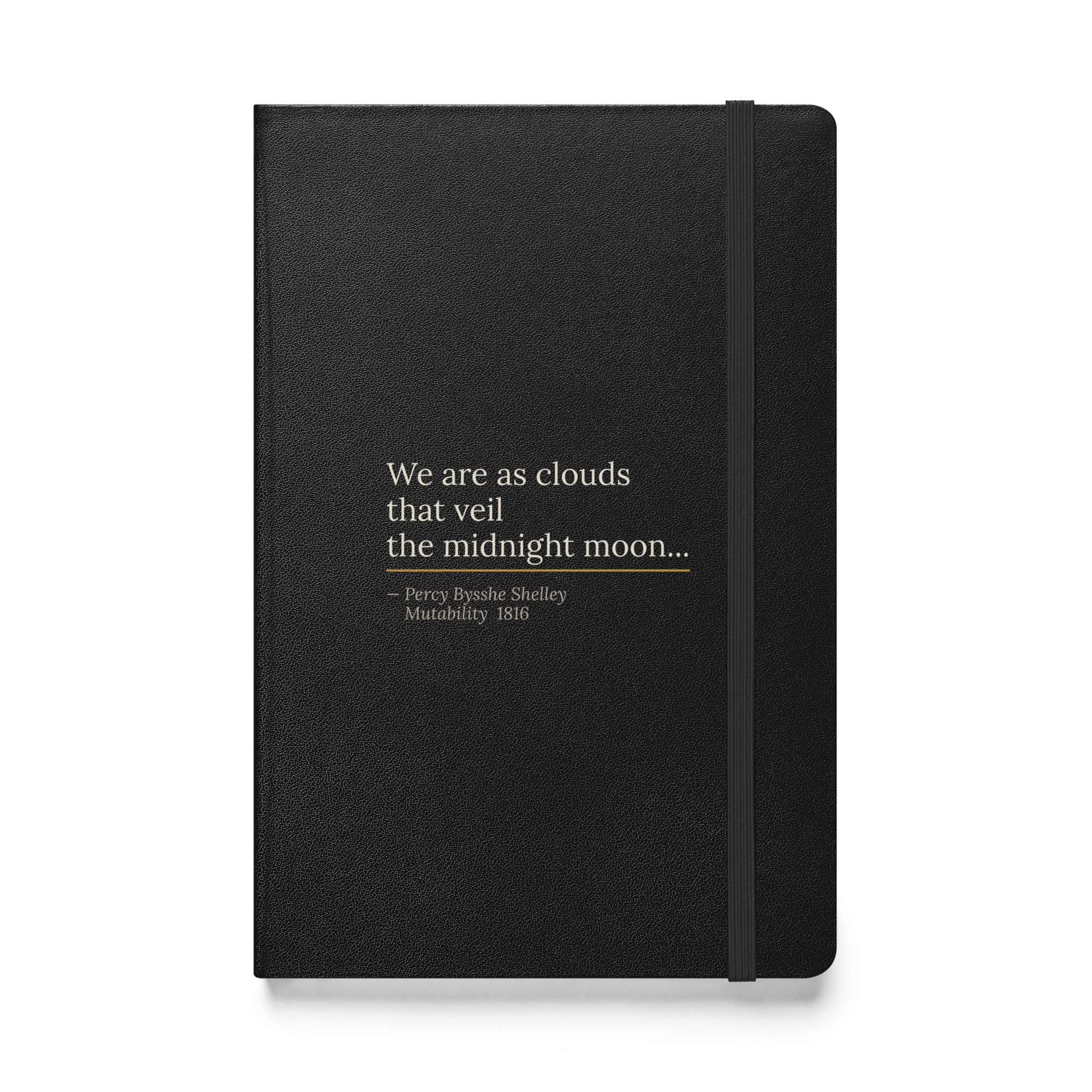




The Midnight Moon — P. Shelley Mutability Journal
Shelley wrote “Mutability” before he was twenty-five. The poem is twelve lines. This journal holds whatever it is you need to write before it changes.
Percy Bysshe Shelley, "Mutability" (1816)
"We are as clouds that veil the midnight moon..."
Shelley wrote "Mutability" as an argument about impermanence — not a lament, an observation. We are the clouds. We veil the moon briefly, then move on. The poem continues past this line, but this is where most readers stop, because the ellipsis says everything the rest of the poem says at greater length. A journal is where you put the things that are passing before they pass — the thought that won't survive until morning unless you write it down now.
If you've ever:
- Written something down because you knew it would be gone if you didn't
- Found that the act of writing a feeling was the only way to hold it still long enough to understand it
- Kept a journal not as archive but as witness — proof that the moment existed
This is for that.
Writing isn't just recording — it's the act of slowing the cloud down long enough to see it clearly. Shelley's ellipsis trails because everything does. The journal is where you catch it before it goes.
The Design
Three lines of the poem sit on a black hardcover, a warm burnished rule beneath them, the attribution in warm gray below. The ellipsis is Shelley’s own — the opening image trailing into the rest of the stanza, which the cover leaves to you. It opens a journal the way a first line opens a poem.
Also available: The Midnight Moon Tee and The Midnight Moon Mug.
About This Journal
- 5.5″ × 8.5″ hardcover — 120 lined pages, acid-free paper
- Elastic band closure, ribbon bookmark, lay-flat binding
Who It's For
The person who writes to catch what's passing. The reader who finds Shelley returning to them unexpectedly. The one who journals because it's the only place time slows down enough to see clearly.
Write it down. The cloud is already moving.
Percy Bysshe Shelley, in Plain English
- Lived: 1792–1822, England
- Spent his adult life in self-imposed exile from England — too radical for polite society, too unconventional to be forgiven for it
- "Mutability" (1816) is structured as a proof: clouds veil the moon, forgotten melodies haunt us, forgotten thoughts return — everything changes, nothing holds still, and we are no different
- His ashes are buried in the Protestant Cemetery in Rome, near Keats — two Romantic poets who both died before 30, both abroad, both now in the permanent canon
- Karl Marx kept a copy of Shelley's work on his desk; George Bernard Shaw called him "a Shelleyan socialist"; his political writing was as radical as his poetry
Choose options