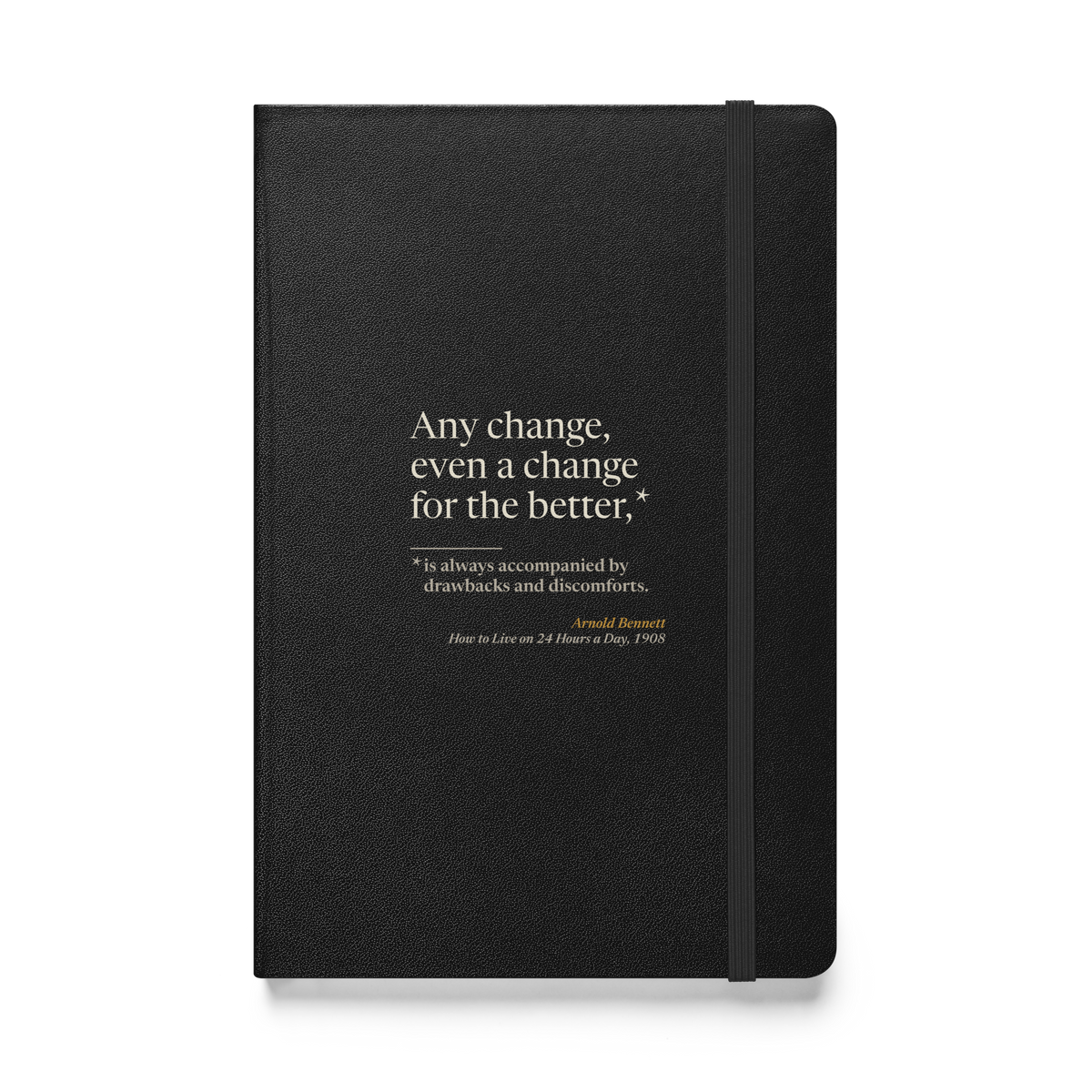




The Drawbacks — Bennett Heretics Journal
Bennett put the hardest truth in his 1908 time-management book plainly: “Any change,” he wrote, “even a change for the better, is always accompanied by drawbacks and discomforts.” This journal is for the part you do after you accept that.
Arnold Bennett, How to Live on 24 Hours a Day (1908)
“Any change, even a change for the better, is always accompanied by drawbacks and discomforts.”
Context
Written in 1908 as one of the earliest self-help manuals ever published, How to Live on 24 Hours a Day treats time as the only currency that actually matters — and this line is its quiet warning: even the right move will feel wrong at some point along the way. The drawbacks aren’t a sign you chose badly. They’re the toll booth on every road worth taking. This journal is for what comes after you accept that — the actual thinking, the adjustments, the moments when you talk yourself back into the thing you already decided was worth doing.
The Design
Two warm burnished rules frame CHANGE on the cover — one above, one below — the word given its own space between the setup and the consequence. Any sits in italic above the first rule; the rest of the argument runs below the second in roman type. Bennett’s point is that discomfort is the evidence of progress; the design holds the evidence apart from the conclusion so each one has room to land.
The same line is on The Drawbacks Tee — for when you want to wear it into the world instead of write through it.
About This Journal
- Size — 5.5″ × 8.5″ (fits a bag, a shelf, a nightstand)
- Pages — 80 lined, cream-colored pages — enough room to think, not so much that it intimidates
- Cover — hardcover — feels substantial, holds its shape
- Closure — built-in elastic band keeps it shut; ribbon marker keeps your place
- Inner pocket — expandable back pocket for receipts, index cards, the scrap of paper you wrote something important on
Who It’s For
People mid-pivot. Anyone doing the right thing and finding it harder than expected. The reader who needs to sit with an idea rather than perform it. Not a motivational journal — a thinking journal.
Progress doesn’t feel like progress yet. Write through it.
Arnold Bennett, in Plain English
- English novelist and essayist (1867–1931)
- How to Live on 24 Hours a Day (1908) was one of the first productivity books ever written — a century before the genre had a name
- He wrote over 30 novels, managed a theatre, and ran a journal of his own for decades
- His argument: most people waste the hours they’re actually awake. The book is a case for using them deliberately.
- Not a cheerleader. A realist who happened to be right.
Choose options