Article: ‘It’s Alive!’ Isn’t in Frankenstein
‘It’s Alive!’ Isn’t in Frankenstein
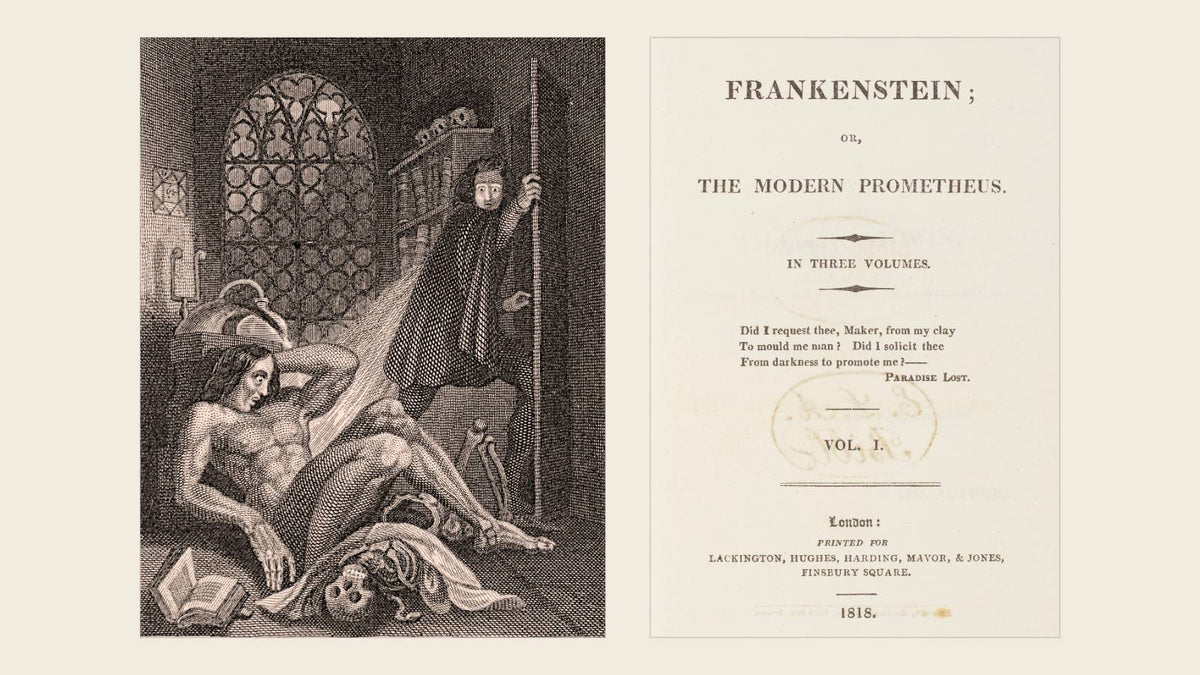
Cover: Theodor von Holst’s frontispiece to the 1831 edition, beside the title page of the 1818 first edition. Both public domain.
You can hear it already. Thunder, sparks, a body on a table rising toward the storm, and a man shouting, “It’s alive! It’s alive!”
It’s one of the most famous lines in movie history. The American Film Institute ranked it number 49 on its list of the 100 greatest movie quotes. And it isn’t in Mary Shelley’s Frankenstein. Not once.
We checked. We searched the 1818 first edition and the 1831 revised edition, both free on Project Gutenberg. The word “alive” turns up here and there, but nobody in the novel ever shouts that line. It belongs to Hollywood.

Nobody in the novel shouts “It’s alive!” But the creature does say this, and it’s better: “Beware; for I am fearless, and therefore powerful.” Shop the tee →
Where “It’s alive!” really comes from
The line comes from Universal’s 1931 film Frankenstein, directed by James Whale, with Boris Karloff as the Monster and Colin Clive as the scientist. The film even changed his name: in the movie he’s Henry Frankenstein, not Victor. It was adapted from a stage play, which was adapted from the novel, and a lot changed along the way.
The movie gave us the lab, the lightning, and the triumphant shout. It’s great cinema. It’s just not the book.
What the book says instead
In Mary Shelley’s novel, the creation scene is quiet, and it’s sad. There’s no crowd and no thunder. There’s one exhausted young man, late at night, by a nearly burnt-out candle:
“It was on a dreary night of November, that I beheld the accomplishment of my toils.”
Mary Shelley, Frankenstein (1818), Vol. I, Chapter IV
A few lines later, Victor sees “the dull yellow eye of the creature open; it breathed hard, and a convulsive motion agitated its limbs.” And then, instead of shouting for joy, he feels his whole dream fall apart. He’d worked for nearly two years, and now “the beauty of the dream vanished, and breathless horror and disgust filled my heart.” He runs from the room.
That’s the real shock of Frankenstein. It isn’t that the creature lives. It’s that the man who made him can’t bear to look at him.
The poem hidden inside the novel
Here’s the part we love most. Later in the book, Victor climbs into the Alps, up to Montanvert and the great sea of ice, hoping the mountains will lift his grief. The weather is gray. The mountains are lost in cloud. And in the middle of the climb, he recites a poem:
We rest; a dream has power to poison sleep.
We rise; one wand’ring thought pollutes the day.
We feel, conceive, or reason; laugh, or weep,
Embrace fond woe, or cast our cares away;
It is the same: for, be it joy or sorrow,
The path of its departure still is free.
Man’s yesterday may ne’er be like his morrow;
Nought may endure but mutability!Frankenstein (1818), Vol. II, Chapter II
Those lines aren’t Victor’s, and they aren’t exactly Mary’s either. They’re the last two stanzas of “Mutability,” a poem by her husband, Percy Bysshe Shelley, published in 1816 with his collection Alastor. In the novel, the poet isn’t named on the page. Mary just lets her character speak Percy’s words, in a scene about how nothing stays the same.
And the timing is perfect. Later that same day, out on the ice, Victor sees a figure coming toward him “with superhuman speed.” It’s the creature. The poem about change is the doorway to the meeting that changes everything.
Mary came back to that same poem years later and quoted it again in her novel Lodore (1835). Some lines stay with a person.
How the poem begins
The stanzas in Frankenstein are the back half of the poem. The front half opens with an image that has nothing to do with monsters and everything to do with how it feels to be a person:
“We are as clouds that veil the midnight moon…”
Percy Bysshe Shelley, “Mutability” (1816)
That opening line is on our Midnight Moon tee, mug, and journal. The poem goes on to watch those clouds race and gleam across the dark, and then vanish. We’re like that, Percy says. Restless, bright for a moment, and always moving on.
Mary Shelley’s real lines
The novel doesn’t need a movie catchphrase. It has better lines of its own.
Early in the book, young Victor describes the hunger that will ruin him, and it’s hard not to recognize yourself in it:
“The world was to me a secret, which I desired to discover.”
Mary Shelley, Frankenstein (1818), Vol. I, Chapter I
That’s the 1818 wording. When Mary revised the novel in 1831, she changed the ending of the line to “a secret which I desired to divine.” We print the original on our Secret World tee.
And then there’s the creature. Mary gives him the most eloquent voice in the book. After Victor destroys the companion he had promised to build, the creature turns on him with a warning:
“Beware; for I am fearless, and therefore powerful.”
Mary Shelley, Frankenstein (1818), Vol. III, Chapter III
It’s a chilling line, and a sad one. He’s fearless because he has nothing left to lose. It’s on our Fearless tee and journal, and if you want more on the woman who wrote it, we wrote about the real Mary Shelley too.
Why it matters
“It’s alive!” is a fine line. It just has a different author. When we hand Mary Shelley a movie’s catchphrase, we lose the quiet, strange book she actually wrote, with her husband’s poem tucked inside it like a pressed flower.
A lot of literary merch gets the words wrong. We built a shop that won’t. Every Frankenstein line we carry comes straight from the 1818 text, and every Percy Shelley line from the poem he published.
Wear the real line
“Beware; for I am fearless, and therefore powerful.” Mary Shelley. Tee, journal.
“The world was to me a secret, which I desired to discover.” Mary Shelley. Tee.
“We are as clouds that veil the midnight moon…” Percy Bysshe Shelley. Tee, mug, journal.
Not sure which line is yours? Take Find Your Line. Five questions, no email.
About the Quoteiac Team. We trace every line to a primary source before it goes on anything we sell. When we get one wrong, we fix it and say so.