
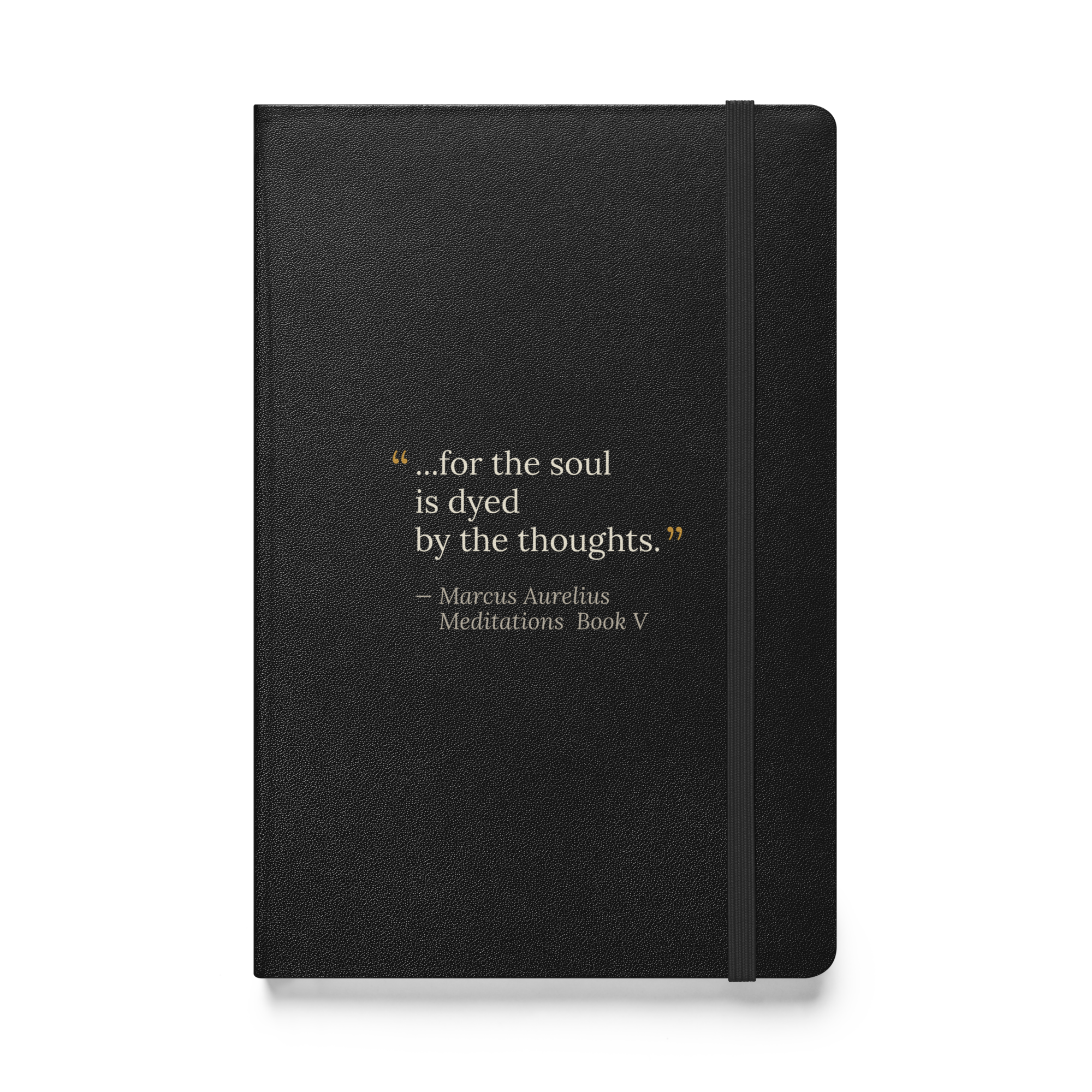


Soul of the Thoughts — Aurelius Meditations Journal
A journal for the practice Aurelius actually kept — writing down the thoughts he intended to live by, rather than the ones that arrived uninvited.
A literary journal featuring Marcus Aurelius’s “…for the soul is dyed by the thoughts.” from Meditations, V.16 (tr. George Long, 1862). Stoic philosophy objects by Quoteiac.
Marcus Aurelius
"…for the soul is dyed by the thoughts."
Meditations, V.16 — tr. George Long, 1862 (public domain)
Aurelius wrote Meditations as a private journal — notes to himself, never meant for anyone else's eyes. The entire text is a record of a man trying, in real time, to think correctly. He returned to the same ideas over and over not because he'd forgotten them, but because he knew that knowing something and living it are two different things. The practice was the point.
The Design
The cover carries the same ellipsis he would have understood — arriving mid-thought, as if the thinking was already underway. Gold quotation marks open and close it. The words are still.
Read the full story behind this quote: The Soul Becomes Dyed: What Marcus Aurelius and Thoreau Actually Said.
Also in the Marcus Aurelius collection: Soul of the Thoughts Tee, Waste No More Time Tee, Waste No More Time Mug, and The Quality Tee. Browse the full Marcus Aurelius collection.
About This Journal
- Hardcover bound journal
- 80 lined, cream-colored pages
- Size: 5.5" × 8.5"
- Built-in elastic closure
- Ribbon page marker
- Expandable inner pocket
Who It's For
The one who writes to think, not to record. The person who knows the difference between knowing something and having worked it through on the page. Anyone who returns to the same questions because they're worth returning to.
Write what you want to become.
Marcus Aurelius, in Plain English
- Lived: 121–180 AD, Rome
- Roman Emperor for 19 years — also the last of the Five Good Emperors, and the only one who was a practicing philosopher
- Wrote Meditations entirely in private, in Greek, in military camps during wartime — it was never intended for publication
- The manuscript survived by accident; we almost lost it entirely several times over the centuries

Choose options