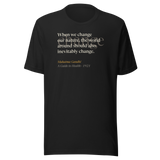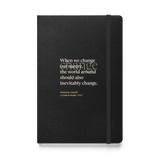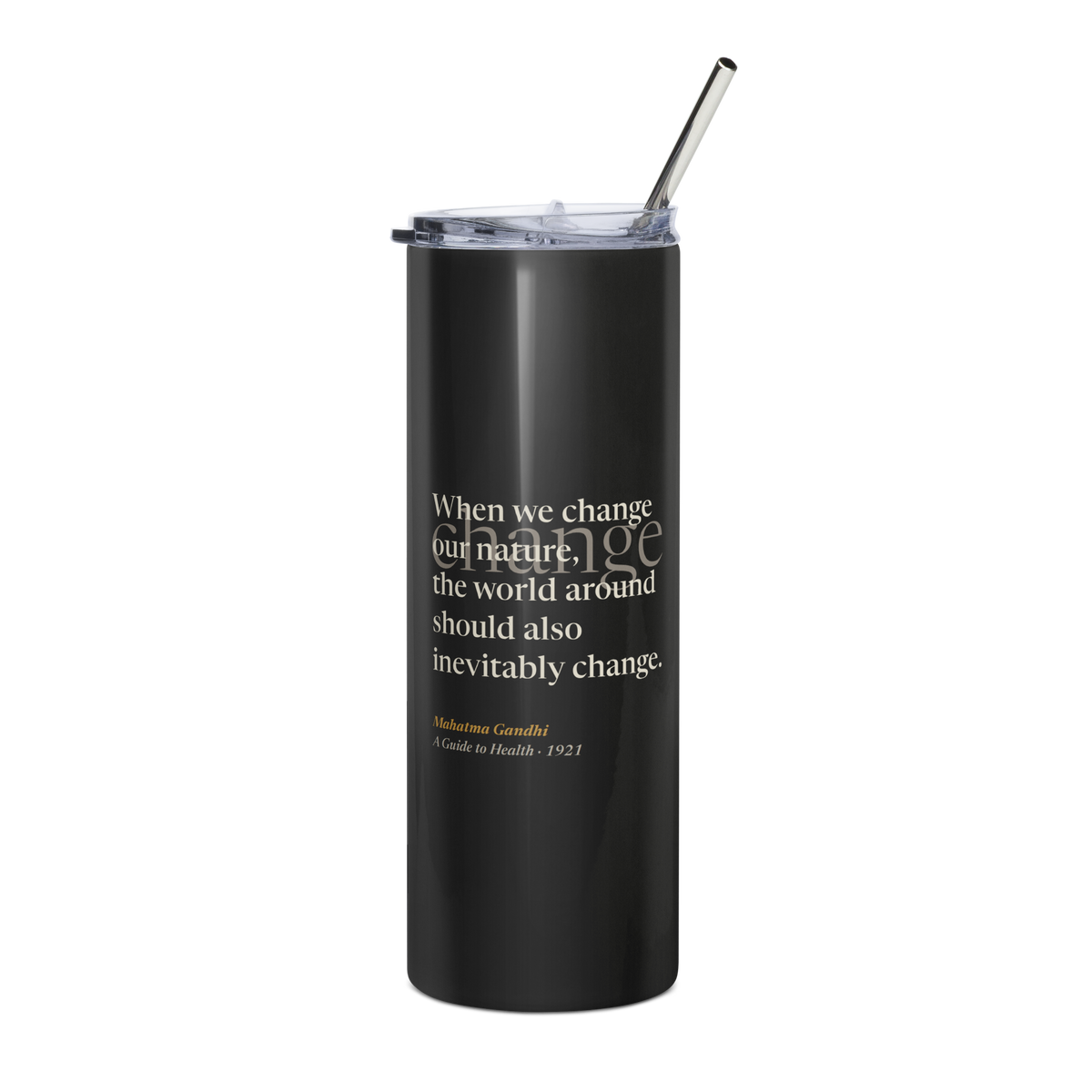





Be The Change — Gandhi Philosophy Tumbler
Gandhi never wrote the exact phrase — it crystallized sometime in the 1970s or 80s, a paraphrase so good it outlived its origins. What he did write, in 1913, was a letter arguing that behavior is more persuasive than argument. The formulation changed. The idea didn't.
Widely attributed to Mahatma Gandhi
"Be the change you wish to see in the world."
On the Attribution
No one can prove Gandhi said this. Scholars have traced the modern phrasing to a Brooklyn schoolteacher named Arleen Lorrance, writing in 1974. What Gandhi wrote — in 1913 — was this: "If we could change ourselves, the tendencies in the world would also change. We need not wait to see what others do."
Close enough that his family insists it was his. Unverified enough that it belongs to everyone now. The idea is older than the attribution — which is usually how the true ones work.
This tumbler is for the people who lead by action, not by waiting for someone else to go first.
Every time you use it, you're reminded: change starts with you. Not tomorrow. Not when conditions are perfect. Now.
The Design
On a cylinder, that vertical line becomes a seam — it wraps with you through the day, the composition moving as the tumbler turns in your hand. The W that folds in the into itself completes World on something you carry out the door. The circle at the base is what it always was: weight, not punctuation.
Attribution runs vertically along the axis.
The design is built around the same commitment the quote is built around.
About This Tumbler
- Stainless steel, 20oz
- Double-wall vacuum insulation
- Keeps drinks cold 24hrs, hot 12hrs
Who It's For
If you:
- Show up before you're asked
- Hold yourself to a higher standard than you hold anyone else
- Need the reminder daily, not just when it's convenient
Carry this one.
Mahatma Gandhi, in Plain English
- Lived: 1869–1948, Gujarat, India — lawyer, independence leader, and the primary architect of nonviolent resistance as a political strategy
- Led the Indian National Congress and the movement that ended British colonial rule in 1947
- His method — satyagraha, or truth-force — influenced Martin Luther King Jr., Nelson Mandela, and the global civil rights tradition
- In 1913, he wrote to a colleague: "If we could change ourselves, the tendencies in the world would also change." The famous paraphrase came decades later — close enough to be his, different enough to remain disputed
- Assassinated in January 1948, seven months after Indian independence
Carry your conviction.
Choose options