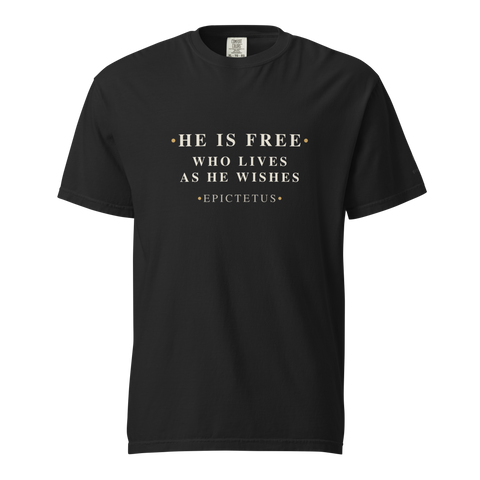
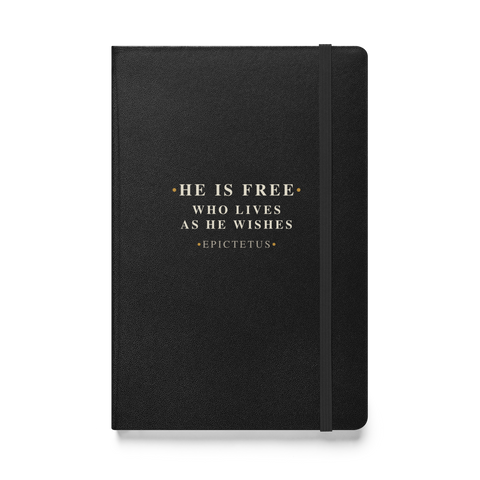
“He is free who lives as he wishes.”
Documented source
Every quote here is traced to a documented source. How we verify →
About this line
Epictetus was born a slave. Freed, then banished from Rome, he ran a school at Nicopolis until he died. He opens Book IV with this line and then spends the whole chapter dismantling it: he doesn’t mean doing whatever you please — he means the freedom of a judgment no one can seize, no matter what they do to you.
Why we carry this line
No judgement. How many times have we heard that and thought someone meant the exact opposite? Again, knowing the backstory gives this line a lot of bite.
The design
Set in Roman capitals, the way Latin was cut into stone. HE IS FREE is the top line and the largest, set apart by interpuncts, the dots Roman stonecutters carved between words. The condition, WHO LIVES AS HE WISHES, sits smaller underneath. His name gets the dots too.
What happened next
Epictetus never wrote anything down. His student Arrian took notes, and they became the Discourses.
A generation later, a Stoic teacher named Rusticus lent his own copy to his student, Marcus Aurelius. In the first pages of the Meditations, the emperor thanks Rusticus for that book.
A former slave’s lessons ended up in the hands of the most powerful man in Rome.