The Dickinson Dash: Intentional Chaos AI Can’t Counterfeit
Everyone thinks the em dash is an AI tell now. Screenshots of ChatGPT replies get roasted for the endless dash train. But long before large language models spammed punctuation, Emily Dickinson was puncturing polite grammar with dashes that actually meant something. Read about the biographical reality behind that refusal to perform for audiences.
If you're tired of being told your sentence is "too chaotic," this is your permission slip. Dashes aren't lazy. They're a design choice. The problem isn't the dash—it's whether there's a human hand on the throttle.
Why AI Leans on the Dash
Large language models write by probability. They predict the next most likely token. The em dash gives them cover. It lets the model switch topics without committing to a structure. Dash, new clause, forward we go.
That’s why so many AI paragraphs feel mushy. The dash becomes a shrug. No rhythm. No tension. Just another hallway to nowhere.
Humans don't have that excuse. When Dickinson used a dash, it was a gasp. A redirection. A tiny lightning bolt. Her punctuation was a musical score—rests, tempo shifts, a heartbeat.
Dickinson's Dash Grammar (Yes, She Had One)
Emily wasn't randomly mashing the minus key. She used dashes to:
- Interrupt certainty. "I heard a Fly buzz—when I died—" She inserts the dash where you expect decorum. Death gets a buzzing insect instead.
- Stack dual meanings. She'll put two options on either side of a dash so both feel true. It's a literal split.
- Force breath control. The dash dictates how you read the line out loud. It's choreography.
In other words, the dash wasn't decoration. It was structure. Same symbol, different intention. Read about the argument she was making by keeping all of it private.
How to Keep Your Em Dashes Honest
If you want your dashes to feel human (and not like AI hedging), run them through this checklist:
- Is there tension on both sides? If both clauses say the same thing, cut the dash.
- Are you buying time or adding meaning? If it's just buying time, restructure the sentence.
- Would a comma work? If yes, you probably don't need the dash.
- Do you hear a beat change? Read it aloud. If your voice doesn’t naturally pause, you're forcing it.
The goal: every dash should feel like a decision, not a default.
Give the Dash a Job
Dickinson didn't sprinkle punctuation for flair. Every dash pulls weight. Before you add one, ask what task it's performing:
- Shock the reader. Drop a dash where politeness usually lives. Make the polite sentence catch fire.
- Split the meaning. Let two opposing ideas sit on either side so the reader has to hold both.
- Control the breath. If the line is racing, a dash is a hand on the shoulder telling the reader to pause.
If the dash doesn't have an assignment, it doesn't belong.
Bring the Dash to Your Wardrobe
Quotes aren't just on paper. We printed Dickinson's surgical punctuation obsession across our apparel—clean serif, long dash, zero apologies.
Try this: Wear a line that breaks mid-thought. Watch how many people ask, "Why the dash?" Now you have the conversation that algorithms can't fake.
Ready to wear some intentional punctuation?
The Every Door tee carries the line where Dickinson held every possibility open — “I dwell in Possibility” The Possibility tee puts the dash exactly where she did: mid-line, mid-thought, deliberate.
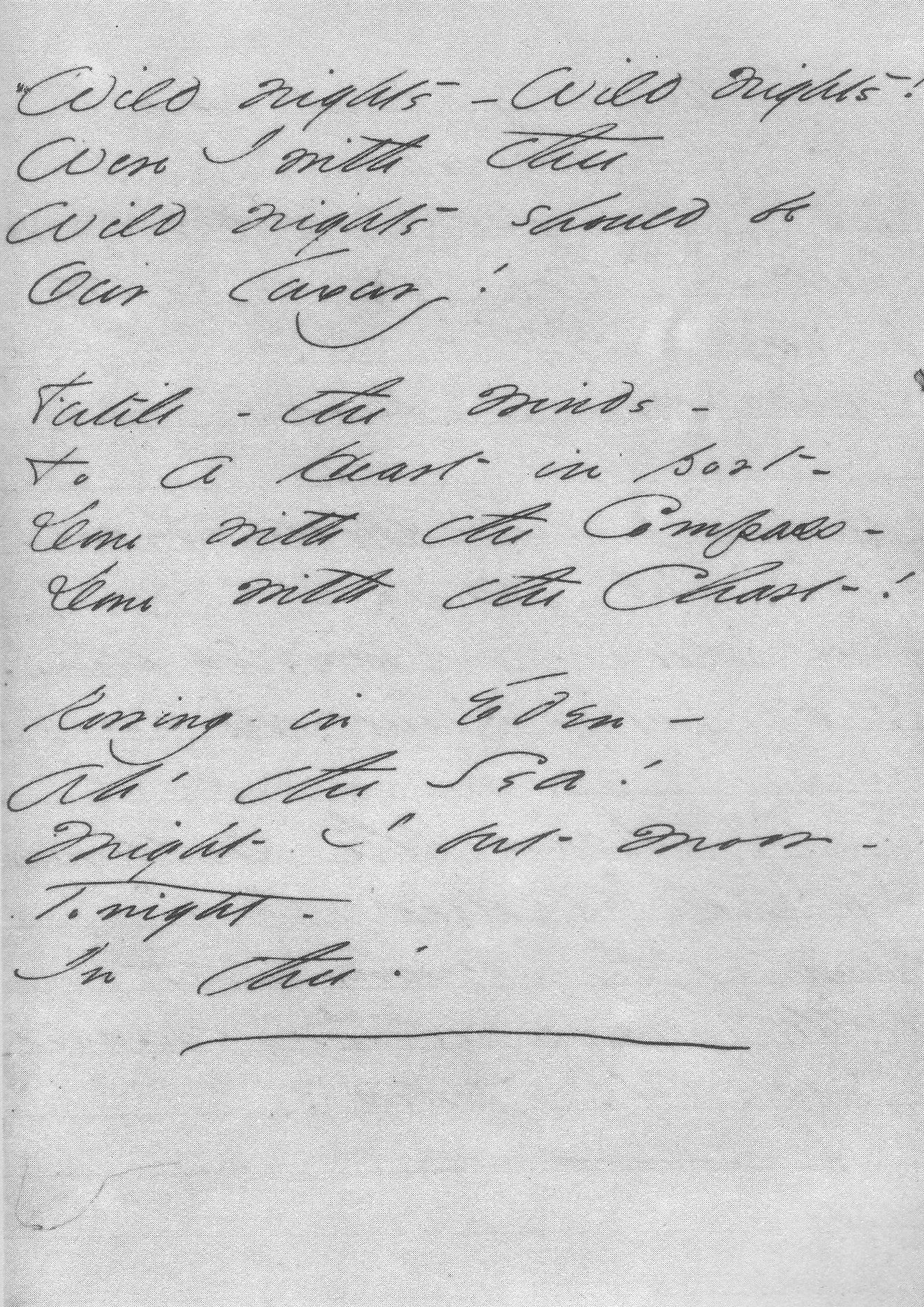
The manuscript above is the real thing — Dickinson's own hand, from one of the hand-sewn fascicle booklets she made herself around 1861. Those em dashes aren't an editor's flourish; they're exactly as she wrote them. Her mentor Thomas Wentworth Higginson refused to publish "Wild Nights" during her lifetime, fretting it was "too climactic" for Victorian readers — so it sat unpublished until 1891. The original is held at the Amherst College Archives.
Wear the wider brain.
The Dickinson designs that carry these dashes into the world — the Fleur de Brainiac Tee and the Fleur de Brainiac Phone Case — use fleurons (hedera) as the framing ornament: typographic symbols from the same 15th-century printing vocabulary Dickinson's own editors would have recognized. The dashes are intact. The punctuation is hers. Explore the Emily Dickinson collection.