




















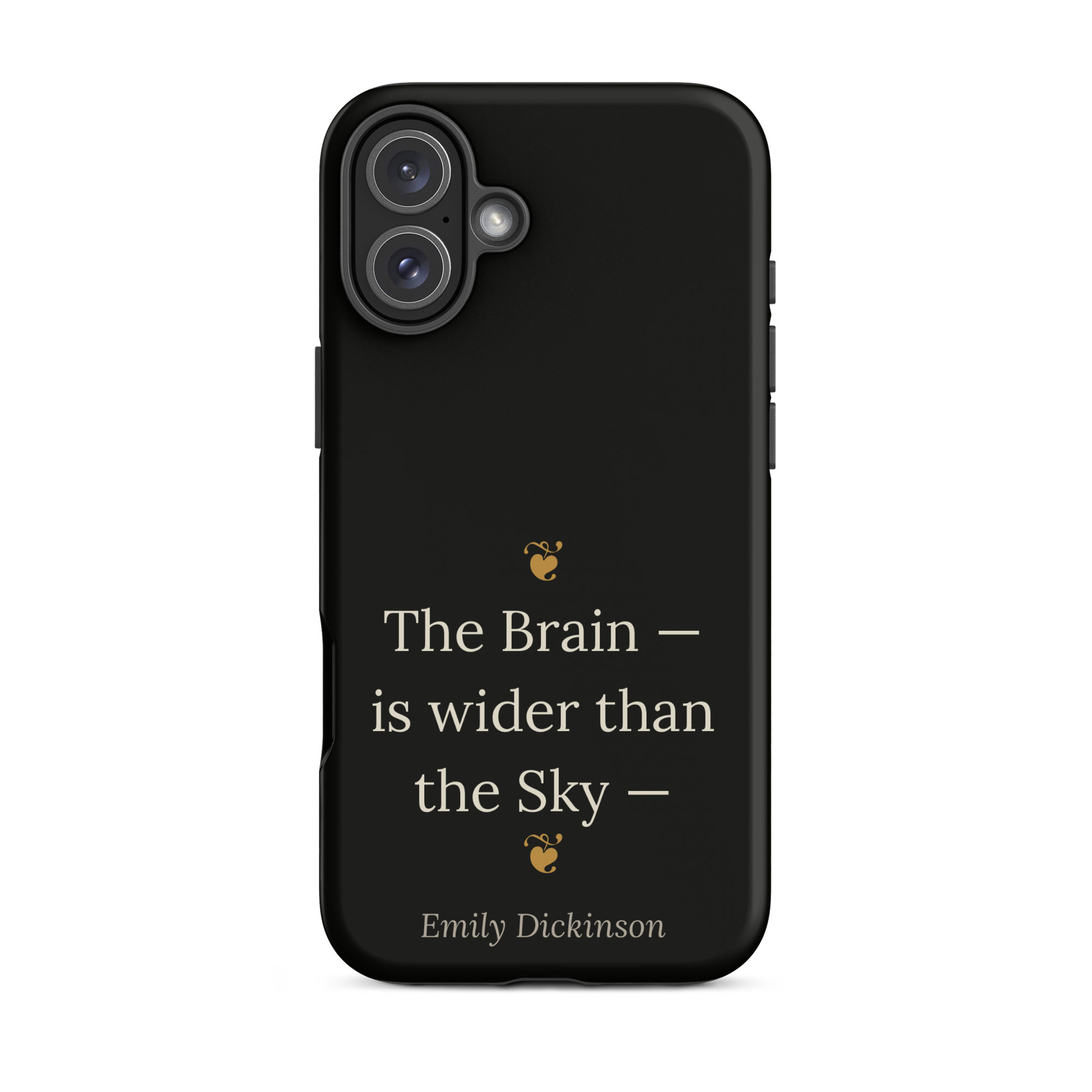

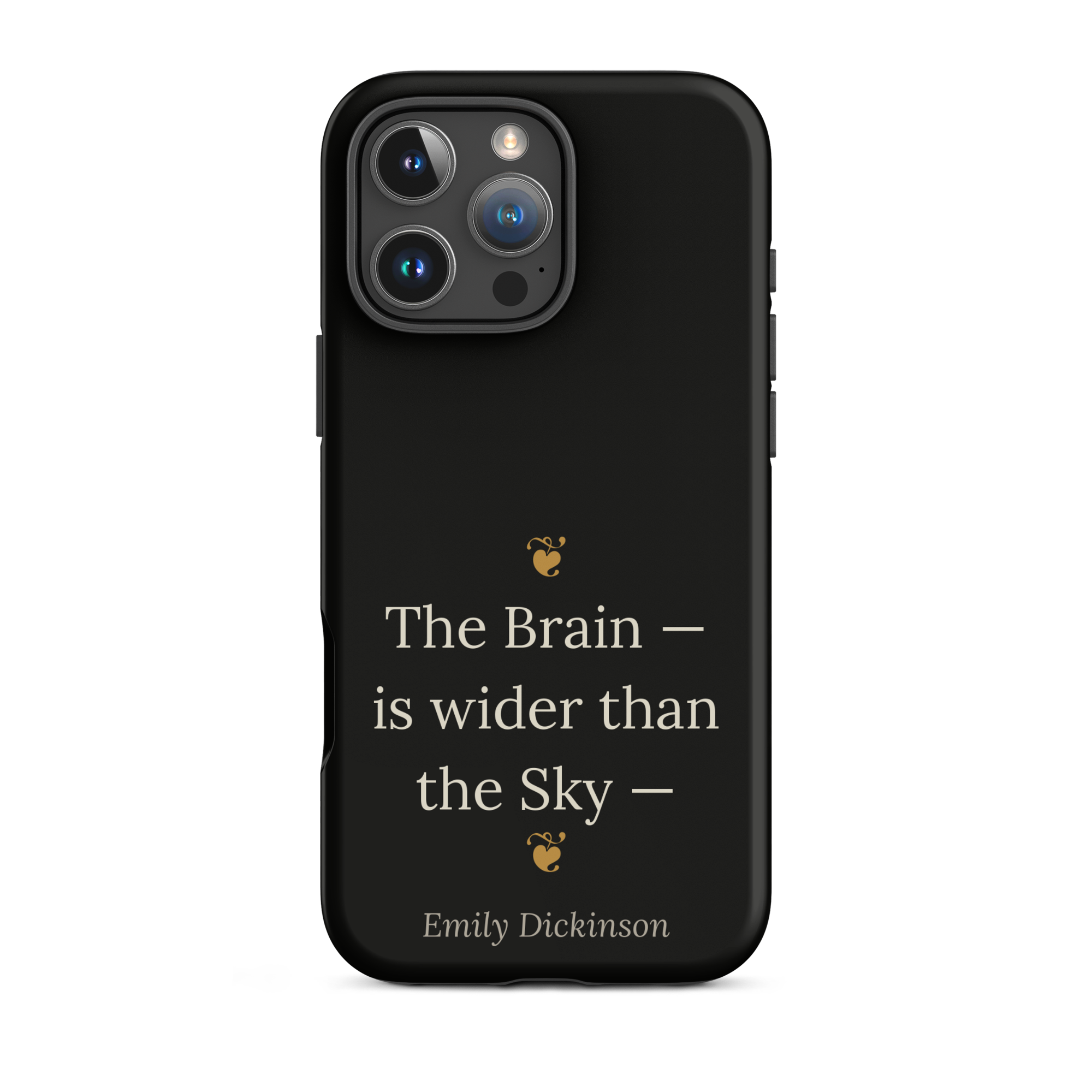


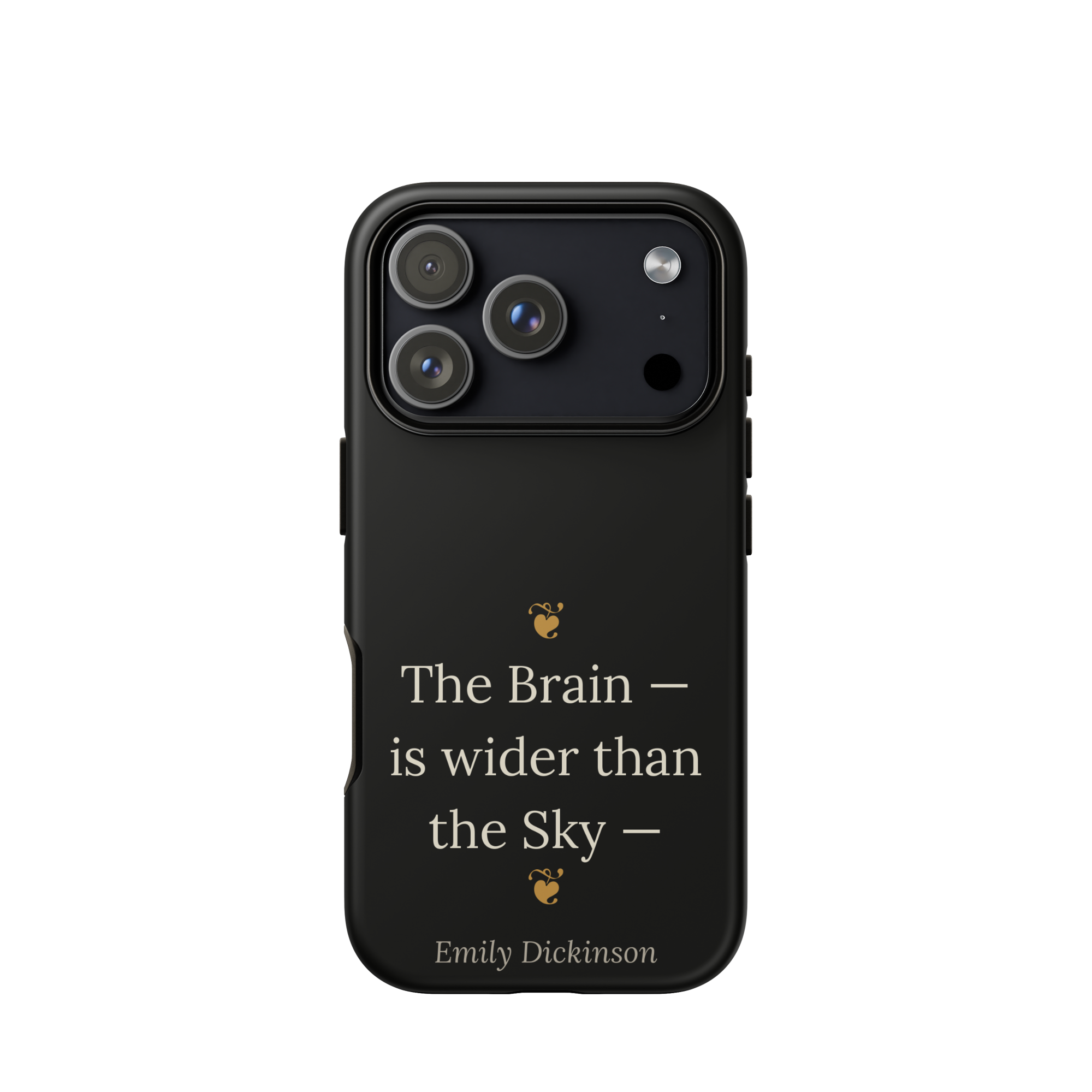

The Brain Quote — Dickinson Phone Case
Every time you pick up this case, the first thing you read is Dickinson's most quietly radical claim — that the brain is bigger than everything outside it. She wrote the poem around 1862, in a house she rarely left: no phone, no feed, no inbox, just a mind she spent her days inhabiting. What you carry in your head is larger than what you're looking at.
Emily Dickinson, c. 1862
"The Brain — is wider than the Sky —"
The em dashes are hers; the capital "Sky" is hers. Early editors tidied both away in the 1890s; scholars spent decades undoing the cleanup and printing what she actually wrote — the small private marks she never meant for a wide audience.
The Design
The two gold ornaments framing the quote are fleurons — also called hedera, Latin for ivy: a heart entwined with vines, one of the oldest typographic ornaments there is. They were used to divide text in Greek and Latin manuscripts long before print, then set by hand to mark where a poem began and ended. At this size, held a few inches from your face, they do what they were built to do: frame a few lines and tell you this part matters, slow down.
Read the full story: Why Emily Dickinson Valued Private Journals Over Public Fame. Also: the Fleur de Brainiac Tee, and the Wider Sky Phone Case.
About This Case
- Tough dual-layer construction — flexible TPU inner layer, hard polycarbonate outer shell
- Raised edges protect the screen and camera
- Wireless charging compatible — works with most Qi-enabled devices
Keep away from prolonged direct sunlight and high-alcohol liquids to preserve the design.
Who It's For
The reader who wants Dickinson with them all day. The person who finds Victorian typography more honest than modern minimalism. The one who keeps picking up their phone and putting it down, and wouldn't mind being reminded why.
Carry the wider brain.
Emily Dickinson, in Plain English
- Lived: 1830–1886, Amherst, Massachusetts — mostly inside one house, by choice
- Wrote nearly 1,800 poems. Published fewer than a dozen while alive; the rest she sewed by hand into roughly forty small booklets and kept close — her sister Lavinia found them after her death
- She wrote in pencil, on whatever was within reach: the backs of recipes, grocery lists, scraps in her apron pocket
- The dashes early editors "fixed" were never broken — it took scholars decades to undo the cleanup and print what she actually wrote
Choose options