Article: Jefferson Never Said It: The Fake Founder Quotes You’ll See Before Election Day
Jefferson Never Said It: The Fake Founder Quotes You’ll See Before Election Day
Every election season, the founders come back to life on social media. A stern portrait of Thomas Jefferson, a line in an old-timey font, thousands of shares. People on every side do it. And a surprising number of those lines were never written by Jefferson at all.
The good news is that someone keeps track. The research staff at Monticello, Jefferson’s home in Virginia, maintains a long list of spurious quotations: lines that get pinned on Jefferson but don’t appear anywhere in his letters, papers, or speeches. Here are five you’re likely to see before Election Day on November 3, and then some real lines from the founders, with the letter and the date, so you can check them yourself.

Model photo created with AI. The printed line is real.
The fakes came from a 1914 debate, a newspaper joke feature and an Irish lawyer. This one Jefferson really wrote, to John Adams in 1816: “I like the dreams of the future better than the history of the past.” Shop the tee →
1. “When government fears the people, there is liberty. When the people fear the government, there is tyranny.”
It has the rhythm of a founder, but Monticello has found no evidence Jefferson ever said or wrote it. Its researchers did find something close in a 1914 debate about socialism, where a man named John Basil Barnhill made the same point with the halves flipped. The earliest printing they found that pinned it on Jefferson came in 1994, more than 160 years after his death.
2. “A government big enough to give you everything you want, is a government big enough to take away everything that you have.”
Monticello says neither this line nor any of its many variations has been found in Jefferson’s writings. Its first known appearance in print was in 1952. In 1957 it was even syndicated in a newspaper feature called “Today’s Chuckle.” Plenty of politicians used it over the years. Nobody connected it to Jefferson in print until 2005.
3. “Dissent is the highest form of patriotism.”
This one is just as spurious. The earliest use Monticello found was a 1961 publication that asked, as a question, “is dissent the highest form of patriotism?” The phrase caught on during the Vietnam War era, when New York’s mayor, John Lindsay, used it in a 1969 speech. Jefferson had been gone for well over a century by then.
4. “Eternal vigilance is the price of liberty.”
This is the granddaddy of fake founder quotes. Monticello found it in print by 1817, with Jefferson’s name attached by 1834, but no evidence he ever said it. Its roots go back to the Irish lawyer John Philpot Curran, whose longer line about liberty and “eternal vigilance” got shortened and reattributed until it landed on Jefferson.
5. “An educated citizenry is a vital requisite for our survival as a free people.”
This one is sneaky, because it sounds like something Jefferson believed, and he did. Monticello calls it “a generally accurate paraphrase of Jefferson’s views on education.” But it’s not his sentence. What he actually wrote is shorter and, honestly, better. In a letter to the British writer Richard Price on January 8, 1789, Jefferson said the new Constitution’s success was proof:
“wherever the people are well informed they can be trusted with their own government”
Thomas Jefferson, letter to Richard Price, January 8, 1789
What Jefferson actually wrote
The real Jefferson is less of a bumper sticker and more of a person. His best lines come from letters to friends, with no crowd to play to.
Here’s one he wrote to his friend Dr. Benjamin Rush in September 1800, in the middle of the presidential campaign, explaining why some clergy feared him:
“I have sworn upon the altar of God eternal hostility against every form of tyranny over the mind of man.”
Thomas Jefferson, letter to Benjamin Rush, September 23, 1800
That line is on our Tyranny of the Mind journal.
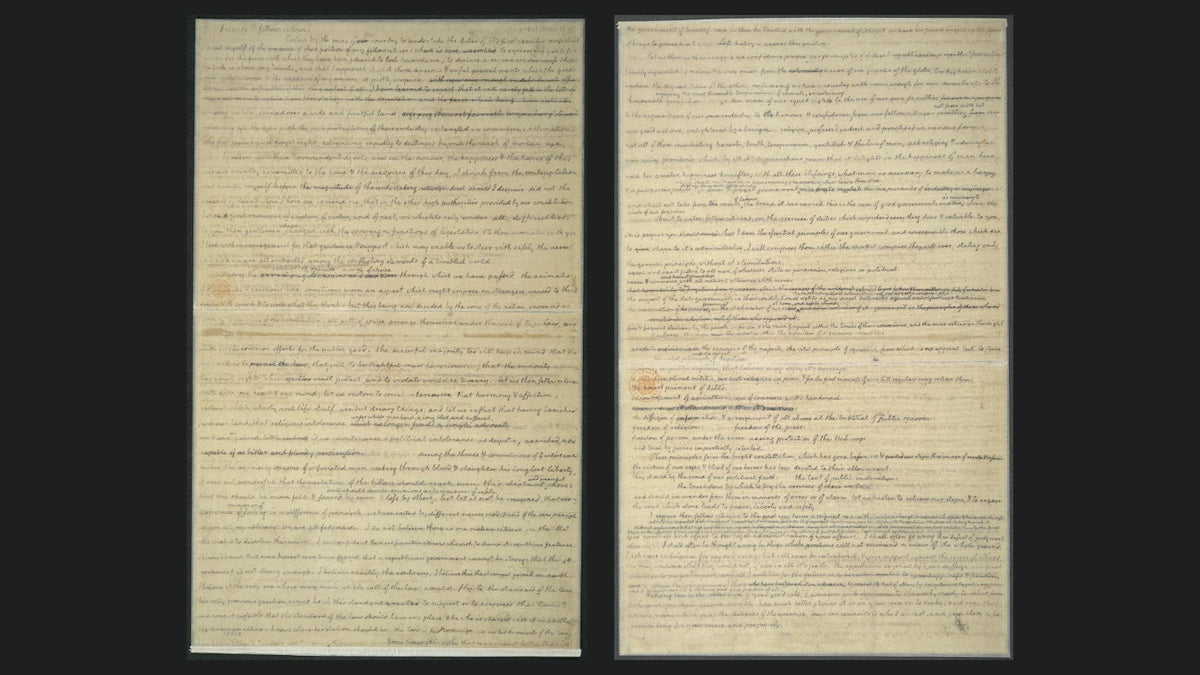
After that election was finally settled, Jefferson stood up to give his first inaugural address on March 4, 1801. The country had just been through a bitter fight. His answer is worth reading this fall, whoever you vote for:
“every difference of opinion is not a difference of principle. We have called by different names brethren of the same principle.”
Thomas Jefferson, First Inaugural Address, March 4, 1801
And here’s the one we come back to most. Years later, Jefferson and John Adams, who had once been bitter rivals, became pen pals in old age. Near the end of a letter to Adams on August 1, 1816, Jefferson wrote this:
“I like the dreams of the future better than the history of the past.”
Thomas Jefferson, letter to John Adams, August 1, 1816
It’s on our Dreams of the Future tee.
Two more founders worth quoting correctly
James Madison wrote one of the most famous sentences about human nature in Federalist No. 51 (1788): “If men were angels, no government would be necessary.” It’s on our If Men Were Angels tee and journal.
Years later, in an 1822 letter to William T. Barry praising Kentucky’s plans for public schools, Madison warned that “A popular Government, without popular information, or the means of acquiring it, is but a prologue to a Farce or a Tragedy; or perhaps both.” The next sentence is the one on our Knowledge tee:
“Knowledge will forever govern ignorance…”
James Madison, letter to William T. Barry, August 4, 1822
(Madison’s own spelling in the letter was “Knowlege will for ever govern ignorance.” Our print follows the 1910 Gaillard Hunt edition of his writings.)
And then there’s John Adams. In December 1770, Adams did something deeply unpopular: he defended the British soldiers charged in the Boston Massacre. In his closing argument to the jury, he said:
“Facts are stubborn things; and whatever may be our wishes, our inclinations, or the dictates of our passions, they cannot alter the state of facts and evidence”
John Adams, closing argument for the defense, Rex v. Wemms, December 1770
The phrase itself was already a saying. It shows up in a 1749 English translation of the novel Gil Blas. Adams made it stick.
A lawyer arguing for the side nobody wanted to hear, asking a jury to stick to the evidence. It’s on our Facts Are Stubborn Things tee.
How to check a founder quote in two minutes
Before you share, search the exact words on Founders Online, the National Archives’ free database of letters and papers from Jefferson, Madison, Adams, and others. If it isn’t there, check Monticello’s spurious quotations list. Real founder quotes almost always come with a recipient and a date. If a quote has neither, that’s your sign.
A lot of the founder quotes on merch aren’t real. We built a shop that won’t print them. Every founder line we carry has a real letter, document, or trial record behind it, and we’ll tell you which one.
Wear the real line
“I have sworn upon the altar of God eternal hostility against every form of tyranny over the mind of man.” Thomas Jefferson. Journal.
“I like the dreams of the future better than the history of the past.” Thomas Jefferson. Tee.
“If men were angels, no government would be necessary.” James Madison. Tee, journal.
“Knowledge will forever govern ignorance…” James Madison. Tee.
“Facts are stubborn things…” John Adams. Tee.
Not sure which line is yours? Take Find Your Line. Five questions, no email.
Top image: Thomas Jefferson’s handwritten draft of his First Inaugural Address, 1801. Library of Congress, Manuscript Division.
About the Quoteiac Team. We trace every line to a primary source before it goes on anything we sell. When we get one wrong, we fix it and say so.