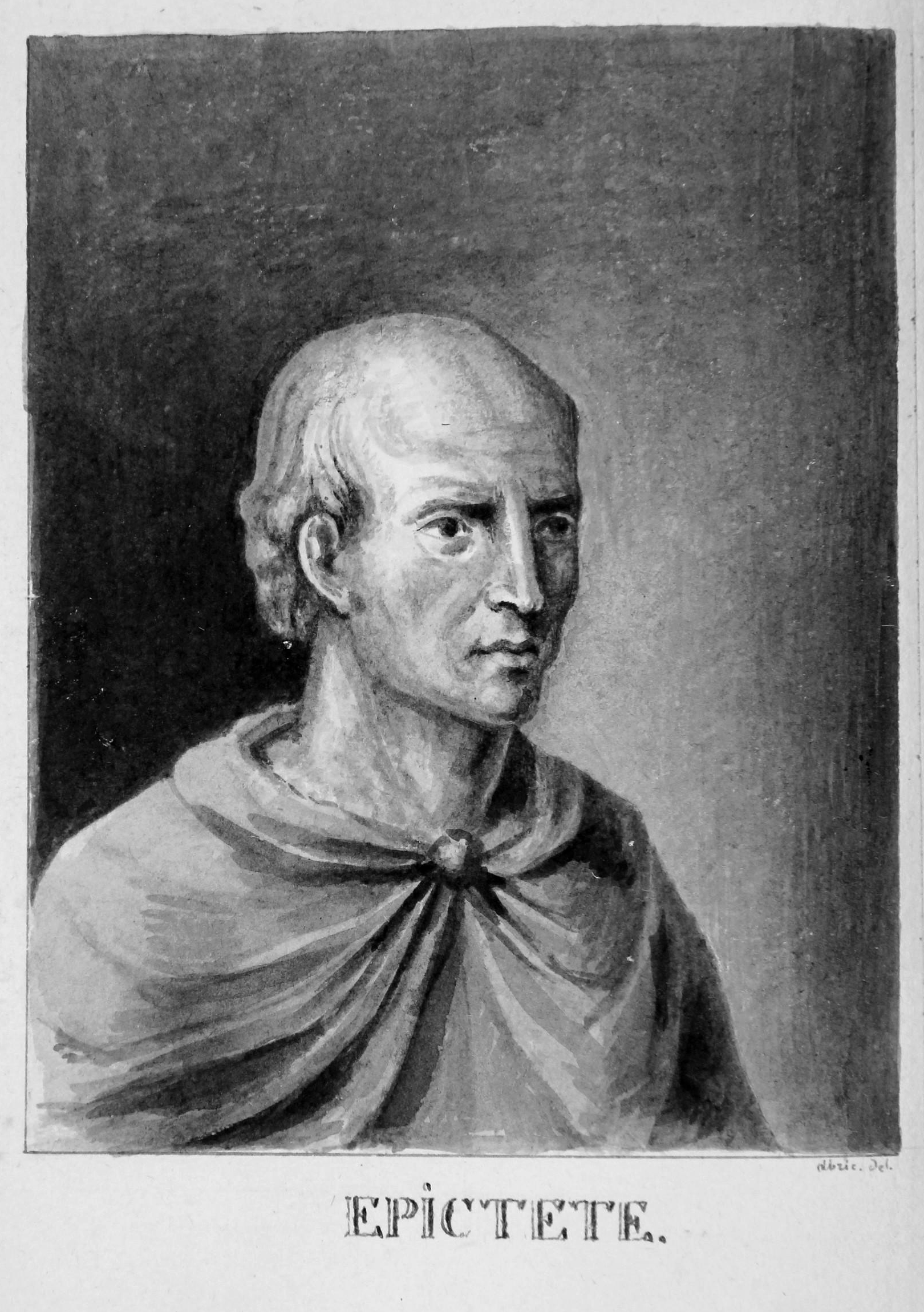
Epictetus: The Stoic Who Had Nothing and Knew Everything
Epictetus (c. 50–135 AD) was a Greek Stoic philosopher born into slavery in Hierapolis, Phrygia, who became one of the most influential teachers of the ancient world — not despite his circumstances, but because of the question those circumstances forced him to answer: when external conditions cannot be changed, what can? His school in Nicopolis attracted students from across the Roman Empire. His teachings, recorded by his student Arrian in the Discourses and the Enchiridion, have never been out of circulation since.
Marcus Aurelius wrote Meditations while commanding the Roman Empire. He was arguably the most powerful man alive, writing private notes to himself about humility and impermanence. The notes were never meant to be published. They are extraordinary for what they are — a private record of a powerful man trying to stay honest with himself. See also: the man who read Epictetus and wrote Meditations from a position of total power.
Epictetus had none of that. What he had was the question that confronts anyone with nothing: when external circumstances cannot be changed, what can be? His answer became the foundation of a philosophy that has outlasted the empire that enslaved him.
The Life
Epictetus was owned by a man named Epaphroditus, a freedman who had himself been a slave and who served as a secretary to Nero. At some point — the ancient sources are imprecise on when and how — Epictetus was freed. He began studying Stoic philosophy under Musonius Rufus, one of the teachers Nero had exiled. He eventually established his own school in Nicopolis, in northwestern Greece, where he taught until his death, probably around 135 AD.
He wrote nothing himself. What survives comes from his student Arrian — the same man who chronicled Alexander the Great’s campaigns — who compiled Epictetus’s lectures and conversations into two works: the Discourses and the shorter Enchiridion, or Handbook, assembled around 125 AD. The Enchiridion is essentially a field guide: fifty-three short chapters on how to think, react, and live under conditions you didn’t choose. See also: how Seneca’s comparable legacy — the letters — survived differently.
The Dichotomy of Control
The first chapter of the Enchiridion is the argument everything else depends on. Epictetus divides the world into two categories: what is “up to us” — our judgments, our desires, our responses, our values — and what is “not up to us” — our bodies, our reputation, our circumstances, other people’s actions. Most human suffering, he argues, comes from treating the second category as if it were the first.
Chapter 1 puts it this way: “Make the best use of what is in your power, and take the rest as it happens.”
This is often read as passive acceptance. It is not. Epictetus is describing a radical act of attention — directing your effort and concern toward the only domain where effort and concern actually produce results. Worrying about outcomes you cannot control is not caution; it is wasted capacity.
From the Discourses: “He is a wise man who does not grieve for the things which he has not, but rejoices for those which he has.” And more directly: “Seek not the good in external things; seek it in yourself.”
These are not comfort. They are discipline.
Why Epictetus Is Different
The Stoic tradition includes emperors, generals, and senators. Epictetus is the exception — not just philosophically, but experientially. He is not writing about how to maintain perspective while governing a vast empire. He is writing from a position where external circumstances were entirely beyond his control, where the law defined him as an object, where what he could govern was limited to his own mind.
That distinction changes the weight of the philosophy. When Marcus Aurelius writes about not being attached to power, you’re reading a man with all the power. When Epictetus writes about not being attached to external goods — to health, to freedom, to reputation — you’re reading a man for whom those things were legally unavailable.
The philosophy was tested under conditions most people will never face. That’s worth knowing before you apply it to a bad week at work.
What the Enchiridion Asks of You
The Enchiridion is not comfortable reading. It asks you to stop blaming circumstances, to stop waiting for conditions to improve before you decide who you’re going to be, to accept that most of what you spend energy fighting is simply not yours to fight. It asks for something close to complete responsibility for your interior life — combined with complete release of everything outside it.
The Declaration Tee carries the directive plainly: First say to yourself what you would be. The He Is Free Tee carries the answer — the one Epictetus spent an entire book of the Discourses unpacking.
Browse the Epictetus collection and the broader Stoic Wisdom collection — for the philosophy that was built under pressure, not around it.
The School at Nicopolis
Epictetus ran his school for decades. Students came from across the Roman world — some wealthy, some not. He reportedly lived simply: a rented room, a straw mattress, a clay lamp. Lucian mentions the lamp sold at auction after Epictetus’s death for a significant sum, on the logic that it had belonged to a philosopher. Epictetus would have found this exactly as absurd as it sounds.
He died free, having built something that outlasted everything that once owned him. The Enchiridion is still in print. The empire is not.